
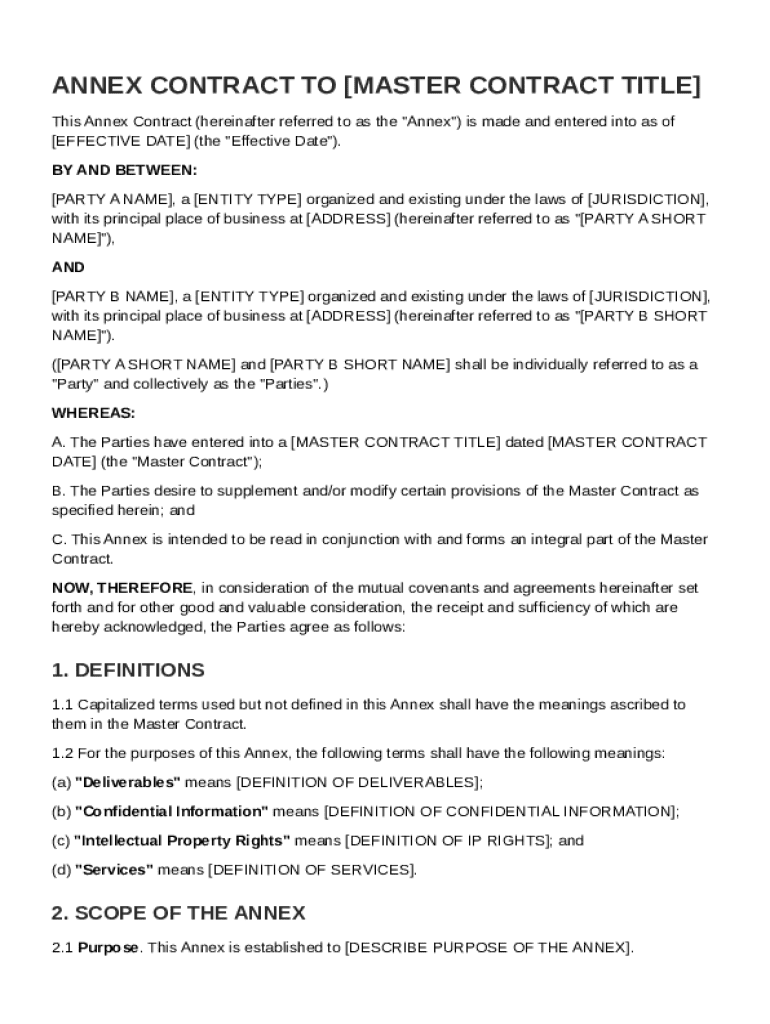







Definition & Meaning
An Annex Contract Template serves as an extension to a Master Contract, providing additional clarity and customization for specific agreements between two parties. This document augments the main contract by detailing supplementary provisions that modify or add to the existing terms. Common elements include definitions, the scope of services or goods, obligations of each party, and payment terms. It is crucial for specifying performance metrics, liability limitations, and termination conditions. The annex emphasizes its relationship to the Master Contract and includes provisions related to governing law, amendments, and notices.
Practical Examples
- Supplementary Services: In a service agreement, an annex might define additional services not covered in the Master Contract and set out any special terms or fees related to these services.
- Extended Payment Terms: A buyer and seller may use an annex to modify payment terms in the event of economic changes to ensure continued cooperation without rewriting the primary contract.
- Jurisdiction Specifications: If two parties operate in different states, an annex can specify which state’s laws govern the resolution of potential disputes.
Key Elements of the Annex Contract Template
The Annex Contract Template consists of key elements, including specifications that contribute to its enforceability and relevance to the Master Contract.
Detailed Breakdown
-
Definitions and Terminology: Provides clear definitions to avoid ambiguity and ensure mutual understanding.
-
Scope of Services or Goods: Clearly outlines the additional services or goods covered by the annex.
-
Obligations of Each Party: Specifies duties, responsibilities, and obligations supplementary to the Master Contract.
-
Payment Terms: Declares any changes or additions to the initial payment structure, including schedules and methods.
-
Performance Metrics: Establishes the criteria for measuring fulfillment and performance levels of contractual obligations.
-
Liability Limitations: Sets boundaries for the extent of liabilities to prevent undue burdens on either party.
-
Termination Conditions: Specifies conditions under which the annex or associated Master Contract can be terminated.
Examples and Use Cases
-
Expansion of Service Agreements: When a tech company offers new software services to an existing client, the annex can specify subscription levels and tech support options.
-
R&D Collaborations: In a collaborative research project, different funding terms might be annexed to accommodate additional expenses tied to new research phases.
How to Use the Annex Contract Template
Using an Annex Contract Template involves several actionable steps, ensuring the document effectively supplements the Master Contract.
Steps to Implement
-
Review the Master Contract: Understand existing terms to ensure the annex complements the established conditions.
-
Draft with Transparency: Clearly articulate the added terms while maintaining consistency with the Master Contract’s language and framework.
-
Collaborate with Legal Counsel: Engage legal professionals to verify compliance with existing laws and contractual obligations.
-
Detail Specific Changes: Highlight specific clauses or terms that are being modified or introduced in the annex.
-
Mutual Agreement and Signatures: Obtain written consent and signatures from all involved parties to legally enforce the annex.
Real-World Application
-
Vendor Agreements: A vendor might need adjustments due to market changes; the annex outlines these adjustments to prevent disruptions.
-
Long-Term Projects: Real estate projects with timelines exceeding initial projections can use annexes to modify project scope or timelines.
Legal Use of the Annex Contract Template
Legal nuances play a significant role in the applicability of the Annex Contract Template, affecting its enforceability and the strategic value it adds to the Master Contract.
Governing Legal Considerations
-
Consistent Adherence to Initial Contract: The annex must not contradict the terms of the Master Contract, ensuring synergistic integration.
-
Understanding Jurisdiction: Legal validity requires awareness of the jurisdiction under which the Master Contract falls, influencing dispute resolutions.
-
Compliance with Regulations: Stay updated with federal, state, and local laws to avert any legal pitfalls.
Legal Scenarios
-
Commercial Contracts: Amendments to delivery schedules due to logistical delays are documented in an annex, followed by legal vetting.
-
Licensing Agreements: When new intellectual property components are integrated, licenses are modified via annexes to protect rights.
Who Typically Uses the Annex Contract Template
An array of professionals and industries find the Annex Contract Template invaluable when managing complex contractual relationships.

Key Users
-
Legal Professionals: Lawyers utilize annex templates to fine-tune agreements, ensuring comprehensive representation of client interests.
-
Business Executives and Managers: Executives employ annexes to address fluctuating business environments, maintaining operational continuity.
-
Project Managers: In project-driven industries, annexes facilitate dynamic project adaptations without renegotiating the core contract.
-
Procurement Specialists: Annexes are employed to update terms with suppliers and vendors as market conditions evolve.
Common Industries
-
Technology: Frequent changes in development timelines and deliverables make annexes essential for software service providers.
-
Manufacturing: Annexes adjust supply chain agreements to accommodate shifts in resource availability.
Important Terms Related to Annex Contract Template
Understanding key terminology is fundamental to utilizing the Annex Contract Template effectively and ensuring it meets all parties' needs.
Glossary of Terms
-
Master Contract: The principal contract to which the annex is attached, forming the legal foundation.
-
Supplementary Provisions: Additional clauses that extend or modify the original contract.
-
Binding Agreement: A legally enforceable document following the annex's integration.
Examples
-
Addendum vs. Annex: While an addendum adds information without changing the existing structure, an annex might include amendments affecting the original terms.
-
Rider: Similar to an annex, a rider modifies a policy but is specific to insurance agreements.
Steps to Complete the Annex Contract Template
Completing an Annex Contract Template involves careful preparation and precise documentation to enhance the contractual relationship between parties.
Completing Process
-
Gather Necessary Information: Collect all relevant details that need inclusion or amendment.
-
Draft the Annex: Use clear and concise language to draft the annex, ensuring it aligns with the Master Contract.
-
Ensure Clarity: Define the scope, roles, and expectations to eliminate potential misunderstandings.
-
Seek Approval: Present the draft for review and approval by all parties and their legal advisors.
-
Final Signatures: Secure signatures from authorized representatives to enforce the contract legally.
Completion Scenarios
-
Additions to Service Contracts: When extending services, detailed annexes help manage new deliverables effectively.
-
Reassigning Responsibilities: If party roles change, annexes systematically document the reassignment of obligations.
State-Specific Rules for the Annex Contract Template
U.S. states may have varying requirements and regulations pertinent to contractual modifications that may affect how annex templates are structured.
State Regulations Overview
-
Conflicts of Law: Address discrepancies in jurisdictional laws that might impact the annex's enforceability.
-
State-Specific Clauses: Depending on the state, certain clauses might require additional specificity or formal requirements.
Examples and Differences
-
California: Might prioritize disclosure and transparency, requiring specific language to comply with state business codes.
-
New York: Emphasizes the scope and duration limitations, impacting long-term contractual agreements.




