






Definition & Meaning
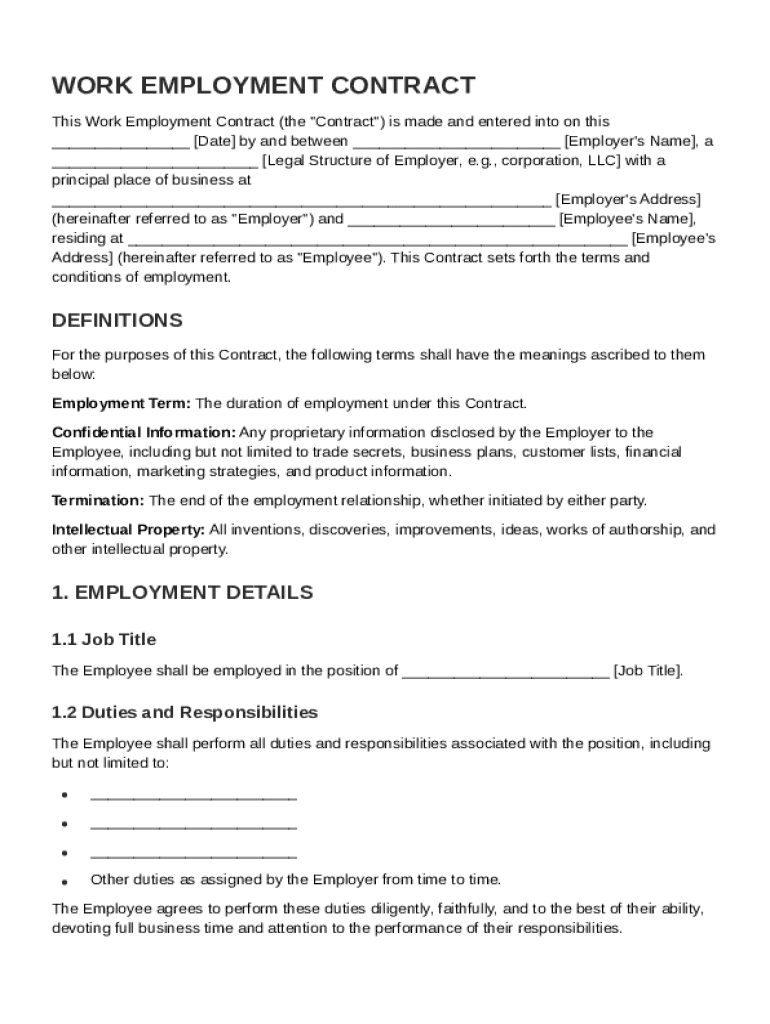
The Work Employment Contract Template is a legally binding document that formalizes the relationship between an employer and an employee. It outlines the rights, responsibilities, and obligations of both parties during the term of employment. The contract typically includes elements such as job title, duties, compensation, benefits, work schedule, termination procedures, confidentiality agreements, and non-compete clauses. It serves to protect the interests of both the employer and employee by clearly defining expectations and providing a framework for resolving disputes.
Key Elements of the Work Employment Contract Template
The primary elements of a Work Employment Contract Template include:
- Job Title and Description: Specifies the employee’s role and primary duties.
- Compensation: Details the employee’s salary or wage rate, payment schedule, and any bonuses.
- Benefits: Outlines health insurance, retirement plans, and other perks provided by the employer.
- Work Schedule: Defines expected working hours and any flexibility or overtime policies.
- Termination Clause: Describes conditions under which either party can terminate the contract, including notice periods.
- Confidentiality and Non-Compete Clauses: Ensures employee confidentiality about company information and restricts competitive actions post-employment.
Steps to Complete the Work Employment Contract Template
- Gather Required Information: Collect details about the employee and employer, including legal names and addresses.
- Define Job Responsibilities: Clearly outline tasks and responsibilities associated with the position.
- Outline Compensation and Benefits: Specify salary, bonuses, and benefits to provide clear financial expectations.
- Establish Work Schedule: Agree on standard working hours and any provisions for overtime or remote work.
- Finalize Legal Terms: Include clauses on confidentiality, intellectual property, termination, and dispute resolution.
- Review and Sign: Both parties should carefully review the contract for accuracy and clarity before signing.
Legal Use of the Work Employment Contract Template
A Work Employment Contract Template serves as a vital legal document protecting both parties in an employment relationship. It is important to ensure that the contract is compliant with federal and state labor laws, addressing aspects such as minimum wage, working hours, and employment discrimination. Legal use involves accurately reflecting mutual agreement between the employer and employee, preventing misunderstandings and providing a basis for legal recourse in case of dispute.
Who Typically Uses the Work Employment Contract Template
This template is commonly used by:
- Employers: To formalize employment agreements and set clear expectations.
- Human Resources Departments: For standardizing contracts across an organization.
- Employees: To understand their rights and obligations within a company.
- Legal Advisors: To tailor contracts to specific legal or business requirements.


Important Terms Related to Work Employment Contract Template
Some key terms include:
- At-Will Employment: Employment that can be terminated by either party at any time without cause.
- Non-Disclosure Agreement (NDA): Ensures that confidential business information is not disclosed to unauthorized parties.
- Provisions: Specific clauses detailing rights and responsibilities in the contract.
- Indemnity: A clause that provides protection against potential losses or damages.
Why Use a Work Employment Contract Template
Utilizing a Work Employment Contract Template provides multiple benefits:
- Clarity and Consistency: Ensures all parties have a clear understanding of the terms and expectations.
- Legal Protection: Reduces the risk of legal disputes by clearly outlining terms and conditions.
- Efficiency: Speeds up the process of generating agreements with structured templates.
- Risk Management: Mitigates risks by including necessary legal clauses and protections.
Examples of Using the Work Employment Contract Template
- Scenario One: A tech startup uses the template to hire a software developer, detailing remote work options and intellectual property clauses due to the nature of the work.
- Scenario Two: A retail chain employs the template to engage seasonal workers, specifying short-term employment terms and termination at season's end.
- Scenario Three: An established corporation modifies the template to include extensive non-compete clauses for high-level executives, addressing the risk of industry competition.