01. Edit your form online
Type text, add images, blackout confidential details, add comments, highlights and more.

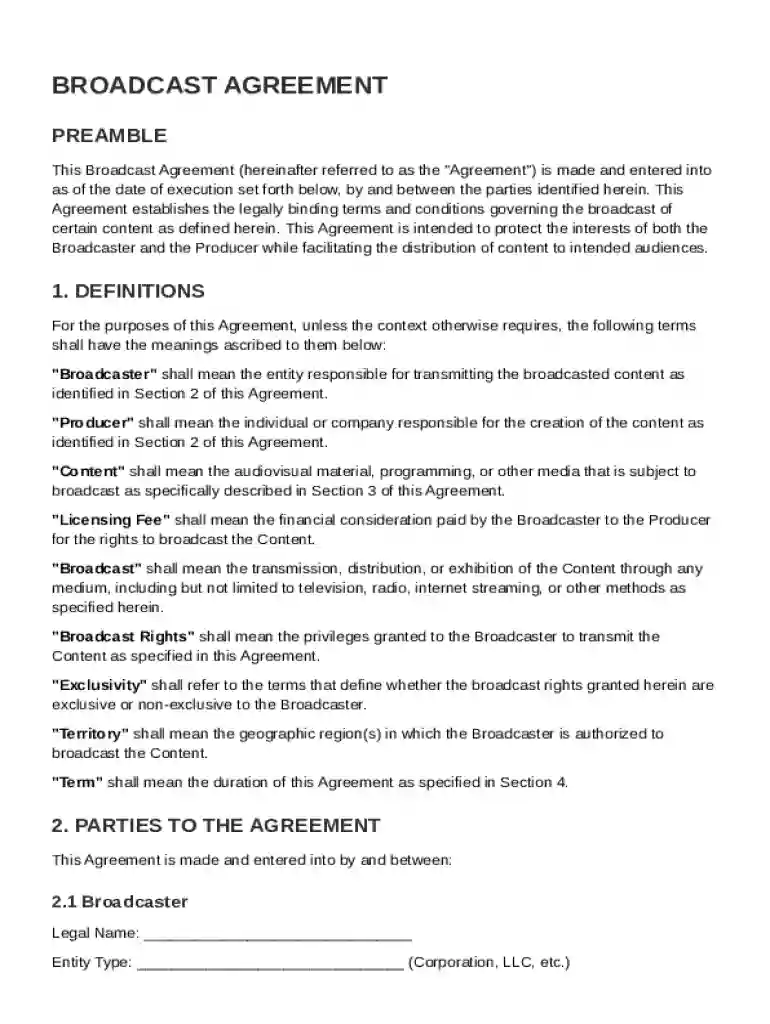
Type text, add images, blackout confidential details, add comments, highlights and more.

Draw your signature, type it, upload its image, or use your mobile device as a signature pad.

Send it via email, link, or fax. You can also download it, export it or print it out.
A Broadcast Agreement Template is a formal document that outlines the terms and conditions between two parties — typically a broadcaster and a producer — for the transmission of audiovisual content. This template serves as a foundational framework for clarifying each party's responsibilities, defining the scope of content, and establishing the legal and financial parameters surrounding the broadcast arrangement. It aims to protect the interests of both parties and facilitate cooperation while ensuring compliance with relevant broadcasting standards.
The Broadcast Agreement Template includes several critical components, each addressing specific areas of importance:
The template is designed to prevent ambiguity and potential conflicts. By detailing each aspect of the broadcasting relationship in a structured manner, both parties can have a common understanding that reduces the likelihood of disagreements and costly legal disputes.
The usability of a Broadcast Agreement Template extends to various aspects of preparing and finalizing a broadcasting agreement. Here are detailed steps and considerations for its use:
Review the Template: Go through the entire template carefully to understand all sections and ensure that it includes all necessary provisions relevant to the specific broadcast deal.
Customize for Specific Needs: The template is a starting point and should be tailored to suit the particular requirements of the parties involved. Adjust sections such as financial terms and delivery specifications to match the agreed-upon conditions.
Negotiation Phase: During negotiations, use the template as a guide to discuss and finalize the terms of the agreement. Ensure both parties are comfortable with the adjustments made to the template.
Legal Review: It's crucial to have the finalized document reviewed by legal professionals to ensure compliance with applicable laws and to verify that the rights and obligations of each party are appropriately addressed.
Finalization and Signatures: Once both parties agree to the terms, the template should be signed, making it a legally binding agreement. Maintain copies for future reference.
Completing the Broadcast Agreement Template requires attention to detail and thorough understanding of the contractual nuances. Here is a comprehensive guide to finishing the document:
Gather Information: Collect all relevant details related to the project, including content descriptions, technical requirements, and contact information for both parties.
Fill Out Basic Details: Start by entering basic information such as the names and addresses of the broadcaster and producer, along with the effective date of the agreement.
Specify Content and Rights: Clearly define the content to be broadcast and outline the rights being granted, including any exclusivity or territorial rights.
Detail Financial Arrangements: Accurately document payment terms, including fee structures, milestone payments, and any conditions associated with these payments.
Outline Technical Specifications: List the required delivery format and any technical standards necessary for broadcast compatibility.
Include Marketing and Promotional Obligations: If applicable, specify the responsibilities of both parties in marketing the content.
Address Dispute Resolution: Integrate clauses that outline how disputes will be handled, such as through arbitration or mediation.
Review and Finalize: Go over the completed document to ensure accuracy and completeness. Both parties should conduct a final review to confirm agreement.
Execute the Agreement: Once finalized, both parties should sign the document, thereby making the agreement enforceable.
The essential elements that every Broadcast Agreement Template should encompass include a range of critical topics that ensure a comprehensive understanding and enforceability:
The agreement should explicitly detail the roles and responsibilities of both the broadcaster and the producer. It should address each party's specific duties and obligations, including content creation, delivery, and any promotional activities.
It is vital to define the nature of the broadcast rights being granted. This includes specifying whether the rights are exclusive or non-exclusive, the duration of these rights, and any territorial limitations.
Outline all financial terms, ensuring there is clarity in compensation structures. The agreement should specify payment schedules, any conditions for payments, and consequences for missed or late payments.
Incorporate the technical standards that the content must adhere to, ensuring that it meets the broadcaster’s quality and format requirements. This could include resolution standards and delivery timelines.
Detail the marketing obligations, specifying responsibilities for promotional activities that aim to enhance viewership or engagement with the content.
Include a section dedicated to the methods for resolving disputes. This might involve setting out procedures for arbitration, mediation, or other agreed methods of conflict resolution.
Define the procedures for amending the contract terms, and the conditions under which the agreement may be terminated.
The legal framework of a Broadcast Agreement Template complies with industry standards to provide a robust basis for protecting the rights of both parties involved in broadcasting operations:
Ensure that the document complies with all relevant legal standards and regulations, including intellectual property laws and broadcasting rights legislation.
Once signed, the Broadcast Agreement Template becomes a legally binding document, enforceable by law. It is crucial to include a clause that explicitly states the agreement's legal status.
Detail the ownership of intellectual property rights concerning the content, ensuring that these rights are respected and safeguarded throughout the broadcast.
Real-world scenarios illustrate the practical application and advantages of the Broadcast Agreement Template:
Major networks often use templates to manage the large volume of content agreements necessary for national or international broadcasting.
Independent producers can use the template to secure broadcast agreements with regional television stations, providing opportunities for broader audience reach.
Universities may utilize broadcast agreements to distribute educational content through public broadcasting services, ensuring content dissemination aligns with institutional goals.
The evolution of document management has made digital versions of the Broadcast Agreement Template a practical choice:
Choosing the right software to fill and manage the Broadcast Agreement Template is crucial for seamless workflow integration:
DocHub offers robust compatibility for editing and signing the template digitally, supporting various formats like PDF and DOC. This stimulates efficient document management, enabling real-time collaborations and secure signing processes.
Compatibility with popular platforms such as Google Drive and Dropbox allows easy integration into existing document workflows, providing flexibility in how parties manage and share their agreement files.
These sections provide a complete, detailed, and informative guide to understanding and effectively utilizing a Broadcast Agreement Template.
At DocHub, your data security is our priority. We follow HIPAA, SOC2, GDPR, and other standards, so you can work on your documents with confidence.