
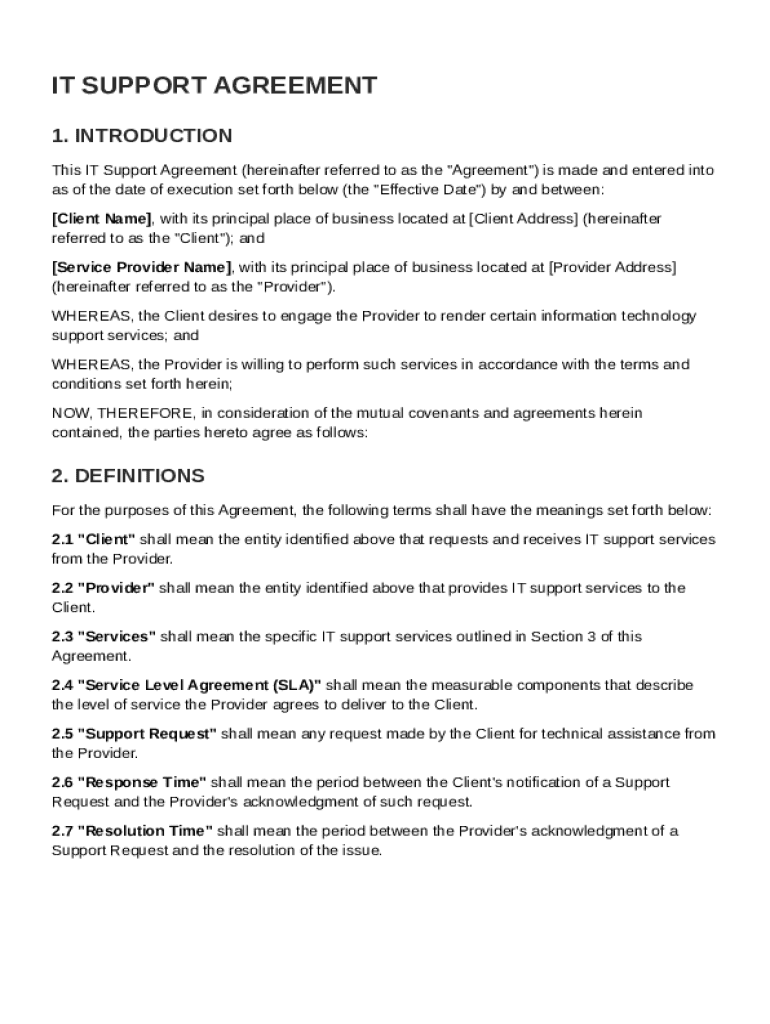







Definition and Meaning
An IT support agreement template serves as a comprehensive legal framework outlining the terms under which a client engages a service provider for information technology support. This document is instrumental in defining key components such as scope of services, service levels, client responsibilities, and payment terms. Understanding these elements ensures both parties share a mutual comprehension of the obligations and expectations bound by this agreement. Notably, these agreements are crucial for establishing a lawful and operational basis for ongoing IT support services, eliminating ambiguity, and minimizing disputes.
Key Elements of the IT Support Agreement Template
Scope of Services
- Detailing Services Offered: Clearly outlines the types of IT support services offered, such as technical support, consultation, system monitoring, and maintenance.
- Service Limitations: Identifies services not covered under the agreement to prevent misunderstandings.
Service Level Expectations
- Performance Metrics: Establishes benchmarks for service quality, including response times and resolution times for issues.
- Escalation Procedures: Provides guidelines on how issues should be escalated if initial resolution efforts fail.
Client and Service Provider Responsibilities
- Client Obligations: Details client responsibilities, such as providing access to necessary resources or reporting issues accurately and promptly.
- Provider Duties: Outlines the service provider’s responsibilities in delivering and managing the services efficiently and transparently.
Legal Use of the IT Support Agreement Template
Ensuring Compliance
- Legal Binding: Asserts the document's enforceability under the ESIGN Act, ensuring electronic signatures gathered are recognized as legally binding.
- Data Protection: Incorporates provisions for maintaining confidentiality and protecting sensitive data shared between parties.
Steps to Complete the IT Support Agreement Template
- Identify Parties: Clearly specify the client and service provider information, including business names and contact details.
- Define Services: Accurately detail the range of IT services being offered and define any exclusions.
- Set Expectations: Establish performance metrics, response times, and escalation procedures.
- Outline Financial Terms: Specify payment terms, billing schedules, and conditions for late payments or penalties.
- Legal Clauses: Include necessary confidentiality clauses and terms for dispute resolution.
- Review and Sign: Both parties should review the agreement, make modifications if necessary, and sign digitally for legal validation.
Who Typically Uses the IT Support Agreement Template

Common Users
- Small to Medium Enterprises (SMEs): Often rely on IT support agreements to maintain operational continuity without in-house IT departments.
- Large Corporations: Utilize these agreements to manage third-party vendors and ensure scalable IT service access.
- IT Service Firms: Develop agreements to standardize service offerings and maintain professionalism in client interactions.

Important Terms Related to IT Support Agreement Template
- Service Level Agreement (SLA): A section detailing service quality and performance metrics.
- Escalation Process: Steps outlined for managing unresolvable issues.
- Confidentiality Clause: Legal requirement to keep shared and proprietary information secure.
State-Specific Rules for the IT Support Agreement Template
Each state may have unique regulations regarding contract formations, such as disclosure requirements and electronic agreement recognition aspects. It's crucial for parties to be aware of and adhere to local laws pertinent to their jurisdictions, ensuring that all included terms meet state-specific legislative criteria.
Digital vs. Paper Version
Benefits of Digital Format
- Convenience: Easily accessible, editable, and shareable electronically, promoting efficiency.
- Security: Incorporates encryption and secure signature protocols to protect document integrity and authenticity.
Considerations for Paper Versions
- Tangibility: Some parties may prefer having a physical document for traditional record-keeping.
- Transition Challenges: Converting paper agreements to digital may introduce logistical challenges and procedural changes for businesses less familiar with digital ecosystems.




