01. Edit your form online
Type text, add images, blackout confidential details, add comments, highlights and more.

Type text, add images, blackout confidential details, add comments, highlights and more.

Draw your signature, type it, upload its image, or use your mobile device as a signature pad.

Send it via email, link, or fax. You can also download it, export it or print it out.
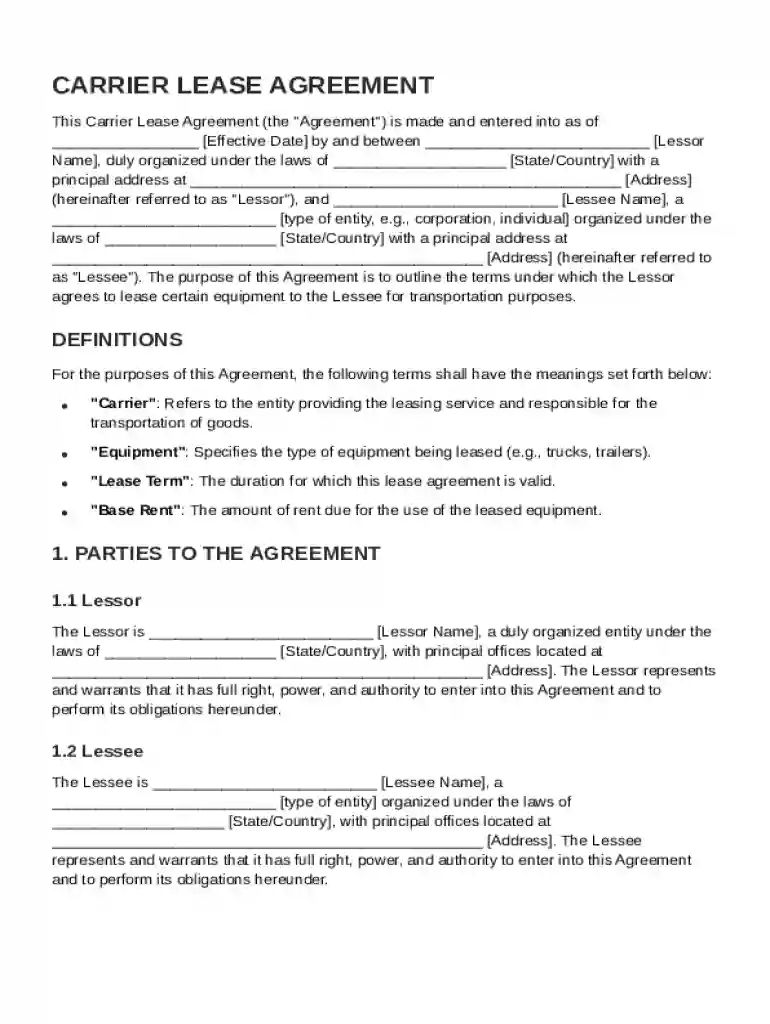
A Carrier Lease Agreement Template is a preformatted legal document used to outline the terms and conditions under which one party (the Lessor) leases transportation equipment to another party (the Lessee). This template is essential for formalizing the leasing relationship, providing clear definitions of key terms, responsibilities, payment terms, lease duration, termination conditions, indemnification clauses, and the governing law. It serves as a contractual framework to ensure compliance with relevant legal obligations while protecting the interests of both parties.
Using the Carrier Lease Agreement Template involves several straightforward steps to customize the document to meet the specifics of the leasing arrangement at hand. Begin by downloading or accessing the template through a digital document platform like DocHub, which allows for easy editing and signing. Review each section of the template, filling in the required information such as the names of the involved parties, equipment details, lease terms, and financial arrangements. Use the platform’s editing tools to add specific terms or additional clauses relevant to your needs. Ensure that all modifications are saved and reviewed by legal counsel before finalization.
Gather Information: Collect all necessary details including the identities of the Lessor and Lessee, equipment specifications, and agreed-upon terms.
Customize the Template: Use a document editing tool to input the gathered information into the template, making sure every section is detailed accurately.
Review for Accuracy: Ensure all information is correct and that the template reflects the agreed terms thoroughly. Consider seeking legal advice for verification.
Sign and Execute: Utilize a platform's e-signature tools to electronically sign the completed agreement, ensuring it is legally binding upon execution.
A Carrier Lease Agreement Template must comply with U.S. transportation industry standards and incorporate relevant statutory requirements such as the Uniform Commercial Code (UCC) for leasing agreements. It should explicitly address liability issues, indemnification, and dispute resolution protocols. Including state-specific provisions is critical when the equipment is operated across multiple jurisdictions with varying requirements.
Each U.S. state imposes its own set of rules concerning equipment leasing agreements. For instance, California requires specific disclosures and identification markings on leased vehicles, while Texas may have unique tax implications. Therefore, it is vital to incorporate state-specific addenda or amendments based on where the equipment will be primarily used or registered. Utilizing knowledgeable legal professionals or consulting specific state transportation departments can help ensure compliance.
This template is commonly used by logistics and transportation companies, independent haulage contractors, freight brokerage firms, and leasing agencies that manage a fleet of transportation equipment. It is also utilized by legal professionals tasked with drafting or reviewing such documents to safeguard client interests in leasing transactions.

At DocHub, your data security is our priority. We follow HIPAA, SOC2, GDPR, and other standards, so you can work on your documents with confidence.