






Definition and Meaning
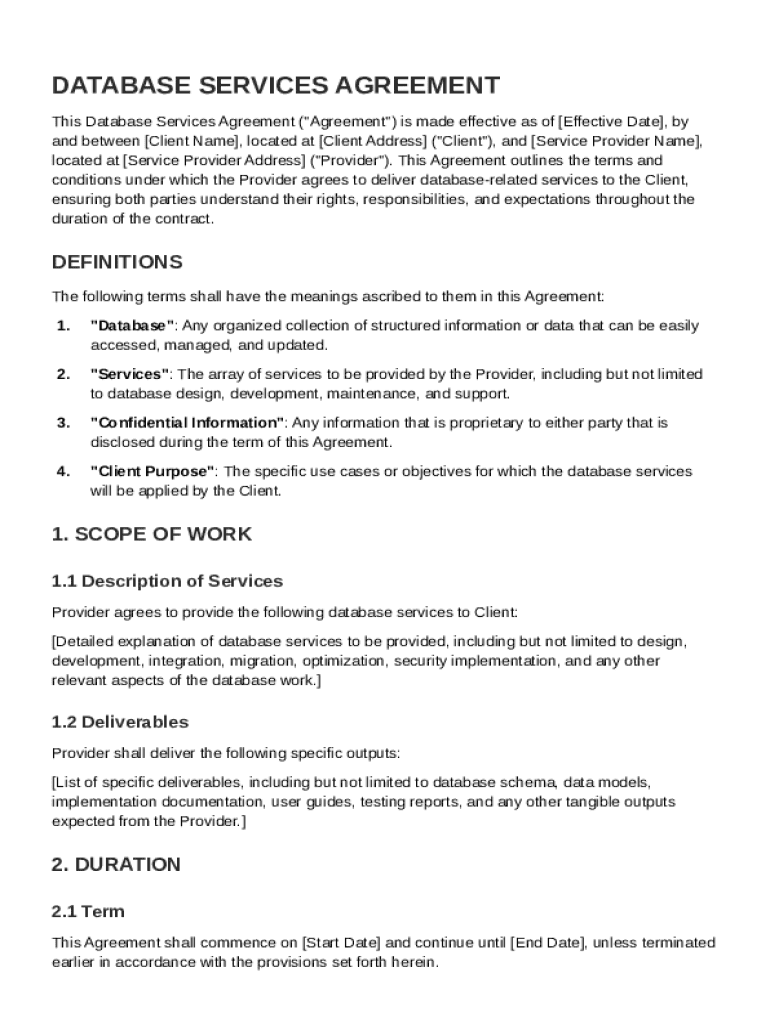
A database contract template is a predefined document designed to facilitate the creation of agreements related to database services. These templates offer a framework for detailing the roles, responsibilities, and obligations of parties involved in a database-related service agreement. The primary purpose is to streamline the contract creation process while ensuring all critical legal and operational aspects are covered. Through the use of such templates, parties can quickly establish clear terms, reducing the time and effort typically required to draft a contract from scratch.
The template usually includes sections to specify the scope of work, confidentiality clauses, payment terms, and liability limitations. It acts as a guide for setting mutual expectations and provides a reference point should disputes arise. Well-crafted templates help maintain consistency across contracts, facilitating smoother negotiations and stronger relationships between service providers and clients.
Key Elements of the Database Contract Template
The database contract template typically includes several key elements essential for a comprehensive agreement. These elements ensure that all aspects of the service are well-defined and legally binding.
- Scope of Work: Clearly outlines the specific services to be performed. This section details all deliverables, timelines, and performance standards required from the service provider.
- Payment Terms: Defines the billing structure, including payment amounts, schedules, and any penalties for late payments. This section ensures financial agreements are transparent and enforceable.
- Confidentiality and Data Protection: Details measures to protect sensitive client data, often including obligations for both parties to maintain data privacy and confidentiality.
- Liability Limitations: Sets boundaries on the responsibility in case services fail to meet the specified standards. This can limit the amount a party might owe in any legal disputes.
- Termination Conditions: Explains the conditions under which either party can terminate the agreement, including any notice periods required.
- Governing Law: Specifies the jurisdiction’s laws that will govern the contract, often important for resolving inter-state or international disputes.
Steps to Complete the Database Contract Template
Completing a database contract template requires careful attention to detail and a clear understanding of the agreement’s terms. Here’s a step-by-step guide:
-
Review Template Sections: Start by thoroughly reading each section of the template to understand what information is required.
-
Fill in Party Details: Enter names and contact information for all parties involved.
-
Detail Scope of Work: Clearly define services to be performed, expected outcomes, and associated deadlines.
-
Specify Payment Terms: Include details on payment schedules, accepted payment methods, and any penalties for late payment.
-
Address Confidentiality: Outline what constitutes confidential information and what measures have been agreed upon to protect such data.
-
Establish Termination Clauses: Set clear conditions under which the contract may be terminated by either party.
-
Review and Customize: Tailor any standard clauses to better suit the specific needs of the agreement, ensuring compliance with applicable laws.
-
Obtain Signatures: Ensure all parties review the completed contract and provide electronic or physical signatures for validation.
Legal Use of the Database Contract Template
In the United States, database contract templates are used to legally bind parties in a service agreement, and they must comply with relevant federal and state laws. Employers and service providers use these templates to ensure that all terms and obligations are documented, preventing misunderstandings.
- Compliance with ESIGN Act: Electronic records and signatures are legally recognized as equivalent to their paper-based counterparts, permitting the use of electronic contracts.
- State-Specific Adjustments: While federal standards provide a broad framework, individual states may have unique requirements or interpretations affecting contract enforcement.
It is advisable to consult with a legal expert to ensure the template complies with all applicable laws and includes necessary provisions for enforceability in the respective jurisdiction.
Examples of Using the Database Contract Template
Database contract templates are employed in various scenarios where database services are provided. Real-world examples include:
- IT Service Providers: These companies often need contracts when managing client databases, covering tasks such as data storage, back-ups, and security audits.
- Consulting Firms: Firms advising on database architecture may use these templates to formalize project terms and protect intellectual property shared during the engagement.
- Enterprise Agreements: Large corporations entering into long-term partnerships with IT service providers may use a tailored template to define extensive service-level agreements (SLAs).
Each example demonstrates the adaptability of contract templates to fit diverse business needs while maintaining legal integrity across different industry practices.
Important Terms Related to Database Contract Template
Understanding specific terminology used in the database contract template is crucial for ensuring the agreement is well comprehension and enforceable:
- Service Level Agreement (SLA): A critical component defining service standards and performance metrics.
- Indemnification: A clause where one party agrees to cover specific losses incurred by another party.
- Force Majeure: A provision releasing parties from obligations due to unforeseen events that are beyond their control.
- Amendment Process: The procedure established for making changes to the existing contract terms.
Awareness of these terms will aid in the effective negotiation and management of database service contracts and help both parties comprehend their rights and responsibilities.
Who Typically Uses the Database Contract Template
Several entities regularly utilize database contract templates to formalize their service agreements:
- Database Administrators (DBAs): Personnel responsible for database setup, monitoring, and maintenance, often needing formal contracts for outsourced administration tasks.
- Software Development Companies: Companies creating database-driven applications require robust contracts outlining database structure services and integration.
- Cloud Service Providers: These providers supply database storage and hosting, necessitating templates to ensure consistent service delivery standards and data protection clauses.
The diverse utility of such templates underscores their significance in fostering transparent, reliable interactions within the tech industry and beyond.


Software Compatibility
Database contract templates can be enhanced by using software like DocHub, ensuring seamless completion and management of documents:
- File Compatibility: Compatible with multiple file formats such as DOC, PDF, and more, facilitating easy import and export.
- Annotation Tools: Features such as adding text, images, and comments can help personalize templates.
- Integration with Google Workspace: Direct integration allows easy manipulation, saving, and sharing of contracts within the Google ecosystem.
These features assist users in efficiently handling their documents, promoting an organized approach to contract management.