
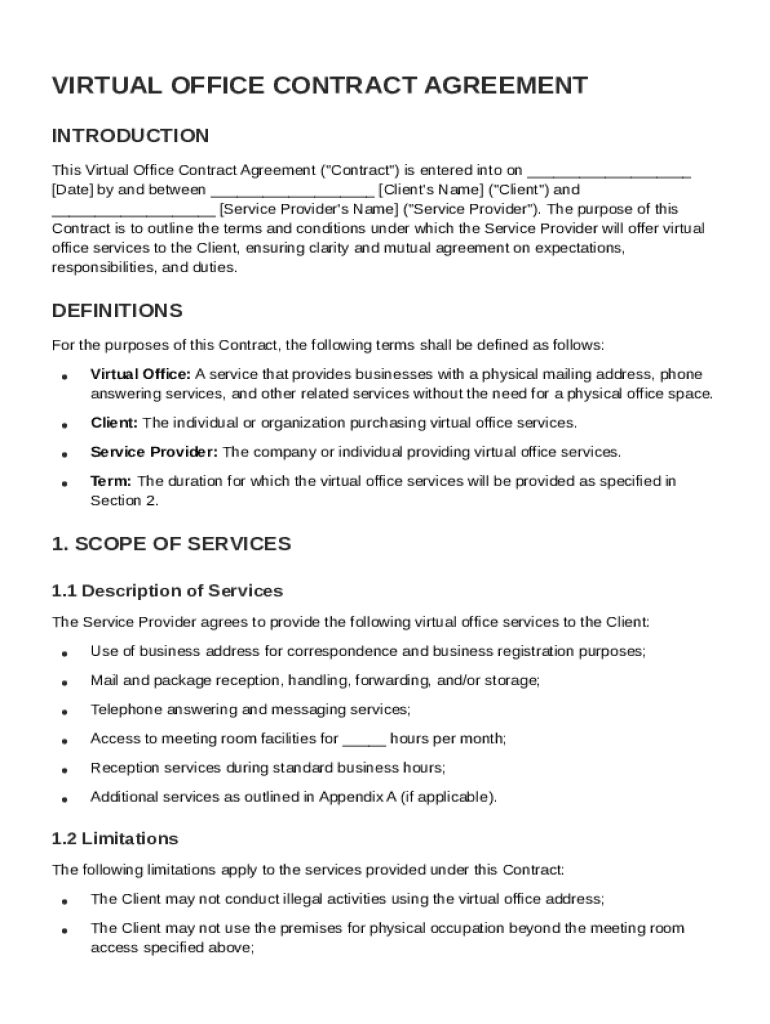





Virtual Office Contract Template 2026

Get Form
Virtual Office Contract Template Preview on Page 1

Here's how it works

01. Edit your form online
Type text, add images, blackout confidential details, add comments, highlights and more.
02. Sign it in a few clicks
Draw your signature, type it, upload its image, or use your mobile device as a signature pad.
03. Share your form with others
Send it via email, link, or fax. You can also download it, export it or print it out.

Definition & Meaning

A Virtual Office Contract Template is a formalized agreement between a client and a service provider concerning the provision of virtual office services. It sets out the terms and conditions for utilizing such services, which might include a business address, mail handling, phone answering, and administrative support, among others. This type of contract serves to clarify the roles and expectations of both parties, ensuring an organized and professional interaction. By defining the scope of services, payment terms, confidentiality obligations, and termination conditions, it seeks to alleviate potential disputes and establish a legally binding framework.

Key Elements of the Virtual Office Contract Template

Capturing essential elements in the Virtual Office Contract Template is crucial to formulating a comprehensive and legally sound agreement. Key elements typically include:

  • Scope of Services: Clearly delineates the types of virtual office services provided, such as business address usage, call handling, and administrative tasks.
  • Payment Terms: Details the pricing structure, payment frequency, and accepted payment methods. It often includes clauses related to late payments and penalties.
  • Responsibilities: Defines the responsibilities and obligations of both the client and service provider to avoid any ambiguities.
  • Confidentiality: Establishes the terms under which sensitive information is protected, preventing unauthorized disclosure.
  • Termination Clause: Outlines the conditions under which the contract can be terminated by either party, detailing notice periods and any associated penalties.

How to Use the Virtual Office Contract Template

Utilizing a Virtual Office Contract Template involves several strategic steps to ensure that the final document meets the needs of both parties. Here's how to effectively use the template:

  1. Customization: Tailor the template to reflect the specific terms agreed upon with the virtual office provider.
  2. Review: Carefully review all sections to make sure they are relevant and lawful per your jurisdiction.
  3. Legal Consultation: Consider having a legal professional review the template to ensure all clauses are enforceable and clear.
  4. Agreement: Both parties should discuss and agree on all details before signing the contract. This can include any amendments or additional clauses deemed necessary.
  5. Execution: Both parties sign the document, acknowledging their acceptance of the terms and conditions.

Steps to Complete the Virtual Office Contract Template

Completing a Virtual Office Contract Template involves a structured process to ensure all relevant sections are accurately filled out. Here is a step-by-step guide:

  1. Initial Details:

    • Fill in the names and contact details of both the client and service provider.
    • Specify the commencement date of the services.
  2. Service Specifications:

    • Detail specific services provided, like mail forwarding or live receptionist services.
  3. Payment Information:

    • Enter the agreed rates, billing cycle, and preferred method of payment.
  4. Legal and Confidentiality Terms:

    • Customize clauses related to confidentiality and data protection per parties' requirements.
  5. Signature Block:

    • Ensure that all signatories sign and date the document, affirming their understanding and acceptance.

Legal Use of the Virtual Office Contract Template

Legal legitimacy is a hallmark of using the Virtual Office Contract Template appropriately. In the United States, it's essential for contract terms to comply with local laws to ensure enforceability. These templates facilitate the creation of legally binding agreements by providing structured layouts that generally include mandatory legal provisions. Ensure any specific legal requirements in your state, such as governing law or jurisdiction clauses, are incorporated, and be aware of the legal standards, such as the ESIGN Act for electronic signatures ensuring legal enforceability.

Who Typically Uses the Virtual Office Contract Template

The Virtual Office Contract Template is predominantly used by businesses and entrepreneurs who require a professional presence without the necessity of physical office space. Common users include:

  • Small Business Owners: Seeking cost-effective office solutions.
  • Startups: In need of flexible workspace arrangements.
  • Freelancers and Remote Workers: Looking for a professional business address and consistent administrative support.
  • Corporations: Establishing regional offices without incurring significant setup costs.

decoration image ratings of Dochub

Business Types That Benefit Most

Certain business types can leverage the benefits of a Virtual Office Contract Template more effectively. These include:

  • Consulting Firms: Often require minimal physical office space and prioritize flexibility.
  • E-commerce Companies: Operate predominantly online but benefit from a professional address.
  • Tech Startups: Require agility and a prestigious address without the overhead costs.
  • Legal Practitioners and Paralegals: In need of professional settings for meeting clients occasionally.

State-Specific Rules for the Virtual Office Contract Template

When using a Virtual Office Contract Template, it's important to consider state-specific regulations that may impact the contract's structure or enforceability. Key considerations include:

  • Licensing Requirements: Some states may require services providers to meet certain registration or licensing prerequisites.
  • Governing Law Clauses: Tailor these clauses to reflect the applicable state laws to ensure compliance and acknowledgment of jurisdictional authority.
  • Special Terms: Certain states might have unique laws concerning the handling of business communications or data protection, necessitating specific contract clauses.

By understanding these elements, you can ensure the Virtual Office Contract Template is a robust legal tool that meets the diverse needs of its users.

be ready to get more

Complete this form in 5 minutes or less

Get form

Got questions?

We have answers to the most popular questions from our customers. If you can't find an answer to your question, please contact us.
Contact us
Open the Google Docs template Contract Template and enter your company details and an image with your signature in the provided space, as well as the actual contract. Familiarize yourself with working with variables if you want to add more placeholders, conditions, or loops to your contract.
Drafting contracts in Word Businesses can choose a template that matches your needs, or you can start with a blank document. They can adjust the document formatting to meet their specific contract requirements. It includes font styles, sizes, line spacing, and margins.
Virtual offices enable businesses to operate remotely with communication services such as mail handling and call forwarding, promoting a flexible work environment. Physical offices require employees to be present onsite during working hours, which may limit adaptability in scheduling and remote collaboration.Jul 22, 2025
Yes, you can write your own LLC operating agreement, especially for simple businesses, using online templates as a starting point, but its highly recommended to have a lawyer review it or draft it for you to avoid crucial errors and ensure it covers state laws and complex situations like profit/loss distribution, management, and dissolution. While some states mandate an agreement, its vital for all LLCs to define member roles, ownership, and operations, even if not filed with the state. Key Considerations State Laws: Each state has specific LLC laws, so your agreement must comply, which templates often miss. Complexity: For complex businesses with multiple members, DocHub assets, or future growth plans, professional legal help is crucial. Templates: Use online templates (like those from LawDepot, Nav, Evergreen Small Business) to build a draft, but understand they might lack critical provisions. Essential Content: Ensure it details ownership percentages, profit/loss allocation, member/manager duties, voting rights, and procedures for buying out members or dissolving the company. Legal Review: Have a business lawyer review any DIY agreement to prevent future costly disputes or legal issues. Notarization: Notarization isnt always required but can add legitimacy; some banks offer free notary services. Recommendation For a simple, single-member LLC, a DIY agreement with a good template might suffice if reviewed. For multi-member LLCs or complex scenarios, investing in legal drafting is the best way to protect your business and members, according to Wolters Kluwer and The U.S. Chamber of Commerce. Basic Information About Operating Agreements | U.S. Small Business AdministrationMay 18, 2016Small Business Administration (.gov)Free LLC Operating Agreement Template | Customize PrintSep 30, 2025 Yes, you can write your own LLC Operating Agreement. LawDepots documents are created by qualified legal experts. Use LawDepot
Yes, the IRS accepts virtual mailboxes for important correspondence and tax filings, but only if they are compliant with USPS regulations for Commercial Mail Receiving Agencies (CMRAs), meaning they provide a real street address (not a P.O. Box number) and require you to complete USPS Form 1583 for identity verification, ensuring a legitimate physical location for mail delivery. This allows for professional presence, privacy, and secure receipt of tax documents without using a home address, unlike anonymous P.O. Boxes which the IRS generally rejects for official use. Key requirements for IRS acceptance: Real Street Address: Must be a physical street address, not just a P.O. Box. CMRA Registration: The virtual mailbox provider must be registered with the USPS as a Commercial Mail Receiving Agency (CMRA). Identity Verification: You must complete and file USPS Form 1583 (Application for Delivery of Mail at a Residence or Commercial Mail Receiving Agency) to verify your identity, linking you to that address. Why it works: Security Compliance: A CMRA-registered virtual address provides a secure, verifiable physical location for sensitive government mail, preventing fraud. Professionalism: It offers a legitimate, professional business address, enhancing your credibility with the IRS and clients. Privacy: It protects your home address from public records and mail lists. What to avoid: P.O. Boxes: The IRS typically does not accept standard P.O. Boxes for official business filings, like EIN applications (Form SS-4), as they lack a physical street presence. In summary, a compliant virtual mailbox from a registered CMRA is an acceptable and practical solution for managing IRS and other official mail. Does the IRS Accept Virtual Addresses? - Davinci VirtualJan 30, 2024 In a world increasingly dominated by remote work and digital solutions, the question of whether the Internal Revenue SDavinci Virtual OfficeVirtual Addresses: What the IRS, Banks, and States AcceptOct 2, 2025 When it comes to the IRS, clarity is everything. The agency needs a physical address where official mail can reliably rAnytime Mailbox

Security and compliance

At DocHub, your data security is our priority. We follow HIPAA, SOC2, GDPR, and other standards, so you can work on your documents with confidence.

Learn more
ccpa2
pci-dss
gdpr-compliance
hipaa
soc-compliance

People also ask

A virtual office is a service that enables employees and business owners to work remotely by providing a range of business functions accessible through the internet. It also enables organisations to create and maintain a presence in a desirable location without the need to pay rent for an actual space.Oct 27, 2024
A virtual office lease agreement is a contract that defines the terms and expectations between a virtual office provider and your business. It specifically outlines how you may use the provided virtual office space or virtual address, without physically occupying traditional office space or a coworking space.Aug 6, 2025
Perceived Disadvantages of Virtual Offices Needing a Physical Location to Complete Work. Businesses that use virtual offices have their employees performing duties from an assortment of locations. Lack of In-Person Social Interaction. Lack of Motivation. Communication.

Related links


