






Definition & Meaning
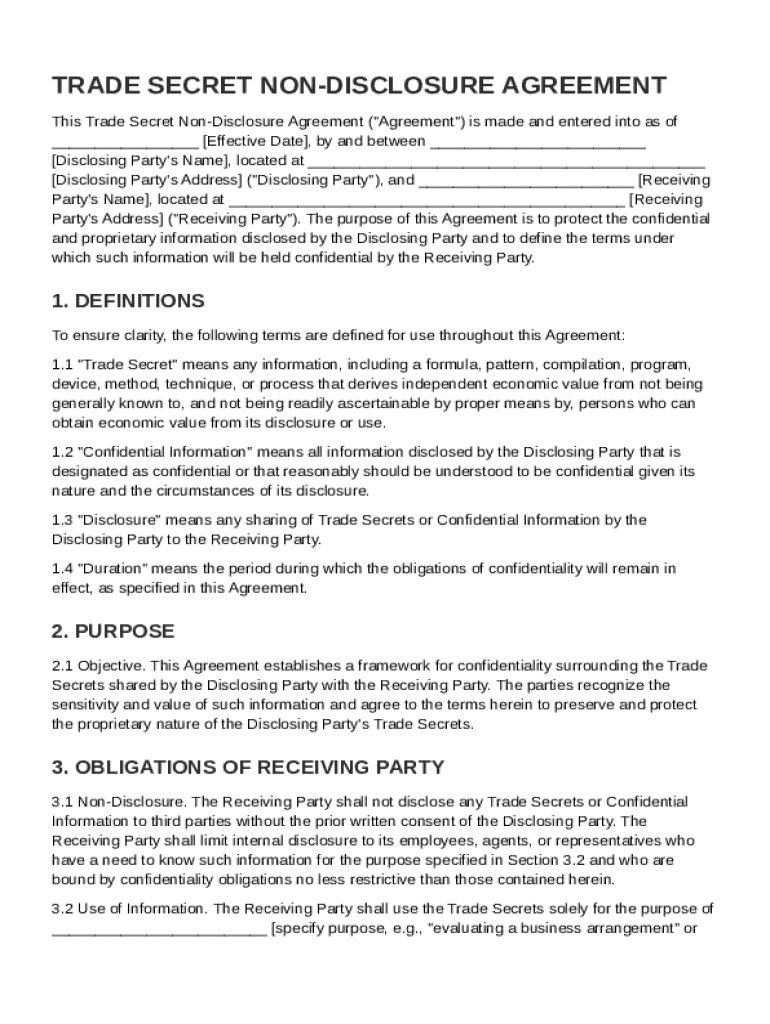
A Trade Secret Agreement Template is a legal framework designed to protect confidential and proprietary information shared between two parties: the Disclosing Party and the Receiving Party. This agreement is essential for businesses looking to safeguard their unique processes, designs, or formulas that give them a competitive edge. Trade secrets typically include any business information that is not generally known, and which a company takes reasonable steps to keep confidential. This template specifies the rights and obligations of both parties concerning the handling and disclosure of the trade secret information.
The agreement typically outlines the scope of what constitutes a trade secret, incorporating definitions of both 'Trade Secret' and 'Confidential Information.' It clearly states that the Receiving Party must keep the information confidential and only use it for a specified purpose. The agreement helps to mitigate the risk of unauthorized disclosure, which could severely impact the competitive advantage of the disclosing party.
How to Use the Trade Secret Agreement Template
To effectively use a Trade Secret Agreement Template, follow a structured approach, ensuring all necessary sections are completed accurately. Start by clearly identifying the Disclosing Party and the Receiving Party. This includes full names, roles, and contact information for both parties involved.
Next, define what constitutes a 'Trade Secret' and 'Confidential Information' explicitly, so there is no ambiguity. Specify the purpose for which the trade secret information is being shared. This purpose should be limited and directly related to the business arrangement or project in question. Both parties must mutually agree on this purpose to avoid any misunderstandings.
You should also outline specific obligations, stipulating what the Receiving Party can and cannot do with the information. Include details about the measures to be taken for safeguarding the data and the conditions under which the information can be disclosed, if any. Complete the template by having both parties review and sign the document to signify their understanding and acceptance of these terms.
Key Elements of the Trade Secret Agreement Template
The Trade Secret Agreement Template includes several fundamental elements designed to provide comprehensive protection for sensitive information. The key components are as follows:
- Identification of Parties: Details of the Disclosing Party and the Receiving Party.
- Definitions: Clear definitions of what constitutes 'Trade Secret' and 'Confidential Information.'
- Obligations of the Receiving Party: Descriptive account of responsibilities regarding non-disclosure and proper use of the information.
- Permitted Use: Specification of how the information can be used, limiting it to the agreed business purposes.
- Exceptions to Confidentiality: Any situations wherein the Receiving Party may disclose the information, such as legal compulsion.
- Duration: The period during which the information must be kept confidential; it can extend beyond the termination of the business relationship.
- Ownership of Information: Statement clarifying that the ownership of the trade secret information remains with the Disclosing Party.
- Governing Law: Legal jurisdiction under which the agreement is valid and enforceable.
- Amendments and Execution Provisions: Processes for modifying the agreement and the manner of execution (e.g., digital signatures).
Steps to Complete the Trade Secret Agreement Template
- Gather Information: Collect the full names and contact details of both the Disclosing Party and the Receiving Party.
- Define Trade Secrets and Confidential Information: Clearly outline what information will be protected under the agreement.
- Specifying Allowed Uses: Describe the permitted uses of the confidential information.
- Outline Obligations: Detail the Receiving Party's responsibilities concerning confidentiality and data protection.
- List Exceptions: Identify any possible legal or protected disclosures.
- Determine Duration: Set a time frame for the agreement's enforceability.
- Review and Sign: Have both parties review the document and sign the agreement to activate its terms.
Why Should You Use a Trade Secret Agreement Template
Utilizing a Trade Secret Agreement Template is crucial for protecting sensitive business information. It ensures all parties involved are aware of their rights and obligations, which helps prevent unauthorized disclosures. The legal framework provides peace of mind to the Disclosing Party that their proprietary processes or formulas are secure, reducing the risk of losing competitive advantages.
This template facilitates clear communication between parties, minimizing potential misunderstandings. By detailing the use and protection of confidential information, businesses can foster trust and collaboration. It may also protect companies legally if a dispute arises regarding the misuse of confidential information, as it provides concrete evidence of agreed-upon terms.
Important Terms Related to Trade Secret Agreement Template
A comprehensive understanding of the following terms is essential when working with a Trade Secret Agreement Template:
- Confidential Information: Any information not generally known to the public, including business strategies, product formulas, and customer lists.
- Non-Disclosure: The obligation not to reveal any information considered confidential to unauthorized parties.
- Permitted Use: Specific, agreed-upon purposes for which the Receiving Party can use the confidential information.
- Exceptions: Conditions under which confidential information may be disclosed without breach of contract.
- Intellectual Property: Legal rights to inventions and creations within trade secrets that provide a competitive advantage.
- Covenant: An agreement within a contract that promises to perform or refrain from a specified action, such as divulging trade secrets.
- Breach of Contract: Failure to fulfill the obligations as outlined in the agreement, potentially leading to legal action.
Understanding these terms is crucial for ensuring the correct interpretation and implementation of the agreement’s provisions.
Legal Use of the Trade Secret Agreement Template
The trade secret agreement is designed to be legally binding, aligning with the ethical and compliance standards required by law. The template provides a clear and concise framework that complies with the Uniform Trade Secrets Act and the Defend Trade Secrets Act within the United States. When executed properly, the agreement serves as valid legal proof that both parties have entered into a mutual understanding regarding the handling of trade secrets.
To maintain legal validity, the agreement should explicitly state that all signatories have entered into it voluntarily and with a full understanding of the implications. Including a governing law clause is essential to specify which state's laws will apply, should any disputes arise. The legal framework established by the Trade Secret Agreement Template offers robust protection and recourse for the Disclosing Party, should their proprietary information be mishandled.
State-Specific Rules for the Trade Secret Agreement Template
While the Trade Secret Agreement Template generally applies across the United States, state-specific nuances may impact its enforceability. Various states may adopt different interpretations of the Uniform Trade Secrets Act, affecting how trade secrets are defined or enforced. Businesses should research applicable state laws to ensure compliance.
For instance, California has unique stipulations regarding non-compete clauses, which might indirectly affect the enforcement of trade secret agreements. Consulting with a legal professional familiar with state-specific trade secret laws is advisable to tailor the agreement for optimal protection. Always consider the governing law of the jurisdiction specified in the agreement to prevent any unenforceability issues.