






Definition and Meaning
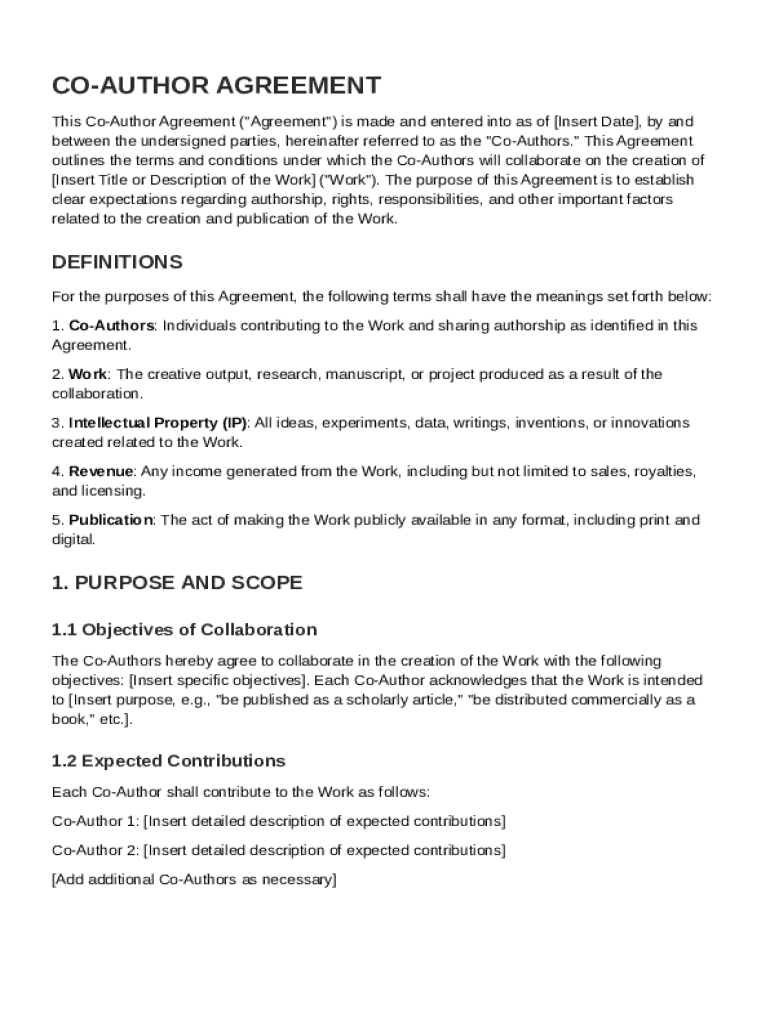
A Co-Author Contract Template is a formal agreement that outlines the collaboration terms among co-authors on a specific project or work. This document serves to detail the responsibilities and contributions of each contributor, ensuring clarity from the outset. By providing a structured approach to co-authorship, the template helps prevent misunderstandings related to intellectual property rights, revenue sharing, and other critical aspects of a joint creative endeavor. Co-Author Contract Templates are especially valuable in mitigation of potential disputes, as they specify expectations and commitments agreed upon by all parties involved.
Importance of a Co-Author Contract Template
The Co-Author Contract Template is essential for setting a firm foundation within collaborative creative works. Without it, co-authors might face challenges in defining authorship roles, establishing clear guidelines for contributions, and protecting their individual rights. By deploying this template, co-authors can define their decision-making processes, and understand how disputes will be resolved if they arise, fostering a transparent and productive working relationship.
Key Elements of the Co-Author Contract Template
The Co-Author Contract Template includes several core components that must be clearly articulated to ensure each party's interests are protected. These key elements include:
- Authorship and Contributions: Specifies the contributions of each co-author and their respective roles.
- Intellectual Property Rights: Details ownership rights concerning the content created, including copyright and patents where applicable.
- Revenue Sharing: Outlines how any profits or royalties will be divided among the co-authors.
- Publication Approval: Establishes the process through which the work will be finalized and published, including unanimous consent if necessary.
- Confidentiality: Ensures that sensitive information shared during the project remains protected.
- Dispute Resolution: Provides a framework for resolving disagreements, which may include mediation or arbitration.
- Termination Procedures: Defines how the agreement can be ended, including the circumstances under which it may be terminated.
Subsections for Each Element
For each key element, the template should provide further guidance and specifics. For instance:
- Authors could outline the specific types of content they will create or review.
- Revenue Sharing might require detailed percentages for different revenue streams, such as book sales, adaptions, or translations.
Steps to Complete the Co-Author Contract Template
Drafting a Co-Author Contract Template involves several systematic steps to ensure thoroughness and clarity:
- Identify All Co-Authors: Begin by listing all individuals involved in the project and gather their contact information.
- Define the Scope of Work: Clearly outline the project objectives, including specific tasks and goals for each co-author.
- Specify Financial Terms: Determine how profits will be distributed and any upfront payments for contributions.
- Discuss and Document Intellectual Property Rights: Agree on how rights will be managed and shared.
- Set Milestones and Deadlines: Establish deadlines for each phase of the project to keep everyone on track.
- Outline Conflict Resolution Mechanisms: Decide on a process for handling disagreements and documenting it in the agreement.
- Review and Finalize the Contract: Have all parties review the draft contract and make necessary changes before signing.
Example Scenarios
Suppose co-authors are working together on a novel, and one wants to adapt it into a screenplay. The contract should specify whether this adaptation is included in the original agreement or requires a separate negotiation process.
Legal Use of the Co-Author Contract Template
Using a Co-Author Contract Template has several legal implications, ensuring that creators have a mutual understanding of their professional relationship and the work they are generating. The document's enforceability depends on its compliance with relevant legal standards and the mutual consent of all parties:
- Binding Agreements: By signing the contract, all parties agree to adhere to the terms, making it a legally binding document.
- Enforcement of Terms: Should any disputes arise, the contract can be used as evidence in a legal setting to support a co-author’s claims.
- Amendments and Updates: Contracts often include clauses for modifications, ensuring that all changes are documented and agreed upon by all co-authors.
Considerations for Legal Compliance
Ensure all co-authors fully understand the contract’s terms and seek legal counsel if they come across unclear clauses. Regular reviews and updates to the agreement could reflect any evolving nature of the project and maintain legal compliance.
Who Typically Uses the Co-Author Contract Template
This template is most frequently employed by individuals in collaborative fields such as:
- Authors and Writers: Working on books, scripts, or academic papers.
- Researchers: Engaging in scientific studies or projects requiring joint intellectual contributions.
- Artists and Creators: Collaborating on visual arts or multimedia designs.
- Musicians and Composers: When creating or producing joint musical works.

Scenario Examples
- Academic Researchers might use the template to clarify research author roles before submitting a paper to a journal.
- Screenwriters might rely on it to negotiate writing credits for a collaborative film project.
State-Specific Rules for the Co-Author Contract Template
Although Co-Author Contracts generally have a universal structure, it is crucial to acknowledge that state-specific regulations might impact certain aspects. In the United States, these regulations influence how the contract is drafted and executed:
- Contract Laws: Each state may have its own laws regarding what makes a contract enforceable, such as witness requirements or specific language prohibitions.
- Revenue Sharing and Tax Implications: State laws might affect how shared revenue or royalties are taxed.
- Dispute Resolution: The availability and recognition of mediation or arbitration agreements can vary, requiring state conformity.
Cross-State Collaborations
When co-authors reside in different states, determining which state's laws govern the contract is vital for enforceability and resolution of disputes.
Examples of Using the Co-Author Contract Template
-
Scenario 1: Two novelists working together on a new mystery novel use the template to define writing and editing roles, determine royalties, and decide on publication rights.
-
Scenario 2: A team of scientists from multiple universities employs the contract to outline research data contributions, lab responsibilities, and credit distribution for a published journal article.
-
Scenario 3: Musicians collaborating on an album decide contribution percentages for songwriting, production credits, and earnings with the help of the template.
Digital vs. Paper Versions
Choosing between a digital and a paper version of the Co-Author Contract Template impacts both convenience and legitimacy:
-
Digital Versions:
- Provide convenient access and editing on electronic devices.
- Allow for electronic signatures that are legally recognized.
- Enable cloud storage for easy sharing and retrieval.
-
Paper Versions:
- Might be preferred for formal presentation settings.
- Offer a tangible format that some may find easier to review in detail.
- Still valid, but lack the immediate capability for updates or distribution of changes.
Impact of Choosing a Format
Digital formats support real-time collaboration and instant updates, which can be beneficial when working across distances. Meanwhile, paper versions might offer more ritualistic comfort for formal agreements but lack the flexibility and convenience of electronic documentation.
By focusing on these intricate details and examples related to the Co-Author Contract Template, the content offers a comprehensive guide for co-authors intending to engage in collaborative projects, ensuring clarity, compliance, and cooperation throughout their work.