






Definition & Purpose of a Support Agreement
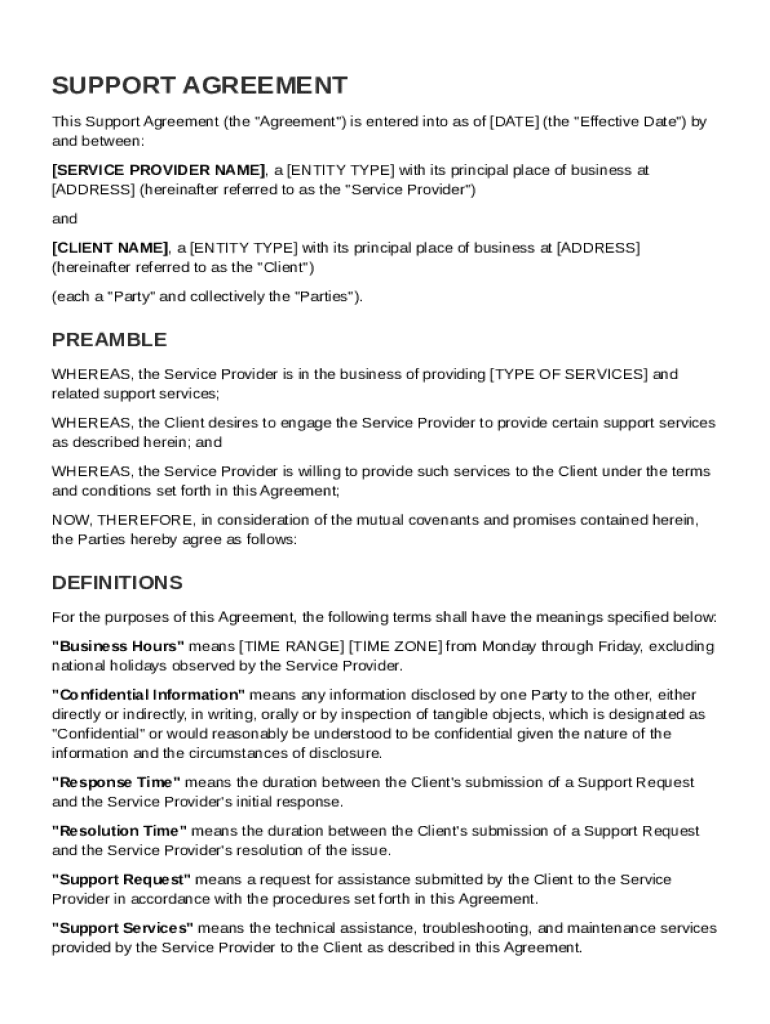
A Support Agreement, often termed a Service Level Agreement (SLA), delineates the conditions under which a Service Provider will deliver support services to a Client. Its primary function is to establish a framework that defines the scope of services, the responsibilities of each party, service levels, response and resolution times for support requests, payment terms, confidentiality obligations, and termination conditions. The purpose of such an agreement is to ensure that both parties have clear expectations and obligations, thereby enhancing communication, and service delivery while safeguarding confidential information.
Key Components of a Support Agreement
- Scope of Services: Clearly outlines what services are covered, including limitations and exclusions.
- Responsibilities: Specifies the duties of the Service Provider and the Client, ensuring mutual understanding.
- Service Levels: Establishes expected performance standards and metrics to measure service quality.
- Payment Terms: Details the financial obligations, including payment schedules and penalties for late payments.
- Confidentiality and Security: Addresses how sensitive information will be handled and protected.
How to Use the Support Agreement Template
Using a Support Agreement Template is a straightforward process that involves tailoring the document to fit the specific needs of the Service Provider and Client. Here are the steps to effectively utilize the template:
- Customize the Template: Begin by personalizing the template with the specific names, roles, and contact information of both parties involved.
- Define the Scope: Clearly articulate the services to be provided, ensuring alignment with both parties' expectations.
- Set Service Levels: Agree upon measurable service standards that will serve as benchmarks for performance.
- Negotiate Payment Terms: Outline the agreed financial arrangements, including frequency and method of payment.
- Review and Revise: Both parties should thoroughly review the document to ensure all terms are correct and agreeable.
- Execute the Agreement: Finalize the agreement with the signatures of all responsible parties.
Steps to Complete the Support Agreement Template
Completing a Support Agreement Template requires attention to detail and collaborative input from both parties. Follow these detailed steps:
- Initial Consultation: Discuss the needs and expectations of both the Service Provider and Client.
- Drafting Content: Edit the template to include specific service details, responsibilities, and terms.
- Review Clauses: Examine sections covering service levels, deadlines, and confidentiality.
- Verification: Double-check all entered information for accuracy and completeness.
- Agreement by Both Parties: Ensure both the provider and client agree to the terms and conditions.
- Sign and Date: Formalize the agreement with signatures and dates, finalizing its validity.
Key Elements and Considerations
Fundamental Clauses in a Support Agreement
- Response and Resolution Timeframes: Specifies expected timelines for addressing and rectifying support issues.
- Termination Conditions: Outlines the conditions under which the agreement may be terminated by either party.
- Amendments and Revisions: Provides guidelines for making future modifications to the agreement.
Consideration for Legal Compliance
- Ensure the agreement adheres to local and federal laws, particularly in relation to data protection and privacy standards.
Examples of Using the Support Agreement Template
Support Agreement Templates can be adapted for various industries. Here are examples illustrating their application:
- Technology Firms: Used to set expectations for maintenance and troubleshooting services.
- Healthcare Providers: Establishes service standards for software used in patient monitoring.
- Financial Services: Ensures timely support for online banking platforms.
Business Types Benefitting from Support Agreements
Beneficial for Various Sectors
- IT Companies: Regularly use SLAs to outline software and hardware support commitments.
- Consulting Firms: Utilize agreements to formalize client service expectations.
- Managed Service Providers (MSPs): Depend on clear agreements to manage client relationships and service provisions.
Specific Advantages
- Provides a structured format to manage customer expectations and deliverables.
- Minimizes ambiguity in business service transactions.
Legal and Compliance Considerations
When drafting a Support Agreement, it is imperative that all terms comply with applicable legal standards. This includes adherence to laws concerning service provision, privacy, and confidentiality. Failure to comply may result in legal repercussions and penalties, underscoring the importance of involving legal counsel in the drafting process.
State-specific Rules for Support Agreements
Though Support Agreements do not typically vary significantly by state, certain jurisdictions may impose specific regulations regarding service contracts. It is vital to consult local laws to ensure compliance with state-specific requirements, particularly those related to consumer protection and business practices.
Versions and Alternatives to Support Agreement Templates
While the Support Agreement Template provides a comprehensive framework, alternative forms and versions may be utilized depending on the complexity and specificity of the service relationship. Businesses can also consider incorporating other agreements such as Non-Disclosure Agreements (NDAs) for enhanced confidentiality protection.