Definition & Meaning
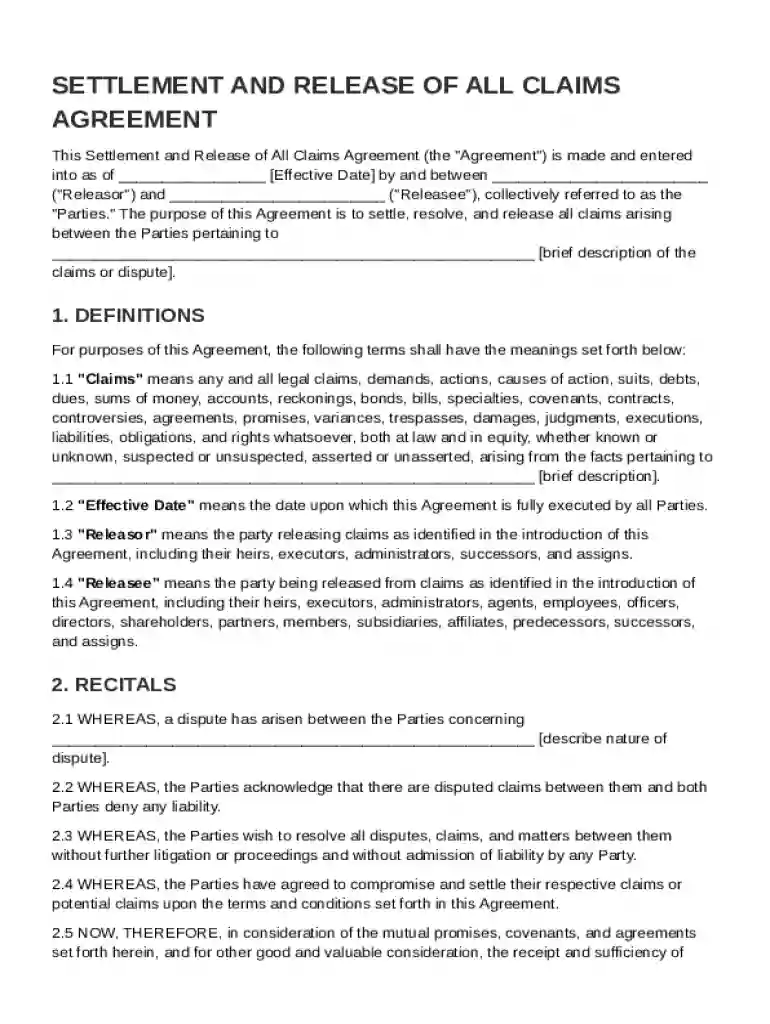
A Settlement and Release of All Claims Agreement Template is a legal document used between two parties, known as the Releasor and the Releasee, to amicably resolve a dispute without admitting liability. This agreement ensures that all claims related to the given dispute are settled, and both parties agree not to pursue further legal actions.
Key Components
- Releasor and Releasee: Clearly identifies the parties involved in the dispute.
- Claims: Outlines the specific claims being released and settled within the agreement.
- Dispute Description: Provides context around the dispute and the resolution achieved through the agreement.
- Confidentiality and Non-Disparagement: Clauses to maintain the privacy of the agreement terms and prevent negative public statements about either party.
Key Elements of the Settlement and Release of All Claims Agreement Template
Understanding the core elements within this template is crucial to ensure that the agreement is comprehensive and legally sound.
Settlement Payment
- Amount: Specifies the monetary amount to be paid by the Releasee to the Releasor.
- Timeline: Details the payment schedule or deadline for settlement completion.
- Method: Outlines the accepted payment methods, such as bank transfer or check.
Confidentiality Obligations
- Scope: Defines what information is covered under the confidentiality agreement.
- Duration: Specifies how long the confidentiality terms remain in effect.
- Exceptions: Lists any scenarios in which disclosure may be permitted, such as legal obligations.
Governing Law
- Jurisdiction: Indicates which state's laws govern and interpret the agreement.
Severability
- Clause Purpose: Ensures that if one part of the agreement is found invalid, the remaining sections continue to be enforceable.
Steps to Complete the Settlement and Release of All Claims Agreement Template
Follow these steps to efficiently fill out the template, ensuring accuracy and completeness:
- Identify Parties: Clearly enter the names and contact information of both the Releasor and Releasee.
- Describe the Dispute: Provide a concise yet comprehensive description of the dispute being settled.
- Outline Settlement Payment: Specify the agreed-upon settlement amount and payment conditions.
- Include Confidentiality Clauses: Draft clauses that clarify the confidentiality obligations of both parties.
- Final Review: Conduct a thorough review to ensure all details are accurate before signing.
Legal Use of the Settlement and Release of All Claims Agreement Template
The legal significance of this template lies in its capacity to lawfully finalize disputes and prevent future litigation.
Compliance with Laws
- ESIGN Act: Allows electronic signatures on the agreement to be recognized as legally binding.
- U.S. State Laws: Adheres to specific state requirements, providing a robust framework for dispute settlement.
Important Terms Related To Settlement and Release of All Claims Agreement Template
Familiarizing oneself with the essential terms ensures precise interpretation and application of the agreement.
Common Terms to Understand
- Releasor and Releasee: Parties involved in the agreement, where the Releasor releases any claims against the Releasee.
- Consideration: The compensation provided for the release of claims.
- Mutuality: Indicates that both parties agree on the terms and the abandonment of further claims.
State-Specific Rules for the Settlement and Release of All Claims Agreement Template
While the template provides a general structure, specific states may have particular rules or additional requirements.
State Variations
- Additional Clauses: Some states might require additional clauses addressing state-specific legal stipulations.
- Notarization Requirements: States like California may require notarization for added validity.
Examples of Using the Settlement and Release of All Claims Agreement Template
These examples highlight how the form can be applied across different scenarios to resolve disputes.
Practical Scenarios
- Workplace Conflicts: Used between an employee and employer to settle workplace disputes without further litigation.
- Construction Disputes: Helps resolve disagreements regarding contract terms or delivered services without affecting long-term business relationships.