
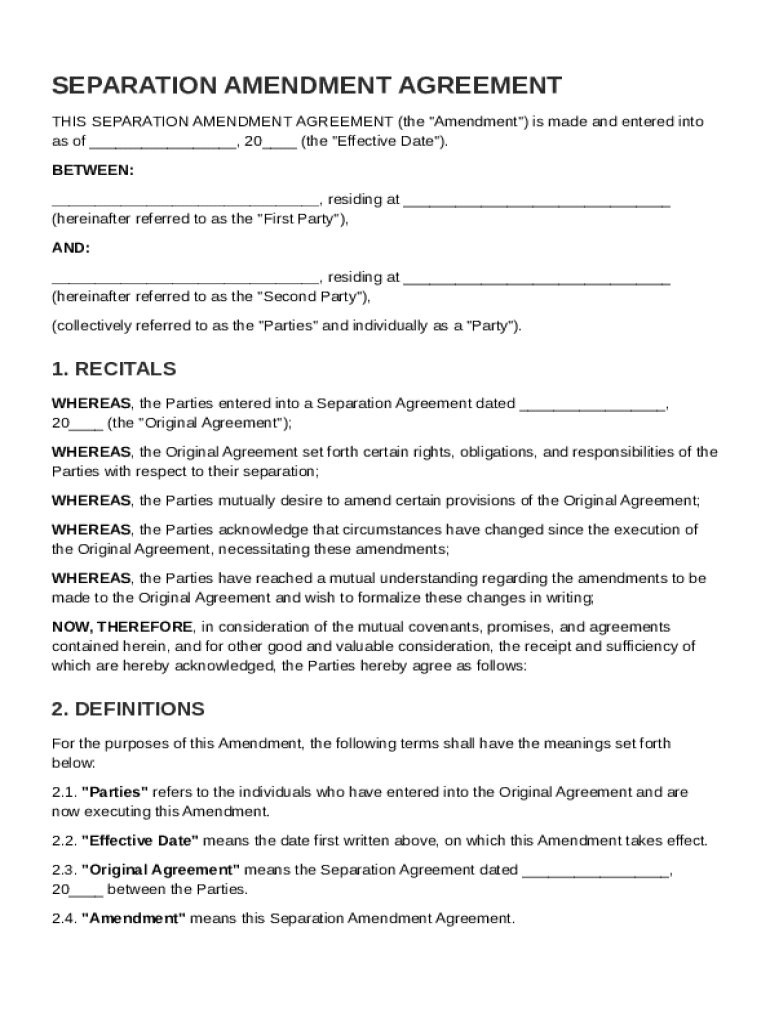







Definition & Meaning
The Separation Amendment Agreement Template is a legal document designed to outline any modifications to an existing Separation Agreement between two parties. This document is essential for formalizing changes in previously agreed-upon terms. It includes amendments, the rationale behind them, and confirms mutual consent and legal compliance. The template ensures that except for specified amendments, all other terms of the original agreement remain unchanged. This document serves as a crucial tool for maintaining clarity and legal validity in evolving relationships between parties who have previously entered a separation agreement.
Key Elements of the Separation Amendment Agreement Template
Several key elements are typically included in a Separation Amendment Agreement Template, ensuring all modifications are clearly articulated and legally binding:
- Introduction and Recitals: Outlines the original agreement date, involved parties, and the purpose of the amendment.
- Amendment Clauses: Detailed description of each amendment to the original agreement, including modified terms and their implications.
- Effective Date: Specifies when the amendments take effect, providing a clear timeline for implementation.
- Legal Authority and Mutual Consent: Confirms that both parties have the legal capacity to amend the agreement and that changes are made with mutual consent.
- Remainder Subject to Original Agreement: States that unchanged terms of the original agreement remain in effect, ensuring continuity.
- Signatures: Requires both parties to sign the document to validate the modifications formally.
How to Use the Separation Amendment Agreement Template
Utilizing the Separation Amendment Agreement Template involves several key steps to ensure amendments are recorded accurately and legally binding:
- Identification and Preparation: Identify the relevant sections of the original Separation Agreement needing amendments. Gather relevant information and supporting documents that justify the proposed changes.
- Customization: Customize the template to reflect specific amendments, ensuring all new clauses are clearly stated.
- Verification: Review each amendment with legal advisors to confirm compliance with applicable laws and the integrity of legal language.
- Draft Approval: Ensure both parties mutually agree to the proposed amendments. Discuss and make adjustments if necessary.
- Execution: Both parties sign the document, officially incorporating the amendments into the existing agreement.
- Distribution and Recordkeeping: Distribute copies to both parties and retain for personal records and future reference.
Legal Use of the Separation Amendment Agreement Template
The legal use of the Separation Amendment Agreement Template prioritizes ensuring compliance with U.S. laws. Important considerations include:
- State Laws: Each U.S. state may have specific legal requirements when it comes to amendments in legal agreements.
- Notarization and Witness Requirements: Depending on state laws, notarization or the presence of witnesses during signing may be mandatory.
- Legal Advice: It is advisable to seek legal advice to ensure the amendments comply with local statutes and regulations.
- Binding Nature: Once signed, the agreement becomes legally binding, so precise language and mutual understanding are critical.
State-Specific Rules for the Separation Amendment Agreement Template
While the Separation Amendment Agreement Template is generally applicable across the United States, variations exist depending on state-specific laws:
- Property Division and Alimony: States like California have community property laws affecting amendments, whereas others follow equitable distribution.
- Child Support and Custody: Modifications involving children often require court approval or adhere to state criteria ensuring the child's best interests.
- Notarization Requirements: Some states mandate notarization to validate amendments in legal agreements, providing additional legal security.
Understanding these variations ensures compliance and prevents future disputes.
Steps to Complete the Separation Amendment Agreement Template
Completing the Separation Amendment Agreement Template requires attention to detail and a comprehensive approach:
- Review Existing Agreement: Understand the sections subject to modifications.
- Drafting Amendments: Write out specific amendments, including all necessary changes in text.
- Legal Verification: Consult with an attorney to verify amendments for consistency with applicable laws.
- Draft Review by Both Parties: Allow both parties to review and discuss the amendments to reach a mutual understanding.
- Formal Agreement and Execution: Facilitate a meeting for both parties to sign the document.
- Submission to Relevant Authorities: If necessary, submit to appropriate legal authorities or registries depending on state requirements.
Who Typically Uses the Separation Amendment Agreement Template
The template is commonly used by individuals and entities involved in legally binding Separation Agreements:
- Divorced or Separating Couples: Individuals who need to update their existing separation terms, such as custody arrangements or property divisions.
- Business Partners: Business partners separating and needing to modify partnership dissolution terms.
- Attorneys and Legal Professionals: Assisting clients in formalizing changes to separation agreements.
- Family Law Practitioners: For creating templates tailored to client-specific scenarios while ensuring compliance with relevant laws.


Important Terms Related to Separation Amendment Agreement Template
Understanding specific terms is crucial when working with the Separation Amendment Agreement Template:
- Amendment: Refers to a change or addition made to the original agreement.
- Effective Date: The date upon which the amendments become enforceable.
- Mutual Consent: Agreement by both parties to the terms of the amendment.
- Legal Capacity: The capability of parties to engage in a binding contract.
- Compliance: Adhering to all relevant laws and regulations governing the agreement.
Acquaintance with these terms ensures clarity and accuracy in executing the amendment process effectively.




