
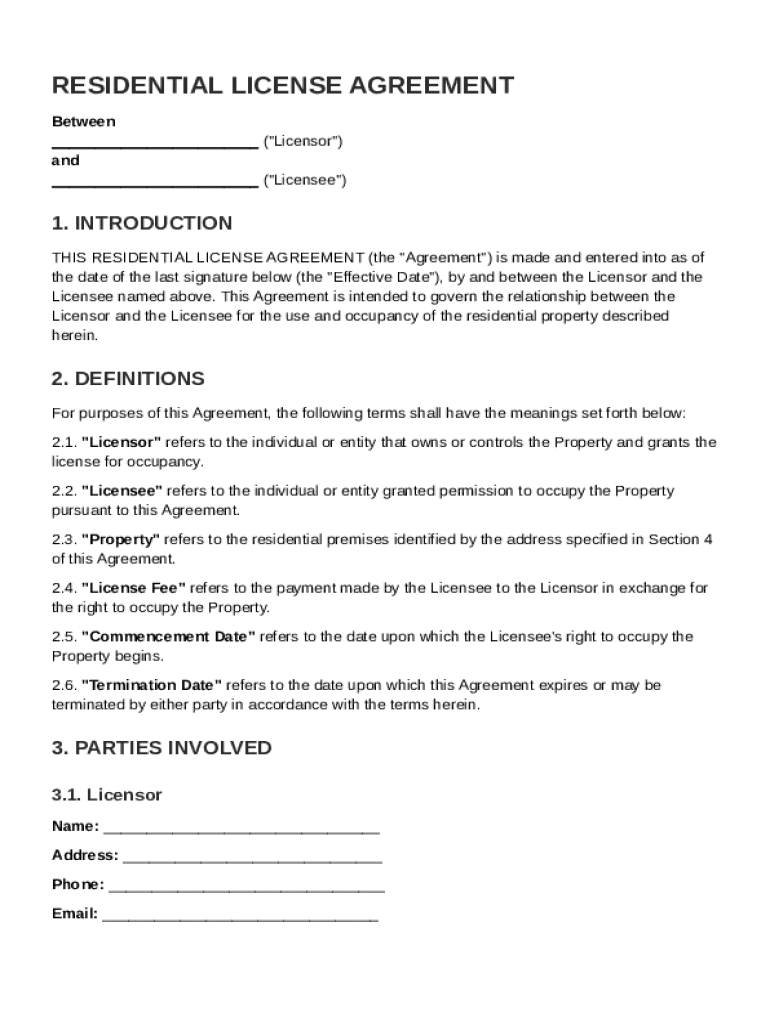







Definition & Meaning
A Residential License Agreement Template outlines the legal arrangement between a Licensor, the property owner, and a Licensee, often a tenant, for the use of residential property. Unlike traditional leases, this agreement provides a license, which means it permits the Licensee to use the property without transferring exclusive possession. It's crucial for differentiating between short-term occupancy scenarios where control over the property remains with the Licensor. Examples include vacation rentals or temporary housing arrangements.
Key Distinctions from Lease Agreements
- Non-exclusive possession: A license grants permission to occupy rather than possess, meaning the Licensor retains control.
- Termination conditions: Typically more flexible than lease agreements, allowing easier termination by either party.
- Legal implications: Because it is not a lease, certain statutory tenant protections do not apply.
How to Use the Residential License Agreement Template
To effectively utilize the Residential License Agreement Template, one must understand its structural elements and how they cater to varying scenarios of occupancy. It serves as a framework to outline terms and ensure mutual understanding.
Step-by-Step Instructions
- Download the Template: Access the document through DocHub to ensure compatibility with your digital workflow.
- Fill in Details: Input specific details about the property, both parties’ information, and the scope of the license.
- Customize Provisions: Adjust clauses to reflect responsibilities, usage conditions, and license fee specifics.
- Add Conditions: Include any special conditions or restrictions pertinent to the use of the property.
- Review Legal Requirements: Confirm that the agreement adheres to local laws and property regulations.
- Electronic Signature: Utilize DocHub’s e-signature feature to sign and collect signatures securely and legally.
Key Elements of the Residential License Agreement Template
A comprehensive Residential License Agreement Template should meticulously detail the roles and responsibilities of both Licensor and Licensee.
Essential Components
- Property Description: Clearly identifies the residential property covered by the license.
- Parties Involved: Names and contact information of the Licensor and Licensee.
- License Term: Specifies the duration of occupancy, including start and end dates.
- License Fee: Details on the amount, payment schedule, and method.
- Rights and Obligations: Outline what each party is permitted and obligated to do.
- Termination Clause: Stipulates conditions under which the license agreement can be prematurely ended.
- Dispute Resolution: Process and conditions for resolving disputes between parties.
Legal Use of the Residential License Agreement Template
Understanding the legality and correct use of the Residential License Agreement Template is critical for its enforceability. It must align with both federal and state regulations to ensure lawful execution.
Compliance and Enforcement
- Adherence to Local Laws: Tailor the agreement to comply with state-specific regulations and local statutes.
- Federal Compliance: Ensure the agreement respects federal housing standards.
- Changes in Law: Regularly update the agreement to reflect any changes in applicable legal requirements.
Important Terms Related to Residential License Agreement Template
Navigating a Residential License Agreement Template requires familiarity with specific terminology that clarifies the framework of the agreement.
Common Terms and Definitions
- Licensor/Licensee: Parties involved, where the Licensor grants rights and the Licensee receives them.
- License Fee: Payment by the Licensee for the use of the property.
- Occupancy: Conditions under which the Licensee can use the property.
- Sub-license: Permission or prohibition of the Licensee’s ability to extend the license to another party.
- Default: Consequences of either party failing to meet their obligations.
State-Specific Rules for the Residential License Agreement Template
Each state may have unique regulations affecting how Residential License Agreements are drafted and enforced. Adjusting for regional law is essential for compliance.
Notable Variations
- California: Requires energy and water disclosures.
- New York: Specific notice period requirements for termination.
- Florida: Distinct rules around short-term rental usage.
Steps to Complete the Residential License Agreement Template
Completing a Residential License Agreement Template involves a structured approach to ensure all necessary elements are appropriately addressed and documented.
Comprehensive Completion Process
- Initial Information Gathering: Collect detailed information about the property and parties.
- Customizing Terms: Modify sections to fit the specific requirements of the transaction.
- Verification: Cross-check details with local laws and regulations.
- Approval: Share the draft with both parties for review and comments.
- Finalization: Make necessary revisions based on feedback received.
- Execution: Sign electronically using secured methods provided by DocHub.
Who Typically Uses the Residential License Agreement Template
Understanding the typical users of this template helps identify its relevance and applicability across various sectors.


User Profiles
- Property Managers: To facilitate short-term or non-traditional residential arrangements.
- Real Estate Agents: Often use the template for clients requiring licensing agreements versus leasing.
- Homeowners: Who rent part of their property temporarily as vacation rentals or guest houses.
By tailoring this agreement to specific contexts and users, the template becomes a valuable tool for various residential occupancy scenarios, offering flexibility and legal coverage.




