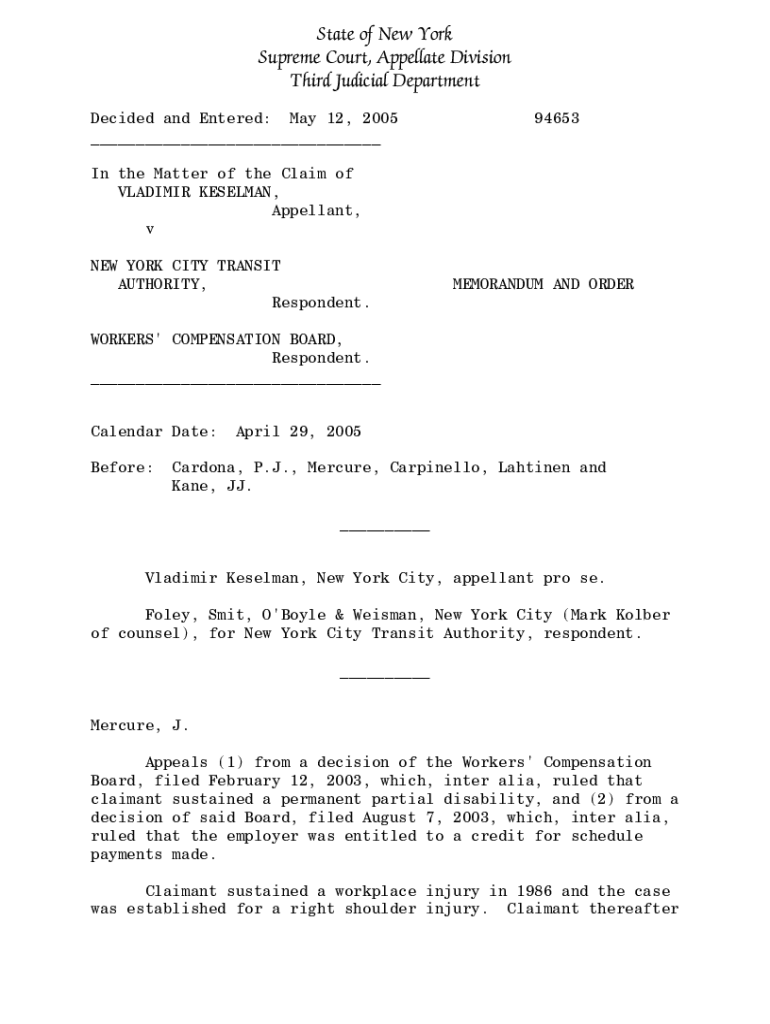







Definition & Meaning
The term "Matter of Johnson v City of New York - State Government Sites" refers to a legal proceeding documented across various New York State government websites. It encapsulates the specific case between an individual, likely named Johnson, and the City of New York. This type of documentation is integral for understanding verdicts, legal precedents, and procedural details within the judicial system of New York. The case likely involves significant legal debates or issues of public interest, thus warranting attention from both legal professionals and the general public.
How to Use the Matter of Johnson v City of New York - State Government Sites
For individuals or legal professionals, utilizing information from this case document can provide insights into specific legal precedents. When preparing a related legal argument or studying case law, one can:
- Review the contextual details and legal arguments presented in the case.
- Analyze the court's reasoning and final judgment for perspective on similar legal issues.
- Reference citations, precedents, and applications of law within your own legal framework.
Steps to Complete the Matter of Johnson v City of New York - State Government Sites
While individual cases do not require "completion" in the traditional sense, accessing and understanding them involves several steps:
- Visit appropriate New York State government websites that host legal documents, such as the court system or appellate division sites.
- Use search functions to locate the specific case by title or case number, if known.
- Download or view the full text of the ruling to analyze the decisions and legal implications comprehensively.
Important Terms Related to Matter of Johnson v City of New York
Navigating a legal document often involves understanding specific terminologies:
- Plaintiff: The party who initiates the lawsuit.
- Defendant: The party being sued or accused in the lawsuit.
- Appellate Division: A higher court reviewing the decisions of a lower court.
- Precedent: Earlier cases used as a benchmark for deciding similar subsequent cases. These terms are vital for grasping the structure and outcomes of the case proceedings.
State-Specific Rules for the Matter of Johnson v City of New York
Understanding the legal framework specific to New York State is crucial:
- New York's laws and procedural requirements may differ from other states, impacting the handling and outcomes of such cases.
- The state follows its own rules regarding the submission of evidence, procedural timelines, and appeals processes.
Examples of Using the Matter of Johnson v City of New York
Studying case precedents like "Matter of Johnson v City of New York" can be crucial:
- In legal education, students analyze such cases to understand the application of law.
- Lawyers reference these cases in briefs to support arguments relating to municipal governance or citizen rights.
Required Documents
To delve into this case, specific documents may be needed:
- The court’s memorandum and order.
- Records or transcripts from lower court proceedings. Such documents aid in a comprehensive understanding of the case dynamics.
Who Issues the Form
Legal forms and documentation related to this case are issued by the New York State Supreme Court or its Appellate Division. These bodies are responsible for documenting and publicizing the case outcomes for public record and legal reference.
Penalties for Non-Compliance
In cases involving non-compliance with court rulings or procedural requirements, various penalties may apply:
- Fines may be imposed for contempt of court.
- In civil cases, judgments may result in financial liabilities. These penalties serve as deterrents and ensure adherence to legal obligations.
Digital vs. Paper Version
Legal documents from the "Matter of Johnson v City of New York" can often be found in both digital and paper formats:
- Digital versions are accessible via online legal databases or state court websites.
- Paper formats might be procured from court archives or legal libraries. Each format serves different accessibility needs depending on the user's preference and resources.