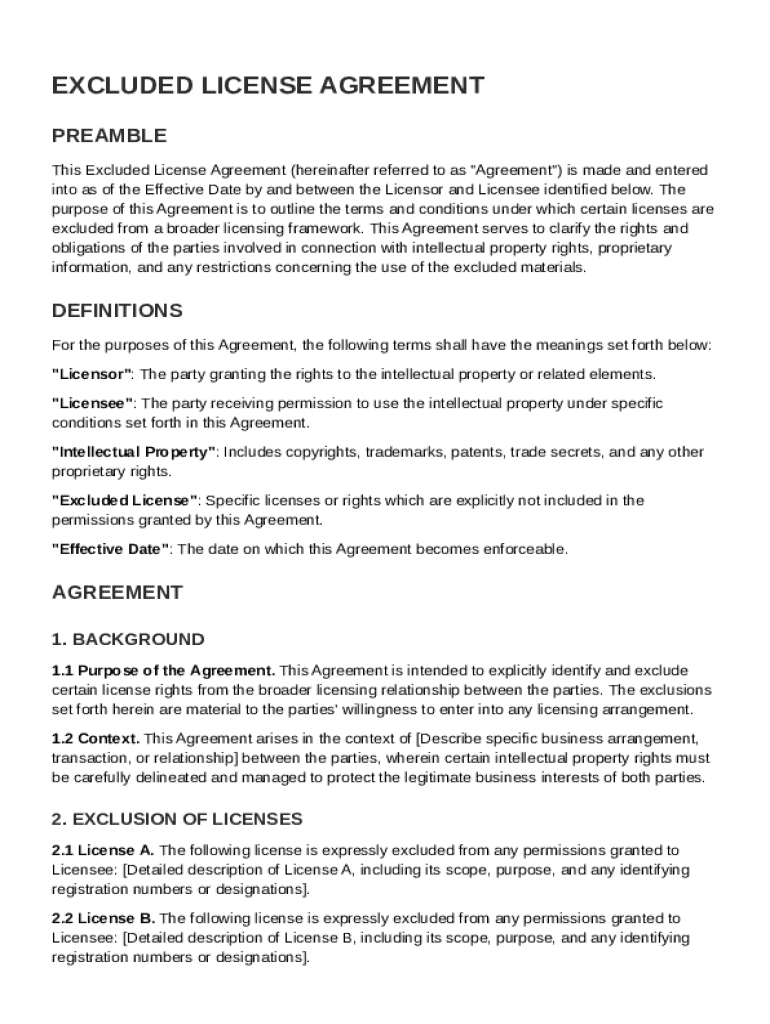







Definition and Meaning of Excluded License Agreement Template
An Excluded License Agreement Template is a legal document framework tailored to outline the specifics of licenses that are purposefully excluded from a larger licensing framework between parties commonly referred to as the Licensor and the Licensee. This template is invaluable for defining the scope of such exclusions in a clear and comprehensive manner. Key sections typically include descriptions of rights and obligations pertaining to the intellectual property involved, ensuring that both parties have a mutual understanding of what is excluded from the general licensing terms. This document also addresses confidentiality commitments, thereby securing sensitive information, and sheds light on indemnification and termination conditions, which are critical to safeguarding the interests of both parties involved.
How to Use the Excluded License Agreement Template
Using the Excluded License Agreement Template involves several strategic steps to ensure that it fits the unique requirements of your licensing arrangement. Start by identifying the licenses you intend to exclude from the main agreement. Importantly, every excluded license should be defined with sufficient detail to avoid any ambiguities. Owners of intellectual property must be specific about the rights being withheld from the broader agreement, which might include usage rights, distribution rights, or modification rights among others. Ensure that conditions under which these licenses can be revisited or renegotiated are also stipulated. Once filled, review the document to confirm that all necessary exclusions have been adequately covered—a key step in maintaining legal clarity and avoiding future disputes.
Steps to Complete the Excluded License Agreement Template
- Identifying the Parties: Clearly list the contact information and legal names of the Licensor and Licensee. Verifying these details can prevent errors that might complicate enforcement.
- Detailing Exclusions: Enumerate each excluded license with precision, including applicable terms and limitations.
- Defining the Rights and Obligations: Specify the rights the Licensee will not have and the responsibilities of both parties pertaining to the excluded licenses.
- Addressing Confidentiality: Include clauses that protect any proprietary information related to the excluded licenses.
- Discussing Indemnification and Termination: Clearly define conditions under which the agreement may be terminated and indemnification requirements in case of disputes.
- Review and Signature: Both parties should review the filled template, consult legal counsel if necessary, and sign to indicate acceptance.
Key Elements of the Excluded License Agreement Template
- Intellectual Property Rights: Central to this template, ensuring detailed explanations of the excluded rights, and the scope of their usage or restriction is crucial.
- Confidentiality Clauses: These provisions protect sensitive information and are particularly important in industries where proprietary technologies or methodologies may be involved.
- Indemnification and Liability: Define how each party will protect the other against legal claims arising from the usage of excluded licenses.
- Termination Conditions: Specific scenarios under which the agreement may be terminated should be clearly outlined, possibly including breach of any agreement terms or mutual consent.
Legal Use of the Excluded License Agreement Template
The legal use of this template hinges on its ability to delineate specific exclusions that prevent misunderstandings or misinterpretations about the scope of the main licensing agreement. Notably, it must adhere to general contract law principles such as consideration, capacity, legality, and mutual consent. Properly executed, the template acts as a binding document enforceable in court, providing legal certainty and protection to both licensee and licensor regarding the terms of the exclusion. Furthermore, these agreements may include state-specific requirements or enactments, so legal consultation is advisable to ensure compliance with relevant jurisdictional laws.
Who Typically Uses the Excluded License Agreement Template
The Excluded License Agreement Template is most commonly used by businesses and individuals involved in intellectual property sectors, such as technology firms, creative companies, and startups that wish to protect select rights while engaging in broader partnerships or licensing agreements. By strategically excluding certain licenses, these businesses can maintain proprietary control over key components of their technology or products, while still collaborating with other entities. This is particularly useful for companies that operate in software development, product design, or media content creation where intellectual property is a major asset.

Important Terms Related to Excluded License Agreement Template
- Licensor: The party granting the license, typically the owner of the intellectual property.
- Licensee: The party receiving the license and the associated rights, with specific exclusions.
- Confidential Information: Data or knowledge that must remain undisclosed to protect the integrity of the business or its competitive position.
- Indemnification: A security mechanism through which one party agrees to cover the potential losses/damages incurred by the other party as a result of specific events.
State-specific Rules for the Excluded License Agreement Template
Different states in the U.S. may impose varying rules and interpretations regarding licensing agreements. For instance, states like California have specific laws regarding software and trade secrets that could impact terms related to confidentiality and intellectual property rights. Before finalizing an Excluded License Agreement Template, reviewing state-specific statutes regarding intellectual property and contract law is essential. Legal counsel specialized in state laws can offer valuable insights into ensuring that the agreement fully complies with local regulations, thereby securing stronger enforceability.
Practical Examples of Using the Excluded License Agreement Template
Imagine a software company that licenses a platform to a service provider but chooses to retain exclusive rights over a new feature under development. By using the Excluded License Agreement Template, the company can formally document this exclusion, ensuring that the service provider is unable to use or distribute the new feature. Similarly, a design firm may license their portfolio to a third party for marketing purposes but exclude designs in specific categories to retain market advantage. These scenarios illustrate how the template can be tailored to protect strategic resources while maintaining flexible business relationships.