Shipper s Declaration for Section Ii Lithium Cells Batteries 2026

Get Form
Shipper s Declaration for Section Ii Lithium Cells Batteries Preview on Page 1

Here's how it works

01. Edit your form online
Type text, add images, blackout confidential details, add comments, highlights and more.

02. Sign it in a few clicks
Draw your signature, type it, upload its image, or use your mobile device as a signature pad.

03. Share your form with others
Send it via email, link, or fax. You can also download it, export it or print it out.

Definition & Meaning

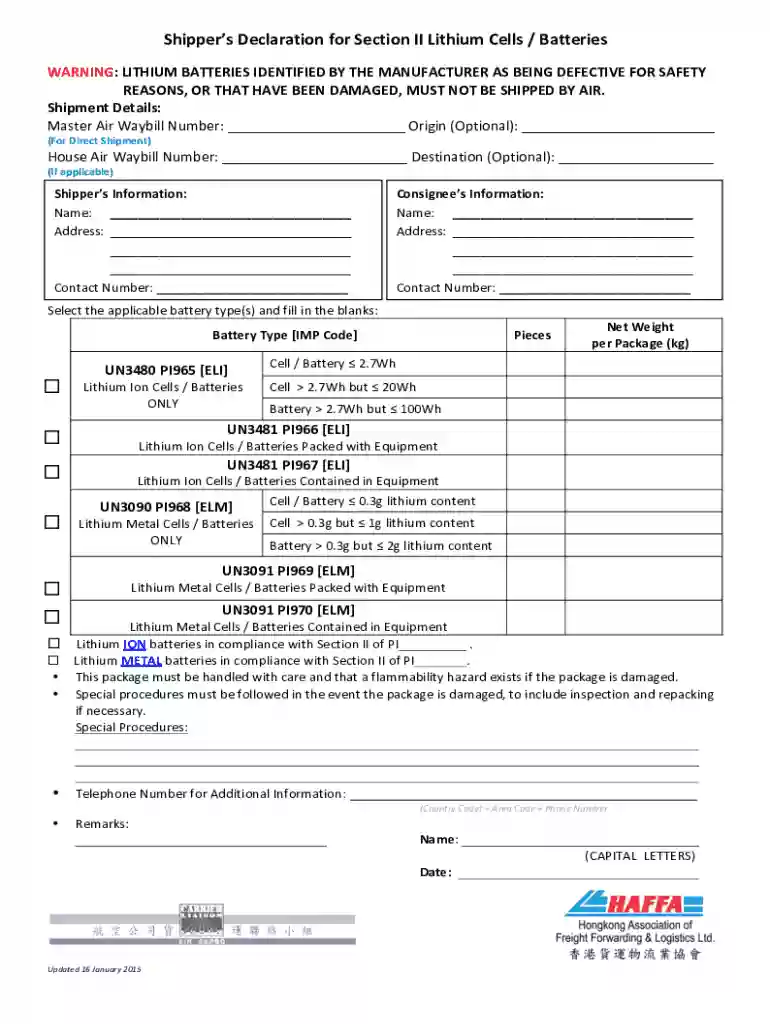
The "Shipper's Declaration for Section II Lithium Cells Batteries" is a crucial document used for the safe transportation of lithium cells and batteries. Its main purpose is to ensure safety by detailing the conditions under which lithium batteries are shipped, highlighting any potential risks associated with faulty or damaged units. As these batteries are sensitive to handling and environmental changes, the declaration ensures all safety measures are adhered to, guarding against incidents during transit.

Practical Examples of Use

  • Bulk Shipping: When a company needs to transport a large quantity of lithium batteries internationally, the declaration is used to inform the carrier and customs of the shipment's contents.
  • Consumer Electronics: For businesses sending devices that contain lithium batteries, such as smartphones or laptops, within the U.S., this document ensures compliance with safety guidelines.

Steps to Complete the Shipper's Declaration

Completing the Shipper's Declaration involves several key steps to ensure all information is properly recorded. Here is a detailed step-by-step guide to filling out the form:

  1. Gather Necessary Information: Before starting, collect all relevant details, including shipper's and consignee's details, battery type, quantity, and weight.

  2. Enter Shipper and Consignee Information: Provide full names, addresses, and contact details for both the shipper and the consignee in the designated sections.

  3. Specify Battery Details: Include the type of lithium battery, whether lithium-ion or lithium metal, and provide additional specifications such as watt-hour rating and lithium content.

  4. Outline Packaging and Handling: Describe the packaging used to ensure battery safety and any special handling procedures to be followed during shipment.

  5. Review and Sign: After filling out all relevant sections, review the document for accuracy before signing. Ensure that all declarations meet the legal standards set by relevant agencies.

Common Mistakes to Avoid

  • Incomplete Information: Leaving out key details such as battery weight or consignee address can delay the shipment.
  • Incorrect Battery Specifications: Misreporting battery type or watt-hour rating can lead to non-compliance with shipping regulations.

Why Use the Shipper's Declaration for Section II Lithium Cells Batteries

Utilizing the Shipper's Declaration is essential for several reasons:

  • Regulatory Compliance: Ensures adherence to international shipping laws and regulations concerning the transport of hazardous goods.
  • Safety Assurance: Provides a framework for safe handling, mitigating risks of shipping dangerous goods.
  • Operational Efficiency: Streamlines the shipping process by offering clear guidelines and reducing shipment delays caused by non-compliance.

Benefits to Businesses

  • Reputation Management: By regularly using the correct forms, businesses can maintain strong relationships with carriers and customers, showcasing commitment to safety and compliance.
  • Risk Mitigation: Proper documentation reduces the likelihood of accidents related to improper handling or packaging.

Key Elements of the Shipper's Declaration

There are several critical elements to the Shipper's Declaration form that ensure comprehensive information is provided:

  • Shipper and Consignee Details: Basic identity and contact information for both parties involved in the shipment.
  • Battery Specifications: Information regarding the type, size, and packaging of the lithium batteries being shipped.
  • Handling Instructions: Any special procedures necessary for safely handling the shipment during transit.

Handling Instructions

  • Special Procedures: Instructions might include specific temperature requirements or prohibitions on stacking that could impact battery integrity.
  • Emergency Contacts: Providing contact information for technical support or emergency response teams in the event of an incident.

Who Typically Uses the Shipper's Declaration

This document is commonly used by various entities involved in the logistics and electronics sectors:


  • Manufacturers: Companies producing electronics often need to ship products containing lithium batteries safely.
  • Logistics Providers: Firms specializing in shipping dangerous goods utilize these declarations to ensure safe transportation.
  • Retailers: Businesses selling products with embedded batteries may need to provide this document for compliance in international sales.
decoration image ratings of Dochub

Specific Industries

  • Aerospace: Due to stringent air transport regulations, aerospace companies ensure compliance through complete documentation.
  • Consumer Electronics: Market leaders in this sector rely heavily on this declaration to ship products globally and domestically.

Legal Use of Shipper's Declaration for Section II Lithium Cells Batteries

From a legal perspective, the Shipper's Declaration is a mandatory document in compliance with various regulations:

  • International Air Transport Association (IATA): Airlines require adherence to IATA guidelines regarding the shipment of batteries.
  • U.S. Department of Transportation (DOT): Regulates domestic transportation, requiring precise documentation to ship hazardous materials safely.

Implications of Non-Compliance

  • Fines and Penalties: Breaching shipping regulations can result in significant fines and reputational damage.
  • Shipment Delays: Non-compliance can result in the cargo being held at customs, causing potential business disruptions.

Form Variants and Alternatives

Different regions and transportation modes may require variant forms or documentation adjustments:

  • IATA-Compatible Forms: For international air shipments, ensure the Shipper's Declaration aligns with IATA standards.
  • Alternative Documentation for Ground Transport: Shipping by road within the U.S. might involve different documentation requirements under DOT guidelines.

Benefits of Using Appropriate Variants

  • Adaptability: Using variant forms ensures conformance with specific transportation modes, thereby reducing risk.
  • Comprehensive Coverage: Some shipments might require multiple declarations to address different regulatory needs simultaneously.

Digital vs. Paper Version

The form's availability in both digital and paper formats allows flexibility in how businesses can manage their shipping documentation:

  • Digital Format: Enables quick, efficient completion and easy sharing with involved parties, particularly useful for companies with digital-first processes.

Advantages of Digital Format

  • Efficiency: Simplifies document storage, retrieval, and sharing.

  • Environmentally Friendly: Reduces paper use, aligning with sustainability goals.

  • Paper Format: Still used widely where digital access is limited or in traditional settings.

Paper Format Considerations

  • Accessibility: Useful where digital tools are not available or practical.
  • Verification: Provides a tangible record that some businesses might prefer for archival purposes.

See more Shipper s Declaration for Section Ii Lithium Cells Batteries versions

We've got more versions of the Shipper s Declaration for Section Ii Lithium Cells Batteries form. Select the right Shipper s Declaration for Section Ii Lithium Cells Batteries version from the list and start editing it straight away!
Versions Form popularity Fillable & printable
2015 4.3 Satisfied (52 Votes)
2012 4.6 Satisfied (47 Votes)
be ready to get more

Complete this form in 5 minutes or less

Get form

Got questions?

We have answers to the most popular questions from our customers. If you can't find an answer to your question, please contact us.
Contact us
What hazard labels are required? For fully regulated shipments, the Class 9 Lithium Battery label is required.
Substances with a Class 9 label are considered miscellaneous dangerous goodsand that includes lithium batteries. Fully regulated lithium battery shipments (such as those under Section IA) must display this label on the outside of the package.
Batteries must be placed in rigid outer packaging (unless contained in equipment) and inner packaging must be designed to prevent short circuits (non-conductive materials) and damage to the batteries. The device must have positive method to prevent accidental activation in transport. Package must not exceed 66lbs.
Class 9 Dangerous Goods Label Substances with a Class 9 label are considered miscellaneous dangerous goodsand that includes lithium batteries. Fully regulated lithium battery shipments (such as those under Section IA) must display this label on the outside of the package.
Labeling for UN3481 shares similarities with UN3480 but includes additional aspects. Each package should have a Class 9 label showing it contains dangerous goods. Moreover, using the UN3481 label is necessary to indicate the correct classification of the lithium-ion batteries packed with equipment.

Security and compliance

At DocHub, your data security is our priority. We follow HIPAA, SOC2, GDPR, and other standards, so you can work on your documents with confidence.
Learn more
ccpa2
pci-dss
gdpr-compliance
hipaa
soc-compliance

People also ask

The mark must indicate UN3481 for lithium-ion cells or batteries packed with equipment. Where a package contains lithium cells or batteries assigned to different UN numbers, all applicable UN numbers must be indicated. The mark must also include a telephone number for those who need to obtain additional information.
Yes. Lithium batteries are considered hazardous materials and dangerous goods that require special UN3481 labels, packaging, and forms for safe and compliant transport.

Related links