Marketing Collaboration Agreement Template 2026

Get Form
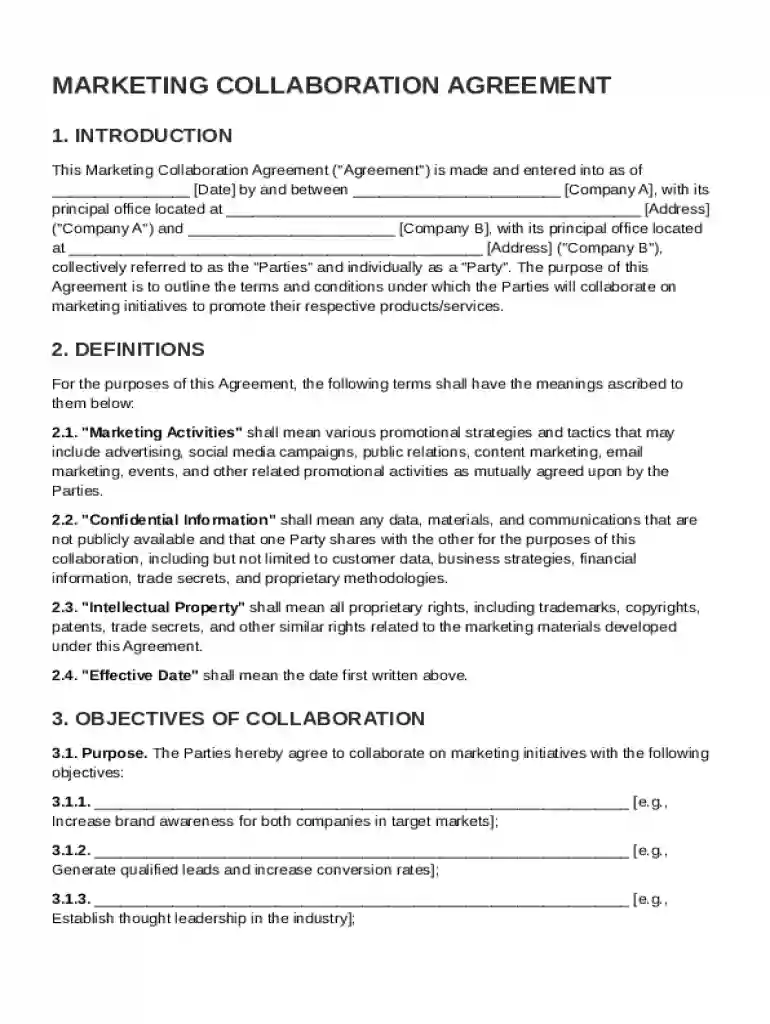
Marketing Collaboration Agreement Template Preview on Page 1

Here's how it works

01. Edit your form online
Type text, add images, blackout confidential details, add comments, highlights and more.

02. Sign it in a few clicks
Draw your signature, type it, upload its image, or use your mobile device as a signature pad.

03. Share your form with others
Send it via email, link, or fax. You can also download it, export it or print it out.

Definition and Meaning

A Marketing Collaboration Agreement Template is a structured document outlining the terms and arrangement between two parties aiming to collaborate on marketing initiatives. This agreement lays the groundwork for mutual engagement by specifying objectives, roles, financial stipulations, intellectual property rights, confidentiality obligations, and dispute resolution mechanisms. Its purpose is to enhance brand exposure, boost lead generation, and solidify thought leadership while ensuring security and privacy of shared intellectual assets.

Key Elements of the Marketing Collaboration Agreement Template

The template incorporates several core components essential for a seamless collaboration:

  • Objectives: Clearly defined shared goals to assure alignment between the collaborating parties.
  • Roles and Responsibilities: Assigns distinct roles to each party to clarify expectations and prevent conflict during execution.
  • Intellectual Property: Establishes ownership and usage rights for any content or product developed during the collaboration.
  • Confidentiality: Aims to protect sensitive information, ensuring that strategic plans and proprietary data are not disclosed inappropriately.
  • Financial Arrangements: Specifies the financial contributions or revenue-sharing models, ensuring transparency and understanding.
  • Dispute Resolution: Details the process for settling disagreements, promoting conflict resolution without disrupting the partnership.

How to Use the Marketing Collaboration Agreement Template

Using the Marketing Collaboration Agreement Template involves several critical steps:

  1. Initial Review: Each party should thoroughly review the template to ensure it meets their specific needs.
  2. Customization: Modify the clauses to reflect the individual objectives, roles, financial terms, and legal considerations pertinent to the agreement.
  3. Consultation with Legal Experts: Before signing, it's advisable for both parties to seek legal counsel to validate the agreement’s terms and compliance with applicable laws.
  4. Finalization and Signing: Upon agreement by both parties, execute the document with legally binding signatures.
  5. Implementation and Monitoring: Actively manage the collaboration as per the agreed terms and periodically review the arrangement for any necessary adjustments.

Steps to Complete the Marketing Collaboration Agreement Template

Completing a Marketing Collaboration Agreement Template can be broken down into these actionable steps:

  1. Identify Parties Involved: Clearly name both entities involved in the partnership.
  2. Detail Objectives and Scope: Include specific marketing goals and a clear scope of the collaboration.
  3. Assign Responsibilities: Clearly outline each party’s responsibilities.
  4. Establish Terms: Specify terms related to financial considerations, intellectual property rights, and confidentiality agreements.
  5. Review and Amend: Jointly review the draft and make necessary amendments.
  6. Seek Legal Approval: Have the agreement reviewed by a legal professional.
  7. Finalize and Sign: Both parties sign and date the agreement to set it into effect.

Important Terms Related to the Marketing Collaboration Agreement Template

Understanding certain terminologies is crucial for correctly utilizing this template:

  • Party A and Party B: Designated names for the entities entering the agreement.
  • Term: The duration for which the agreement is enforceable.
  • Non-Disclosure Agreement (NDA): A clause to protect sensitive information exchanged during the collaboration.
  • Force Majeure: Conditions under which parties may be excused from the agreement due to unforeseen events.
  • Amendment: Procedures for modifying the agreement post-initiation.

Who Typically Uses the Marketing Collaboration Agreement Template

This template is commonly used by:

  • Marketing Agencies: Collaborating with brands or other agencies.
  • Digital Influencers: Engaging with brands for promotional activities.
  • Business Partnerships: Companies coming together to co-promote products or services.
  • Technology Firms: Partnering with marketing consultants for digital marketing strategies.
  • Start-ups: Looking to amplify their reach through strategic alliances with established businesses.
decoration image ratings of Dochub

Legal Use of the Marketing Collaboration Agreement Template

The template’s legal validity is contingent upon:

  • Compliance with Local Laws: Ensuring the agreement aligns with jurisdictional laws.
  • Signatory Authorization: Verifying that parties signing the document have the authority to do so.
  • Adherence to Intellectual Property Laws: Securing intellectual property rights to protect creative outputs.
  • Acknowledgement of Confidential Data: Proper clauses for sensitive data protection are integral to legality.

State-Specific Rules for the Marketing Collaboration Agreement Template

While the template provides a general framework, state-specific regulations might necessitate modifications, especially relating to:

  • Intellectual Property Laws: Different states may have varying laws affecting intellectual property clauses.
  • Contractual Obligations: Variability in enforceability and interpretation of contract law based on jurisdiction.
  • Sales and Tax Regulations: State-specific differences in how financial transactions under the agreement are taxed.
be ready to get more

Complete this form in 5 minutes or less

Get form

Got questions?

We have answers to the most popular questions from our customers. If you can't find an answer to your question, please contact us.
Contact us
Heres what it should encompass: Parties involved. Identify all participants, including their legal names, addresses, and contact details. Project scope. Financial terms. Intellectual property rights. Confidentiality clause. Liability and insurance. Termination conditions. Dispute resolution.
A collaboration agreement is a legally binding contract between two or more parties, aimed at a mutually beneficial project. Sometimes known as a joint venture agreement or strategic alliance agreement, a collaboration agreement is necessary to define each partys roles and responsibilities.
Heres what to include in your agreement: Basic Details. List the names and addresses of each partner and your business. Capital Contributions. Detail what each partner is contributing. Profit and Loss Sharing. Roles and Responsibilities. Decision-Making and Disputes. Banking and Records. Duration and Exit Terms. Signatures.
How to Create a Collaboration Agreement + Free Template Clearly state the goals and scope of the project. Include full legal names, addresses, and contact details of all parties involved (individuals or entities). Specify what each party contributes, such as funds, labor, equipment, intellectual property, or expertise.
You might hear it called a collaborative agreement or collaboration contract, but the aim is the same: to clearly outline each partys roles and responsibilities, ownership of outcomes, how profits or expenses are managed, and what happens if things change along the way.

Security and compliance

At DocHub, your data security is our priority. We follow HIPAA, SOC2, GDPR, and other standards, so you can work on your documents with confidence.
Learn more
ccpa2
pci-dss
gdpr-compliance
hipaa
soc-compliance
be ready to get more

Complete this form in 5 minutes or less

Get form

People also ask

A co marketing agreement allows two or more companies to collaborate on marketing efforts while sharing resources, responsibilities, and results. These agreements help define the scope of the partnership, ownership of created assets, dispute resolution processes, and revenue-sharing models.
An agreement is a formal contract that is legally binding and can be enforced in court, while an MOU is a non-binding document that outlines the general terms and understanding of a relationship.
Use the following guidelines in preparing letters: Keep letters short and to the point. Be specific about the nature of the collaboration or commitment. Usually indicate concrete actions the signer is committed to provide during the project.

Related links