
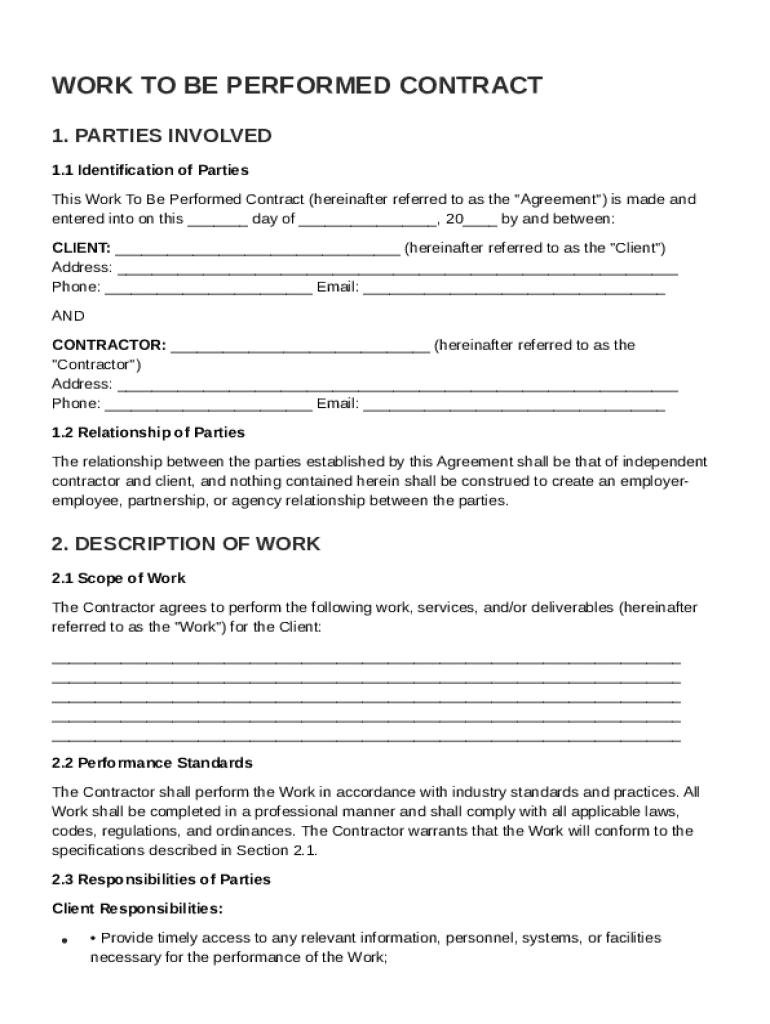







Definition & Meaning
A "Work To Be Performed Contract Template" establishes a clear and detailed agreement between a client and a contractor. This contract outlines various crucial aspects of their professional relationship, ensuring both parties understand their roles and responsibilities. It clearly defines the scope of work, performance standards, and expected deliverables. By setting these parameters, the contract minimizes misunderstandings and provides a framework for project execution and evaluation.
Key Elements of the Work To Be Performed Contract Template
Understanding the components of a Work To Be Performed Contract is essential for its effective use. Essential elements typically include:
-
Scope of Work: Details the specific tasks and responsibilities that the contractor will undertake. This section should be explicit to avoid disagreements later.
-
Timeline: Specifies start and end dates, as well as any critical milestones for project completion.
-
Compensation Structure: Describes how and when the contractor will be paid, including hourly rates, flat fees, or milestone payments. Payment terms should be clear to both parties.
-
Confidentiality Obligations: Ensures that sensitive information remains confidential and details how information will be handled.
-
Termination Conditions: Defines conditions under which the contract can be terminated prematurely by either party.
-
Dispute Resolution Procedures: Outlines steps for resolving conflicts that may arise, including mediation or arbitration processes.
Steps to Complete the Work To Be Performed Contract Template
Successfully completing a Work To Be Performed Contract involves several steps:
-
Gather Necessary Information: Collect all relevant details about the project, including scope, timeline, and financial terms.
-
Customize the Template: Modify the general template to fit the specific needs of your project. Ensure all sections accurately reflect the agreement between parties.
-
Review Legal Terms: Carefully review all legal terms and conditions to ensure compliance with local regulations and laws.
-
Collaborate with the Counterparty: Share the draft with the client or contractor to identify any areas of concern or necessary adjustments.
-
Finalize and Sign: Once all parties agree, sign the contract electronically or manually, ensuring all signatures are legally binding.
Legal Use of the Work To Be Performed Contract Template
The Work To Be Performed Contract Template must be used in compliance with applicable laws and regulations. Key considerations include:
-
Independent Contractor Status: Clearly establish that the contractor is an independent entity, not an employee, to prevent liabilities related to employment regulations.
-
Compliance with Federal and State Laws: Ensure that all terms align with relevant federal and state laws, including labor and contract laws.
-
Enforceability: Make sure the contract includes clauses that are recognized and enforceable under the jurisdiction in which the contract is executed.
Important Terms Related to Work To Be Performed Contract Template
This template involves specific terminology that users must understand:
-
Deliverable: A tangible or intangible product resulting from work undertaken by the contractor, detailed in the scope of work.
-
Milestone: A significant point or event in the project's timeline that necessitates review, approval, or payment.
-
Intellectual Property: Rights associated with creative works produced under the contract, specifying ownership and usage terms.
State-specific Rules for the Work To Be Performed Contract Template
State regulations may affect various elements of the contract:
-
License Requirements: Certain states require that contractors have specific licenses depending on the nature of work being performed.
-
Payment Timelines: States may have laws governing how quickly payments must be made to contractors.
-
Enforcement Clauses: Some states mandate inclusion of specific clauses for contracts to be enforceable.
Examples of Using the Work To Be Performed Contract Template
Exploring real-world scenarios helps illustrate the template's application:
-
Freelance Writing: A publishing company might use the template to hire a freelance writer for a series of articles, defining deadlines, payment, and rights over the content.
-
Construction Project: A client hiring an independent contractor for home renovation would use the template to detail work quality standards and project timelines.
-
IT Consultancy: For a tech project, a business could specify deliverables like a software package along with maintenance duties over a set period.
Digital vs. Paper Version
When considering whether to use a digital or paper version of the contract:
-
Digital Benefits: Faster editing, electronic signatures, and ease of sharing and storing.
-
Paper Format: May still be used for official records or clients preferring traditional methods but involves more handling and storage space.
In both formats, the functionality and legal enforceability remain consistent, though digital versions streamline collaboration and document management.




