






Definition and Meaning of Catanionic Surfactant Vesicles
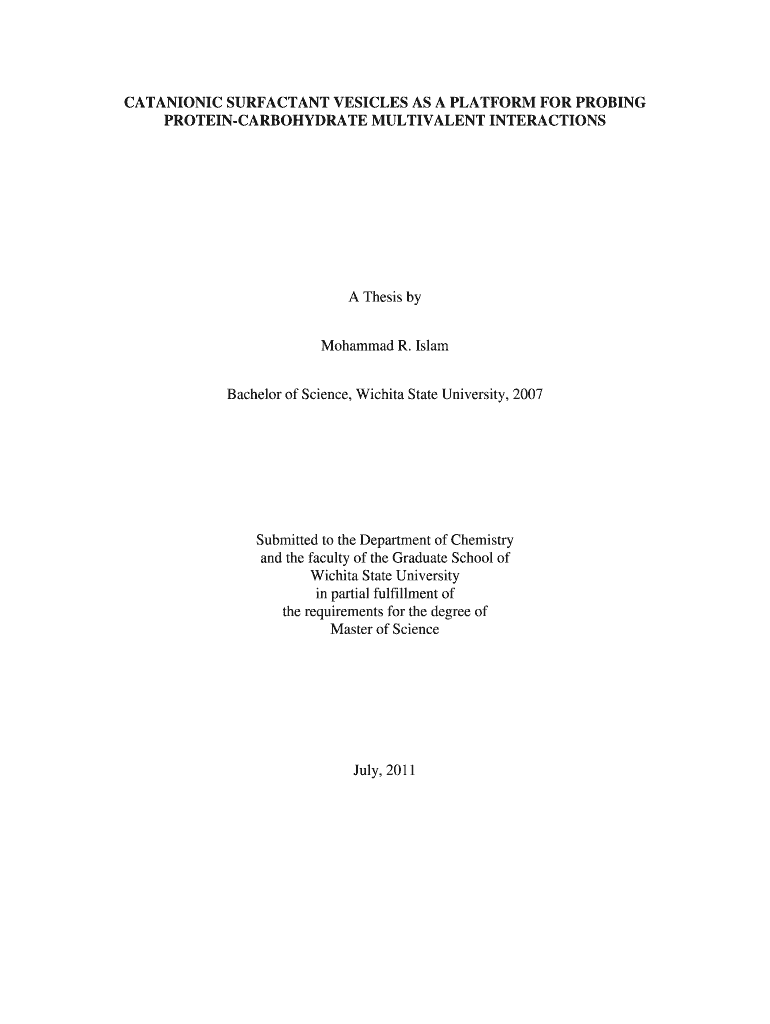
Catanionic surfactant vesicles are self-assembled structures formed by the combination of cationic and anionic surfactants. These structures are unique because of their ability to encapsulate substances, offering a platform for studying biochemical interactions. They serve as a model for understanding protein-carbohydrate multivalent interactions, which are crucial for processes such as cellular recognition and immune response. The significance of these vesicles lies in their potential to mimic biological membranes and facilitate the exploration of binding mechanisms at the molecular level.
How to Use Catanionic Surfactant Vesicles for Probing Interactions
To utilize catanionic surfactant vesicles effectively, one must first prepare the vesicle solution by mixing specific ratios of cationic and anionic surfactants, like cetyltrimethylammonium tosylate and sodium dodecylbenzenesulfonate. This mixture forms vesicles that can be used to encapsulate proteins or carbohydrates. By adjusting the vesicle composition and surface properties, researchers can design experiments to study multivalent interactions with target molecules such as lectins. This setup helps in understanding interaction dynamics by observing binding affinities and competition assays in a controlled environment.
Steps to Complete Experiments with Catanionic Surfactant Vesicles
- Preparation of Vesicle Solution: Determine the appropriate ratio of cationic to anionic surfactants to create a stable vesicle solution.
- Encapsulation Process: Introduce the protein or carbohydrate of interest into the vesicle solution for encapsulation.
- Interaction Analysis: Use analytical techniques like surface plasmon resonance or fluorescence spectroscopy to monitor interactions.
- Data Collection: Record binding events, assess multivalency effects, and compare results under varying conditions.
- Interpretation: Analyze data to understand the binding mechanisms and effects of multivalent interactions on biological functions.
Who Typically Uses Catanionic Surfactant Vesicles in Research
Catanionic surfactant vesicles are predominantly used by biochemists, molecular biologists, and researchers in the field of glycomics. Academics studying cellular interactions, pharmaceutical scientists exploring drug delivery systems, and commercial R&D teams developing new biomaterials also utilize these vesicles. Their versatility in simulating biological membranes makes them invaluable for those investigating drug interactions, vaccine efficacy, or the development of biosensors.
Key Elements of Catanionic Surfactant Vesicles
- Surfactant Composition: The choice of surfactants determines the vesicle's stability and functionality.
- Encapsulation Capability: Ability to encapsulate and protect bioactive molecules within the vesicles.
- Surface Functionalization: Modification of vesicle surfaces to study specific interactions with biological targets.
- Phase Behavior: Understanding the conditions under which vesicles form, disassemble, or transition between phases.
- Multivalent Binding: Capability to study the complex binding interactions that occur due to multiple simultaneous attachment points.
Examples of Using Catanionic Surfactant Vesicles
One practical application is the study of concanavalin A binding to carbohydrate-modified vesicles, demonstrating multivalency effects. Another example involves examining the inhibition of protein-ligand interactions, where vesicles are used to assess the efficacy of potential inhibitors in preventing undesired biological events such as toxin binding. Additionally, vesicles can be used in drug delivery research to enhance the stability and bioavailability of therapeutic agents.
Important Terms Related to Catanionic Surfactant Vesicles
- Critical Micelle Concentration (cmc): The concentration at which surfactants begin to form micelles.
- Critical Aggregation Concentration (cac): The specific concentration where aggregation occurs to form vesicles.
- Lectins: Proteins that bind specifically to carbohydrates, important for understanding cellular interactions.
- Surface Plasmon Resonance: A technique to measure the binding of molecules to a surface, used to analyze multivalent interactions.
- Glycomics: The study of carbohydrates within biological systems, relevant for understanding the role of vesicles in probing interactions.
Software Compatibility for Analyzing Vesicle Data
Researchers often use specialized software to analyze data from experiments involving catanionic surfactant vesicles. Programs like MATLAB, R, and OriginLab are common for processing complex datasets, while molecular modeling software such as AMBER or GROMACS helps simulate vesicle dynamics and interactions. Compatibility with these tools allows for comprehensive data analysis and simulation of experimental conditions, aiding in the interpretation of results and prediction of molecular behavior.