






Definition and Meaning
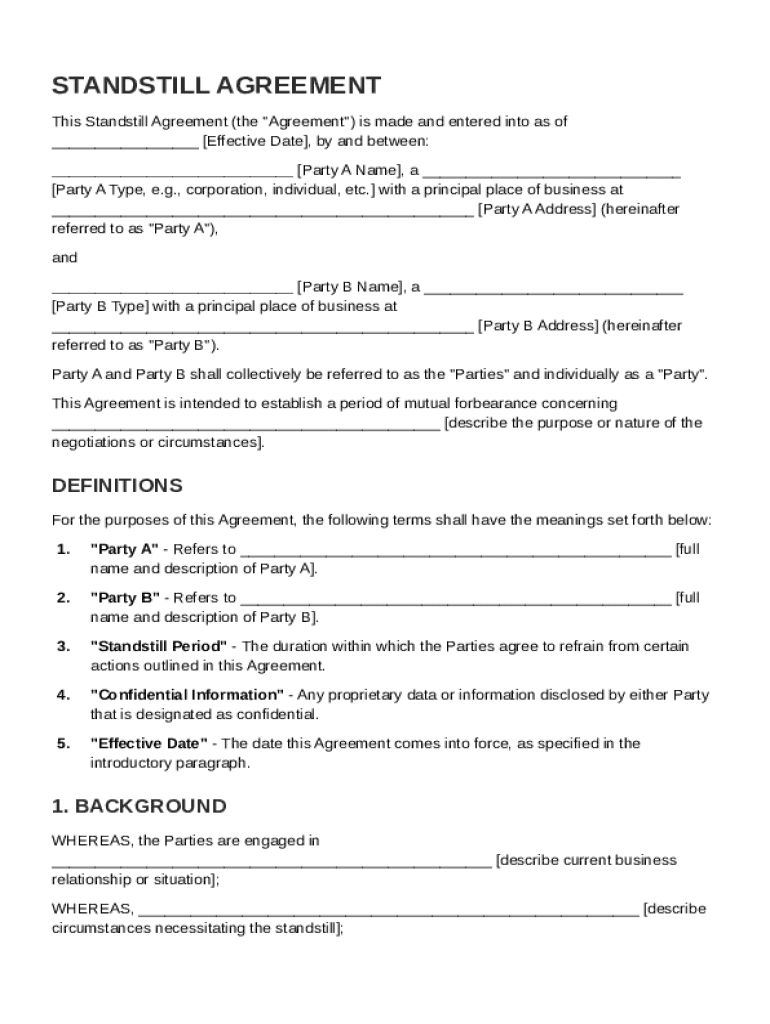
A Standstill Agreement Template serves as a legal document between two parties, known as Party A and Party B, to establish a period during which both parties agree to pause specific activities. Primarily used in negotiation or dispute contexts, the document outlines terms that prevent actions that might undermine negotiations. This agreement is vital to facilitate peaceful, constructive discussions by ensuring mutual forbearance. By defining restrictions, responsibilities, and guidelines, it protects both parties' interests and maintains focus on resolving underlying issues. Standstill agreements commonly include clauses regarding confidentiality, conduct, and the handling of disputes.
Key Elements of the Standstill Agreement Template
Several critical elements must be included in a Standstill Agreement to ensure its effectiveness and enforceability:
- Scope and Duration: The agreement must specify which actions are restricted and the length of the standstill period.
- Obligations of the Parties: Clearly outlined duties and restrictions for each party, including confidentiality obligations.
- Termination Conditions: Circumstances under which the agreement may be terminated early, including the fulfillment of negotiations or breaches of terms.
- Dispute Resolution Provision: A defined method for resolving disagreements that arise during the standstill, often through mediation or arbitration.
- Miscellaneous Clauses: Additional terms, such as governing law and force majeure, to cover other aspects of the agreement.
Including these elements helps ensure the agreement supports the intended negotiation or dispute resolution processes.
How to Use the Standstill Agreement Template
Using a Standstill Agreement Template involves several specific steps to tailor the document to the needs of the involved parties:
- Identify Parties: Clearly specify Party A and Party B, including legal names and contact information.
- Define Scope: Determine which actions need to be paused, including business transactions, litigation, or competitive practices.
- Set Duration: Agree on the start and end dates of the standstill period.
- Detail Obligations: Outline each party's obligations to maintain the integrity of negotiations.
- Include Confidentiality Clauses: Ensure information shared is protected during and after the agreement.
- Review and Modify: Tailor the template to fit the specific situation, possibly involving legal counsel for greater precision.
- Sign and Store: Both parties must sign the agreement and store copies securely, ensuring access if disputes arise.
Using a template simplifies crafting a well-structured agreement that meets the necessary legal requirements and mutual expectations.
Important Terms Related to Standstill Agreement Templates
Understanding specific terminology is essential for effectively utilizing the Standstill Agreement Template:
- Forbearance: An agreement by both parties to delay certain actions.
- Mutual Agreement: Consensus reached by both parties regarding the terms outlined in the document.
- Confidentiality: The obligation to keep certain information private, often enforced through confidentiality agreements.
- Dispute Resolution: Methods included in the agreement to address disagreements or breaches, such as arbitration or mediation.
- Term: The length of time that the agreement or specific clauses remain in effect.
Grasping these terms ensures both parties comprehend their obligations and rights throughout the agreement period.
Steps to Complete the Standstill Agreement Template
Completing the Standstill Agreement Template involves several important steps to ensure it fulfills its legal and practical purposes:
- Gather Necessary Information: Collect details on both parties involved, such as names, roles, and relevant contact details.
- Review Legal Obligations: Understand contractual obligations or previous agreements that may impact the template's usage.
- Clarify Standstill Scope: Specify the activities that are subject to the standstill, focusing on actions that can disrupt negotiations.
- Establish Timeline: Determine the required duration, noting any conditions for extension or early termination.
- Incorporate Key Clauses: Add confidentiality and governance clauses to safeguard against unauthorized disclosures.
- Review by Legal Expert: Seek legal counsel to ensure terms are clear and enforceable in court if necessary.
- Finalize and Sign: Once reviewed, parties should proceed with signing the document to make it operational.
These steps provide a structured approach to effectively using the Standstill Agreement Template for protecting interests during sensitive negotiations.
Legal Use of the Standstill Agreement Template
The legal applicability of Standstill Agreements ensures they serve as protective shields during corporate negotiations:
- Prevention of Hostile Takeovers: In corporate settings, these agreements can be crucial in fending off unsolicited attempts to acquire or control a company.
- Protecting Company Value: By maintaining existing management structures while negotiations are underway, parties safeguard shareholder interests.
- Facilitating Mergers: Agreements can provide the breathing room needed to finalize mergers or acquisitions without outside interference.
- Legal Assurance: Standstill Agreements reinforce legal recourse in the event of breaches, offering a framework for secure and open negotiations.
Having a legally robust agreement ensures that businesses can navigate sensitive periods with greater security and confidence.
Examples of Using Standstill Agreement Template
Several scenarios highlight the template's practical applications:
- Corporations in Mergers: Two companies considering a merger might use a standstill agreement to pause aggressive competitive practices while dialogue continues.
- Joint Ventures: Entities exploring a collaborative partnership could employ the agreement to hone focus on mutual benefits without external pressures.
- Litigation Contexts: Parties in a legal dispute can concentrate on settlement negotiations without the stress of ongoing legal actions.
- Market Competition: Companies assessing a non-compete situation could avoid escalation while determining potential business collaborations.
By providing room for negotiation, standstill agreements facilitate strategic decision-making in varied situations across different industry sectors.
State-Specific Rules for Standstill Agreement Templates
Standstill agreements must consider state-specific regulations that impact their execution and enforceability:
- Governing Law Clause: Always include this clause to specify which state's laws will apply to the agreement.
- State-Specific Requirements: Certain states might require additional disclosures or terms for commercial contracts.
- Enforceability Issues: Differences in legal frameworks can influence the validity of agreement provisions, like non-compete clauses.
- Mandatory Review: Given these variations, it is crucial to review the template against specific state statutes where the agreement will be enforced.
Understanding and complying with state-specific rules ensures the agreement remains legally binding and effective.