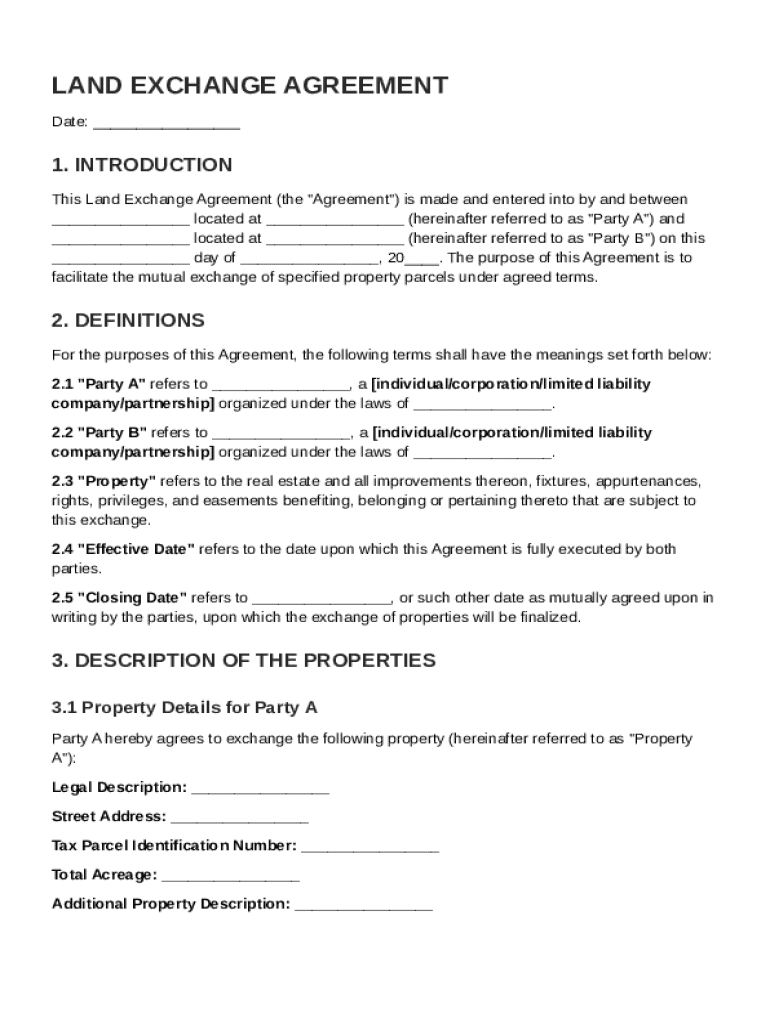







Definition & Meaning
The Land Exchange Agreement Template is a formal document that outlines the terms and conditions for the exchange of land parcels between two parties, referred to as Party A and Party B. This contract serves to detail various aspects of the transaction, ensuring clarity and mutual understanding. Key components include property descriptions, title transfer procedures, and the responsibilities of each party involved. It aims to prevent disputes by clearly defining the legal and financial obligations and protections each party holds.
Key Elements of the Land Exchange Agreement Template
This agreement encompasses several crucial elements to ensure a comprehensive approach to land exchange. Notable components include:
- Property Descriptions: Detailed accounts of each parcel being exchanged, including size, location, and any unique features.
- Title Transfer Details: Terms outlining how and when the title transfers will be completed, ensuring legal ownership is accurately documented.
- Representations and Warranties: Statements from both parties guaranteeing the truthfulness of their claims concerning the property, such as no outstanding liens or legal disputes.
- Indemnification Clauses: Provisions for protecting both parties from potential legal claims arising after the exchange.
- Dispute Resolution Procedures: Agreed-upon methods for resolving any disagreements, often through mediation or arbitration.
- Governing Law: Specification of the state laws that will apply to interpret the contract.
Steps to Complete the Land Exchange Agreement Template
- Gather Necessary Information: Compile detailed descriptions of each parcel of land and any associated legal documentation.
- Define Responsibilities: Clearly outline what each party is responsible for, including any obligations before and after the exchange.
- Draft Preliminary Agreement: Use the template as a guide to draft the initial version of the agreement, ensuring all standard sections are addressed.
- Review and Adjust: Collaborate with legal counsel to review the draft, making necessary adjustments to meet specific needs or state requirements.
- Finalize agreement: Once both parties agree on all terms, the document is finalized and prepared for signatures.
- Execution and Filing: Parties sign the agreement, and the necessary filings with public land records are completed to formalize the exchange.
Legal Use of the Land Exchange Agreement Template
Legal validity is a cornerstone of the Land Exchange Agreement Template. Adhering to U.S. law, it ensures all necessary legal considerations are integrated, providing a robust framework for property exchanges. It emphasizes:
- Legally Binding Terms: Every section of the template serves a legal function, protecting parties' rights and interests.
- Adherence to State Laws: Adjustments may be necessary to comply with state-specific regulations regarding land exchange.
- Record Keeping: Ensures all transactions are properly documented, an essential aspect for potential audits or legal scrutiny.
State-specific Rules for the Land Exchange Agreement Template
While the template offers a universal format, state-specific laws can affect certain clauses or requirements. For example:
- Title Requirements: States may have varying documentation requirements for proving land ownership.
- Tax Implications: Different states might impose different taxes on land transactions, impacting how values are reported in the agreement.
- Disclosure Obligations: Legal needs for disclosing specific property information can vary substantially between states.
Who Typically Uses the Land Exchange Agreement Template
The template is a versatile legal tool utilized by various entities ranging from private individuals to large corporations. Common users include:
- Real Estate Investors: Engaging in property swaps to enhance their portfolio strategically.
- Government Agencies: Facilitating public land exchanges to encourage development or conserve resources.
- Legal Professionals: Drafting or reviewing agreements on behalf of their clients.
- Developers: Acquiring tracts of land to initiate or expand projects.


Important Terms Related to Land Exchange Agreement Template
Understanding specific terms within the agreement is vital for all parties involved:
- Party A/Party B: Designations for the individuals or entities involved in the transaction.
- Encumbrances: Any claims or liens on the property that might affect the transaction.
- Due Diligence: The period during which both parties verify the information regarding each other's property.
- Arbitration Clause: An agreement to resolve disputes outside of court, usually through a neutral arbitrator.
Examples of Using the Land Exchange Agreement Template
Real-world applications highlight the utility of the template:
- Agricultural Land Swap: Farmers exchange plots for better suitability regarding soil type or proximity to markets.
- City Development Initiatives: Urban planners utilize land swaps to reorganize city layouts or reserve spaces for public projects.
- Conservation Efforts: Environmental groups exchange lands to protect habitats or manage resources more effectively.
These varied uses underscore the template's adaptability and necessity in facilitating legal and efficient land exchanges.