01. Edit your form online
Type text, add images, blackout confidential details, add comments, highlights and more.

Type text, add images, blackout confidential details, add comments, highlights and more.

Draw your signature, type it, upload its image, or use your mobile device as a signature pad.

Send it via email, link, or fax. You can also download it, export it or print it out.
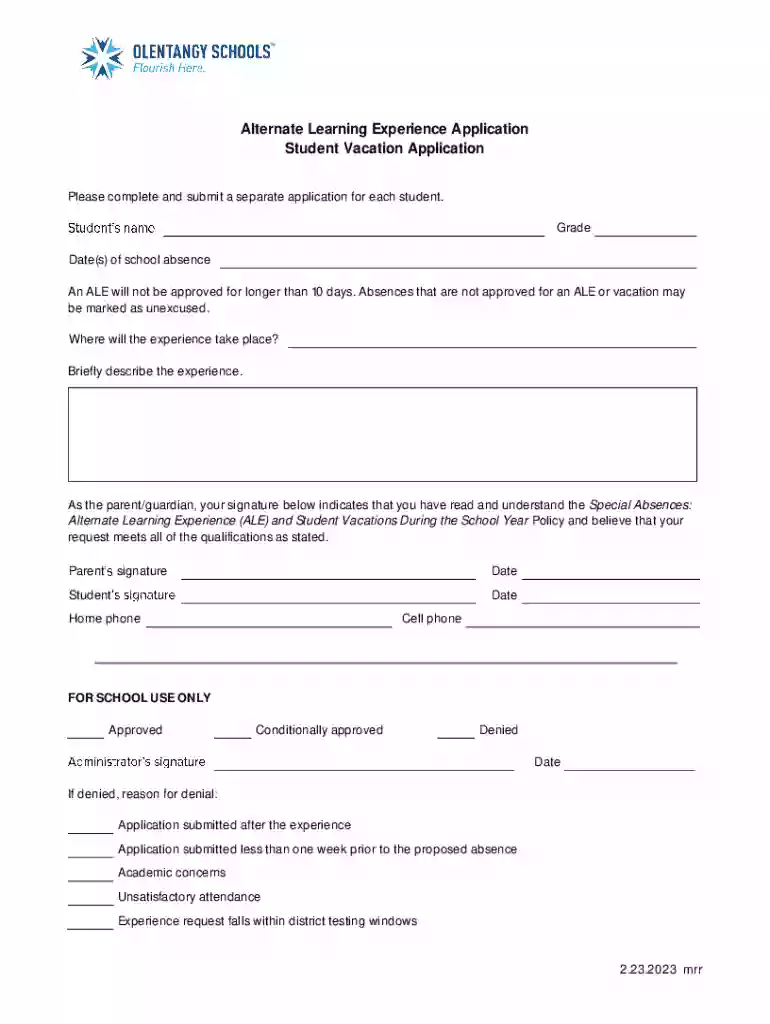
The Alternate Learning Experience Application is a formal document used by students in the United States to seek approval for non-traditional educational experiences, such as independent study or educational trips, typically during the school year. These applications allow students to pursue learning paths that deviate from the standard classroom setting while maintaining their academic standing. The form ensures that both parents and teachers validate the educational merit of the proposed experience, aligning with the student's academic goals.
The application typically outlines the objectives of the alternate learning experience, expected outcomes, and the time frame. Each submitted application undergoes a review process to ensure it meets the necessary educational standards and requirements. It serves as a critical tool for enabling educational flexibility within formal academic structures, allowing students to explore diverse learning opportunities beyond the confines of a classroom.
Gather Required Signatures: Secure signatures from parents and teachers to confirm eligibility and support for the alternate learning experience. This step is crucial in verifying both parental consent and instructional guidance.
Define Learning Objectives: Clearly articulate the learning objectives and expected educational outcomes. This includes detailing the skills or knowledge the student aims to acquire through the experience.
Plan the Experience: Outline a comprehensive plan, including the duration, location, participants, and any associated educational activities. Make sure the schedule aligns with the academic calendar to minimize disruption to required coursework.
Submit the Application: Submit the completed application to the designated school official or committee for review. Ensure all sections are thoroughly filled out and that any supplemental materials are attached.
Await Approval: The school will review the application to ensure it meets educational standards and follows district policies. Approval may require additional meetings or revisions to the proposal.
Implement the Experience: Once approved, carry out the plan. Maintain records of the activities and outcomes, which may be required for assessment upon completion.
Student Academic Standing: Applicants must maintain a satisfactory academic record, demonstrating the ability to manage independent or alternate learning alongside or in place of traditional coursework.
Parental and Teacher Support: Both parental consent and teacher endorsement are required to ensure the experience's legitimacy and alignment with the student's academic progression.
Educational Merit: The proposed experience must have clear educational value and be tied to the student's academic goals, enriching their learning in a way classroom activities alone may not achieve.
Duration Limitations: Typically, these experiences are limited to a maximum number of school days, often no more than ten, to prevent excessive disruption to the student's regular academic schedule.


In the United States, the alternate learning experience must comply with state and district educational regulations. The application serves as a formal record that the experience is recognized and sanctioned by the educational institution. Legal compliance ensures the student's attendance record remains unaffected during approved absences for the learning experience. The form must also adhere to privacy laws concerning student records, ensuring all information is handled in a compliant manner.
Students Seeking Educational Trips: Students planning educational trips or participation in academic competitions may use this application to gain approval and excuse absences.
Independent Study Participants: Those engaging in self-directed learning projects requiring time away from school use this form to formalize their plans and objectives.
Schools with Flexible Curriculums: Institutions fostering integrated learning experiences beyond traditional classrooms heavily rely on such applications to maintain educational oversight.

Independent Study: A learning format where students pursue academic goals guided by a teacher, yet largely self-directed, often requiring an ALE application.
Educational Trip: A journey undertaken for educational purposes, such as museum visits or cultural exchanges that align with academic objectives.
Academic Standing: The status of a student based on their grades and overall performance, which impacts eligibility for alternative learning experiences.
Varying Approval Processes: Different states may have unique processes for approving alternate learning experiences, including distinct forms and deadlines.
Educational Requirements: States might specify certain curriculum requirements that must be met through alternate experiences, ensuring consistency with state educational standards.
Time Limitations: Some states impose stricter limits on the duration an alternate learning experience can disrupt formal schooling, primarily to ensure consistent student attendance.
Objective and Goals: The form must clearly articulate what the student aims to achieve academically through the experience.
Detailed Itinerary: A schedule of activities and locations, ensuring the experience is structured and focused on educational outcomes.
Assessment Methods: Plans for assessing learning outcomes post-experience, ensuring academic goals are met.
Logistical Details: Comprehensive information on travel, accommodation, and supervision to ensure student safety and accountability during the experience.
Each of these elements must be meticulously documented to provide a robust framework for the alternate learning experience, aligning it with academic expectations and standards.
We've got more versions of the Alternate Learning Experience Application form. Select the right Alternate Learning Experience Application version from the list and start editing it straight away!
At DocHub, your data security is our priority. We follow HIPAA, SOC2, GDPR, and other standards, so you can work on your documents with confidence.