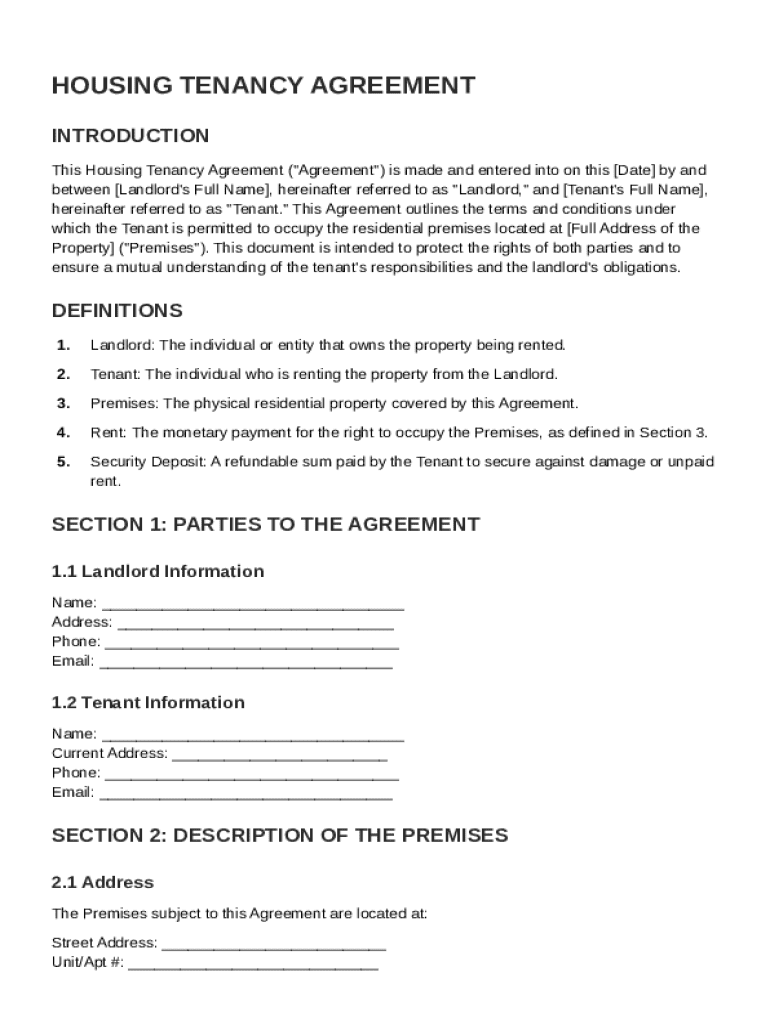







Definition & Meaning
A Housing Tenancy Agreement Template is a legal document utilized between a landlord and tenant, outlining the terms and conditions under which a residential property is rented. This template ensures that both parties clearly understand their rights and responsibilities, thus minimizing potential disputes. It encompasses aspects such as rent, lease duration, and included amenities. Creating this document using a standardized template like DocHub offers a structured approach that simplifies the drafting process, ensuring completeness and legal soundness.
Components Included
- Parties Involved: Identifies the landlord and tenant by name and contact information.
- Property Details: Provides a description of the rental property, including address and unit number.
- Rent Specifications: States the monthly rent amount, payment method, and due date.
- Lease Duration: Details the start and end dates of the lease term.
- Security Deposits: Lists the amount required and conditions for return at lease end.
How to Use the Housing Tenancy Agreement Template
Employing a template to draft a tenancy agreement streamlines the process of documenting landlord and tenant obligations efficiently. With platforms like DocHub, users can edit templates digitally, customizing clauses to meet specific needs.
Steps to Follow
- Access the Template: Open the Housing Tenancy Agreement Template on the DocHub platform.
- Customize Clauses: Modify sections to match the specific terms negotiated between the landlord and tenant.
- Integrate Additional Terms: Insert any extra provisions pertinent to the unique property or tenant, such as pet policies or parking rules.
- Review and Confirm: Double-check all entries for grammatical accuracy and completeness.
- Save and Share: Save the finalized document and share it with the intended parties via email or export it to Google Drive.
Example Use Case
In a scenario where a landlord in New York City needs to lease out an apartment for one year, they would utilize this template to define rent amount, acceptable payment methods (e.g., bank transfer or checks), and specific conditions about maintenance responsibilities for shared amenities, like a gym or pool.
Key Elements of the Housing Tenancy Agreement Template
Understanding the key elements included in a housing tenancy agreement is critical for ensuring a legally binding contract that reflects the intentions of both parties.
Essential Clauses
- Payment and Fees: Clearly defines the amount of rent, due dates, and late fee protocols.
- Utilities: Specifies which utilities are covered by the landlord and which are the tenant's responsibility.
- Repair and Maintenance: Outlines responsibilities regarding property upkeep, repairs, and who to contact in case of emergencies.
- Termination Conditions: Describes the conditions under which the lease can be terminated by either party, such as breach of contract or non-payment of rent.
Legal Considerations
It's crucial to ensure all listed elements comply with local and state laws, such as fair housing and anti-discrimination statutes. Consulting with legal professionals when modifying templates can help verify compliance with current legal standards, reducing the risk of potential legal complications.
Important Terms Related to Housing Tenancy Agreement Template
Knowledge of the terminology used within a tenancy agreement template is essential for comprehension and enforcement of the lease terms.
Glossary of Terms
- Lessee/Lessor: Tenant and landlord, respectively, involved in the agreement.
- Subletting: The act of a tenant leasing the rented property to a third party, usually requiring landlord approval.
- Default: A breach of contractual obligations, potentially leading to lease termination or penalties.
- Tenancy Term: The duration for which the lease is valid, including start and end dates.
- Covenants: Agreed-upon promises or conditions found within the lease, often related to property usage or maintenance.
Legal Use of the Housing Tenancy Agreement Template
The housing tenancy agreement template is a vital tool for legal documentation, meeting the legal requirements for residential leasing. Templates provide a structured form that aids in creating enforceable contracts recognized by court systems.
Compliance Guidance
- Legality: Ensure the agreement adheres to local landlord-tenant laws to prevent invalidation.
- Dispute Resolution: Include clear instructions for resolving disputes, potentially via arbitration or mediation, rather than immediate legal action.
- Amendments: Document any future changes or amendments to the agreement, requiring both parties' acknowledgment and signatures.
Real-World Example
Consider a family leasing a home in Los Angeles. A well-constructed agreement that includes legal dispute resolution clauses can prevent complications if maintenance disputes arise, thereby avoiding costly court processes.
State-Specific Rules for the Housing Tenancy Agreement Template
Each state may have specific requirements governing housing tenancy agreements. It is vital to incorporate these rules to ensure compliance and legality in the document.
Key State Considerations
Different states may mandate certain conditions or clauses:
- California: Rent control laws may necessitate specific rent increase limitations.
- Texas: Requirements for smoke detectors and security devices might be enforced more strictly.
- Illinois: Chicago area leases require disclosures about heating costs and shared utilities.
Adjusting for Compliance
When using a template, ensure sections comply with state laws by consulting resources or experts familiar with local regulations. This practice helps to minimize risks of legal challenges due to non-compliance.
Why Use a Housing Tenancy Agreement Template
The benefits of using a well-crafted housing tenancy agreement template are numerous, ensuring clarity, legality, and easily understandable terms between the landlord and tenant.
Benefits Overview
- Consistency: Templates provide a consistent format, making it easier to manage multiple properties under similar terms.
- Time Efficiency: Reduces the time needed to draft agreements from scratch, allowing landlords to focus on property management.
- Risk Mitigation: Clearly documented terms help to avoid misunderstandings and minimize the risk of disputes.
Illustrative Scenario
A property management company managing several apartment complexes can maintain uniformity across all agreements, quickly onboarding new tenants by using a standardized template. This consistency simplifies tracking lease terms and conditions across properties.
Examples of Using the Housing Tenancy Agreement Template
Understanding how the Housing Tenancy Agreement Template can be applied in practical scenarios strengthens its applicability and benefits both landlords and tenants.
Scenario Applications
- New Tenant Leasing: A landlord rents an apartment to a new tenant, using the template to establish clear expectations for rent payment, utilities, and responsibilities.
- Renewal of Lease: An existing tenant's lease is about to expire. Instead of crafting a new agreement, the template can be modified for renewal terms, ensuring continuity.
- Short-Term Rentals: For vacation homes or temporary work assignments, the template adapts to shorter lease terms, adjusting clauses regarding duration and payment conditions.
Practical Benefits
These examples illustrate the adaptable nature of the template, showing how it can cater to different rental circumstances efficiently. The ability to create consistent, legally compliant leases across various situations proves advantageous for property managers and individual landlords alike.