






Definition & Meaning
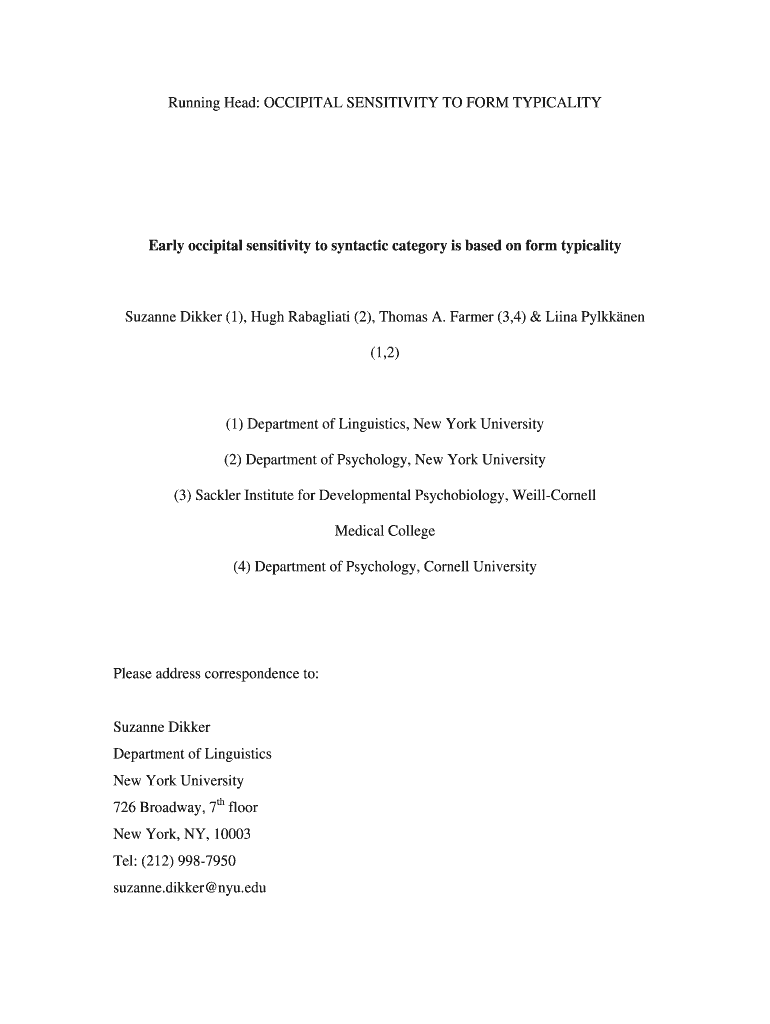
The "Running Head: OCCIPITAL SENSITIVITY TO FORM - Linguistics" refers to an academic study focusing on the sensitivity of the occipital region of the brain to linguistic forms during language processing. This area is pivotal in understanding how the brain processes language and form, highlighting early sensitivity to syntactic structures. It involves experimental procedures, such as magnetoencephalography (MEG), to measure brain activity when individuals process linguistic inputs. The study helps unravel the complex interplay between visual processing areas and language comprehension, providing insight into cognitive linguistic mechanisms.
How to Use the Running Head
To utilize the study titled "Running Head: OCCIPITAL SENSITIVITY TO FORM - Linguistics," researchers typically engage with its findings to further investigate cognitive neuroscience and linguistics. The information can be applied in experiments related to language processing, focusing on how syntactic structures are perceived visually and processed by the brain. Use the study as a framework for developing new hypotheses about language comprehension, particularly for projects exploring how visual cues contribute to syntactic category predictions.
Practical Applications
- Academic Research: Use the findings to support research in cognitive neuroscience and psycholinguistics.
- Education: Implement in cognitive science curricula to teach students about brain-language interactions.
- Technology Development: Inspire AI models simulating human language comprehension.
Legal Use of the Running Head
While the "Running Head" study itself does not have direct legal applications, understanding its content can be crucial for professionals developing educational materials or engaging in intellectual property discussions related to cognitive research methodologies. Ensure all findings are credited appropriately when used in academic or professional settings.
Legal Considerations
- Citations: Properly cite the study in any derivative works or academic papers.
- Intellectual Property: Respect copyright laws governing academic publications.
Key Elements of the Study
The study is centered around how the brain's occipital region is sensitive to linguistic form. It underscores the role of visual cortex activity in language prediction and comprehension, particularly when there is a mismatch between syntactic predictions and actual linguistic input.
Components
- Methodology: Utilizes MEG to observe brain activity in response to linguistic stimuli.
- Findings: Highlights rapid cortical responses to unexpected word forms.
- Implications: Suggests a predictive mechanism in language processing.
Steps to Complete Related Research
Conducting research related to this study involves several critical steps:
- Literature Review: Begin by reviewing relevant literature to understand existing research in this area.
- Research Design: Develop an experiment focusing on occipital sensitivity in language processing.
- Approval: Secure ethical approval from an institutional review board (IRB).
- Data Collection: Utilize tools like MEG to gather data on brain activity.
- Analysis: Analyze results to understand the relationship between visual processing and language comprehension.
- Publication: Prepare findings for publication in a peer-reviewed journal.
Important Terms Related to the Study
Understanding key terminology facilitates better comprehension of the study's findings.
- Occipital Sensitivity: Refers to the brain's response to visual stimuli in the occipital lobe.
- Syntactic Prediction: Anticipating the grammatical structure of language input.
- Magnetoencephalography (MEG): A non-invasive imaging technique for mapping brain activity.
- Sensory Cortices: Brain regions processing sensory data, linked to language perception.
Examples of Using the Study
Researchers have utilized the study to explore various areas of neurolinguistics and cognitive science.
- Experiment Design: Informed experimental frameworks assessing language processing efficiency.
- Neuroscience Education: Incorporated in academic courses to elucidate the neural basis of language processing.
- Cognitive Therapy: Insights applied to therapeutic techniques in language rehabilitation.
Digital vs. Paper Version
Accessing studies like "Running Head: OCCIPITAL SENSITIVITY TO FORM - Linguistics" is possible in both digital and paper formats, each offering unique advantages for researchers and educators.
Comparison
- Digital Version: Easily searchable, accessible remotely, allows for quick cross-referencing with other digital resources.
- Paper Version: Useful for annotating physical copies, preferred by some for comprehensive study without screen distractions.