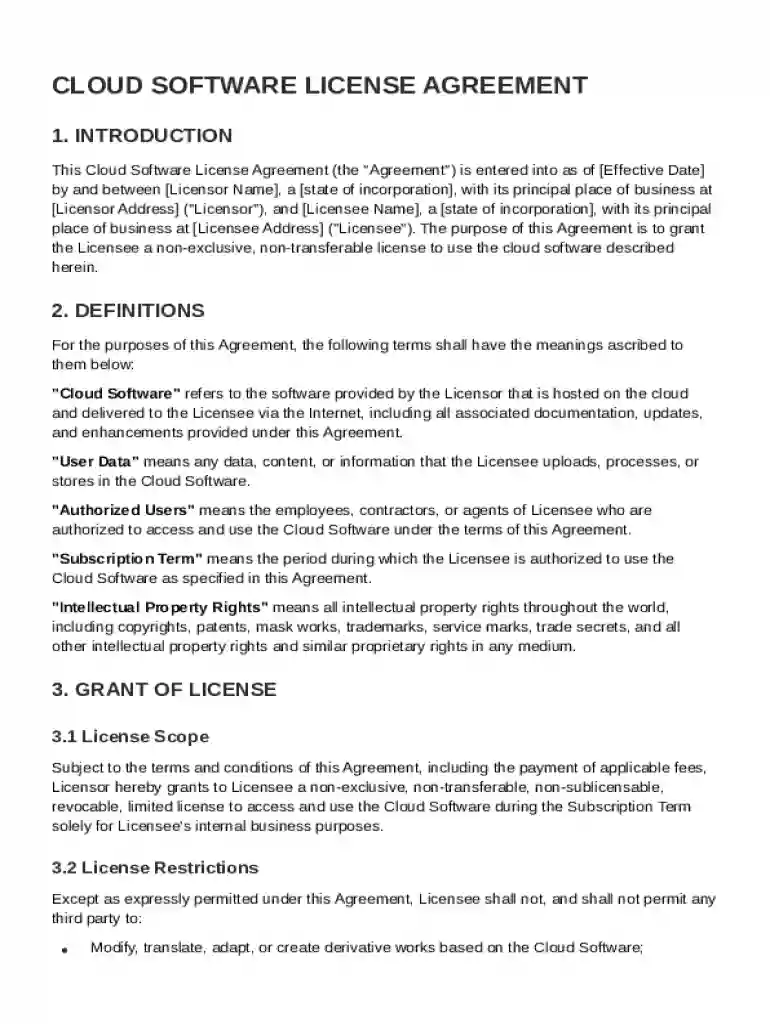
Key Elements of the Cloud Software License Agreement Template
The Cloud Software License Agreement Template includes critical elements that define the interaction between the licensor and licensee. Understanding each element is essential:
- License Grant: Specifies the rights given to the licensee to use the software. Typically, this is a non-exclusive, non-transferable license.
- Scope of License: Outlines permitted uses, ensuring compliance with the intended functionalities and geographical limitations.
- Payment Terms: Details financial responsibilities, including licensing fees, payment schedules, and acceptable payment methods.
- Termination Conditions: Defines the circumstances under which the agreement can be terminated by either party.
- Data Ownership and Security: Clarifies data custody matters, encryption standards, and security protocols.
Consider the following practical example: A software company issues licenses for its application, specifying usage only in North America, thereby restricting scope.
Definition & Meaning
The Cloud Software License Agreement Template is a legal document that outlines terms under which a licensor allows a licensee to use its cloud services. It ensures protection of intellectual property and clarifies the rights and responsibilities of both parties.
- Licensor: The party providing the software.
- Licensee: The individual or entity granted rights to use the software.
- Cloud Services: Services delivered over the internet, often including storage, computing power, and software access.
In a scenario where a company subscribes to an email hosting service, they utilize these agreements to ensure data handling aligns with corporate policies.
How to Use the Cloud Software License Agreement Template
To utilize the template effectively, follow these steps:
- Download or Access: Obtain the template from a reliable source.
- Review Key Sections: Familiarize yourself with vital components such as licensing terms, payment obligations, and security provisions.
- Customize: Adjust terms as necessary to suit specific business requirements.
- Legal Review: Consult with a legal advisor to ensure all terms meet legal and regulatory standards.
- Finalize and Execute: Once all parties agree on terms, sign and store appropriately for future reference.
For example, a startup integrating third-party software for customer management may tailor the template to reflect their unique use case.
Legal Use of the Cloud Software License Agreement Template
Legal use of the Cloud Software License Agreement Template requires adherence to applicable laws:
- ESIGN Act Compliance: Electronic signatures on agreements should comply with this act, ensuring validity.
- Intellectual Property Rights: Protect the licensor’s rights, detailing prohibitions on reverse engineering or sublicensing.
- Data Protection Laws: Align with laws such as GDPR for any data transfer or processing involving EU citizens.
An example scenario includes a U.S. company dealing with EU contacts, thus incorporating GDPR clauses in their agreements.
Important Terms Related to the Cloud Software License Agreement Template
Understanding specific terms within the template is crucial:
- Warranty: A promise regarding the software’s functionality, potentially including uptime guarantees or support services.
- Indemnification: Protects against legal claims related to software use or performance malfunctions.
- Confidentiality: Ensures proprietary information disclosed remains protected throughout the agreement term.
Consider a case where a client is granted a software warranty for operational assurance, mitigating risks associated with system downtime.
State-Specific Rules for the Cloud Software License Agreement Template
Different states may impose unique requirements affecting how these agreements are structured:
- Governing Law: Clauses must specify which state’s law applies, often where the licensor or licensee conducts primary business.
- Registration Requirements: Some states might require license registration, impacting agreement processing time.
- Attorney Fees: Provisions related to fee recovery in case of legal disputes can vary by state.
For instance, a business in California might adjust its agreement due to state-specific rulings on consumer data privacy protections.
Examples of Using the Cloud Software License Agreement Template
Practical applications and examples enhance understanding:
- Tech Startups: Often use these agreements to manage SaaS offerings, ensuring usage terms are clear.
- Educational Institutions: Deploy cloud-based educational tools under defined parameters, safeguarding student data and intellectual property.
- Healthcare Providers: Ensure compliance with HIPAA by customizing agreements to incorporate data security measures necessary for patient information.
Each sector illustrates how customization of the agreement enables specific industry compliance and operational efficacy.
Steps to Complete the Cloud Software License Agreement Template
Completing the template is a structured process:
- Initial Selection: Choose a template aligning with your specific software category.
- Information Gathering: Collect relevant details about the parties involved, including contact information and software specifications.
- Section Customization: Modify clauses to reflect your operational scope, payment arrangements, and termination protocols.
- Review and Revise: Engage with your legal team for comprehensive clause analysis.
- Final Approval: Secure stakeholder endorsements before finalizing.
- Document Execution: Digitally sign and distribute copies to relevant parties for their records.
In a scenario where an app developer licenses usage to a corporate client, each step is tailored to uphold both entity interests.
Who Typically Uses the Cloud Software License Agreement Template
This agreement template is widely employed by various business types:
- Software Developers: License specific programs under defined conditions.
- Cloud Service Providers: Distribute services like storage and applications.
- Corporate IT Departments: Manage third-party software integrations with precise usage terms.
A software development firm offering productivity tools online benefits from streamlining licensing, ensuring clear mutual expectations.