
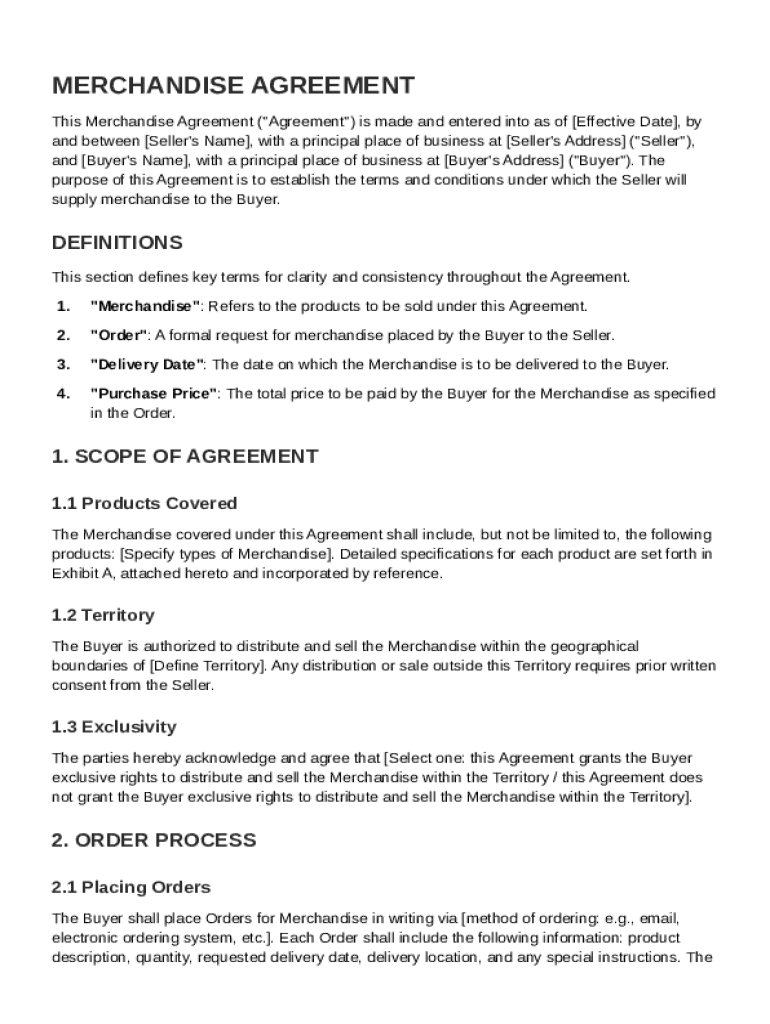







Definition & Meaning
A Merchandise Agreement Template is a legal document that outlines the terms and conditions governing the sale and distribution of merchandise between a seller and a buyer. This agreement serves as a comprehensive framework to ensure mutual understanding and protection of both parties' interests. It defines key terms, sets the scope of the agreement, and establishes guidelines for order processes, pricing, payment, delivery, warranties, and liabilities. It is essential for managing expectations and avoiding disputes.
Key Components
- Parties Involved: Identifies the seller and buyer engaged in the merchandise transaction.
- Scope of Agreement: Delineates the specific products covered under the agreement.
- Order Process: Details the manner and timelines for placing and fulfilling orders.
- Pricing and Payment Terms: Specifies pricing structures, payment methods, and schedules.
How to Use the Merchandise Agreement Template
To effectively use the Merchandise Agreement Template, follow a sequential process that ensures thorough customization and accuracy. This ensures that the agreement aligns with your specific business needs and legal requirements.
- Review the Template: Begin by reviewing the entire template thoroughly to understand its structure and content.
- Customize Details: Input specific details relevant to your transaction, such as party names, contact information, and product descriptions.
- Adjust Terms as Necessary: Modify sections like pricing, delivery terms, and payment schedules to reflect the agreed-upon terms.
- Add Specific Clauses: Include any additional clauses that address unique aspects of your business or industry requirements.
Practical Example
A small retail business looking to procure promotional items can use this template to ensure all terms regarding price, delivery, and product specifications are clear and agreed upon.
Key Elements of the Merchandise Agreement Template
The Merchandise Agreement Template is comprised of several essential elements designed to provide a clear operational framework for merchandise sales. Each element plays a critical role in defining responsibilities and expectations.
- Delivery and Shipping Details: Outlines shipping methods, delivery schedules, and responsibilities for shipping costs.
- Warranties and Liabilities: Specifies any warranties provided by the seller and limits on liability for defects or non-performance.
- Confidentiality Obligations: Ensures that sensitive information exchanged during the transaction remains protected.
- Dispute Resolution: Describes the process for resolving any disagreements that may arise during the execution of the agreement.
Legal Use of the Merchandise Agreement Template
The Merchandise Agreement Template is legally binding and should be used in compliance with applicable laws and regulations. It is designed to meet the requirements established under the Uniform Commercial Code (UCC) in the United States, which governs commercial transactions.
Compliance Considerations
- Ensure all parties have legal capacity to enter into the agreement.
- Confirm the document aligns with state-specific regulations where the parties operate.
- Seek legal advice if uncertain about any clause or requirement.
Important Terms Related to Merchandise Agreement Template
Understanding the specific terminology used within a Merchandise Agreement is crucial for the correct interpretation and execution of its terms.
- FOR (Free on Board): Determines which party is responsible for shipping and handling costs and at what point ownership transfers.
- Non-Disclosure Agreement (NDA): A clause that may be integrated to protect proprietary information during the partnership.
- Indemnification: A provision that ensures one party is compensated for any harm, loss, or liability arising from the other party's actions.
Who Typically Uses the Merchandise Agreement Template
The Merchandise Agreement Template is widely used by various business entities, including:
- Retailers and Wholesalers: Establish agreements for stock replenishment and new product launches.
- Manufacturers: Ensure clear terms for distributing products to third-party vendors.
- E-commerce Businesses: Facilitate agreements for inventory management and order fulfillment with suppliers.


Examples of Using the Merchandise Agreement Template
Examples of use cases can provide valuable insights and ideas on how this template might be effectively employed.
- E-commerce Expansion: An online clothing store entering into new regions can leverage the template to formalize relationships with local distributors.
- Product Launch Partnerships: A tech company collaborates with retailers for an exclusive product release, using the agreement to define stock allocations and marketing commitments.
State-Specific Rules for the Merchandise Agreement Template
While the Merchandise Agreement Template is designed to be broad, certain states may impose additional requirements or variations that must be observed. It's important to understand these state-specific regulations to ensure compliance.
Common State Variations
- Contractual Minimum Age: Different states may have varying legal age requirements for contractual agreements.
- Consumer Protection Laws: States like California have stringent regulations protecting consumer rights, affecting return policies and warranties.




