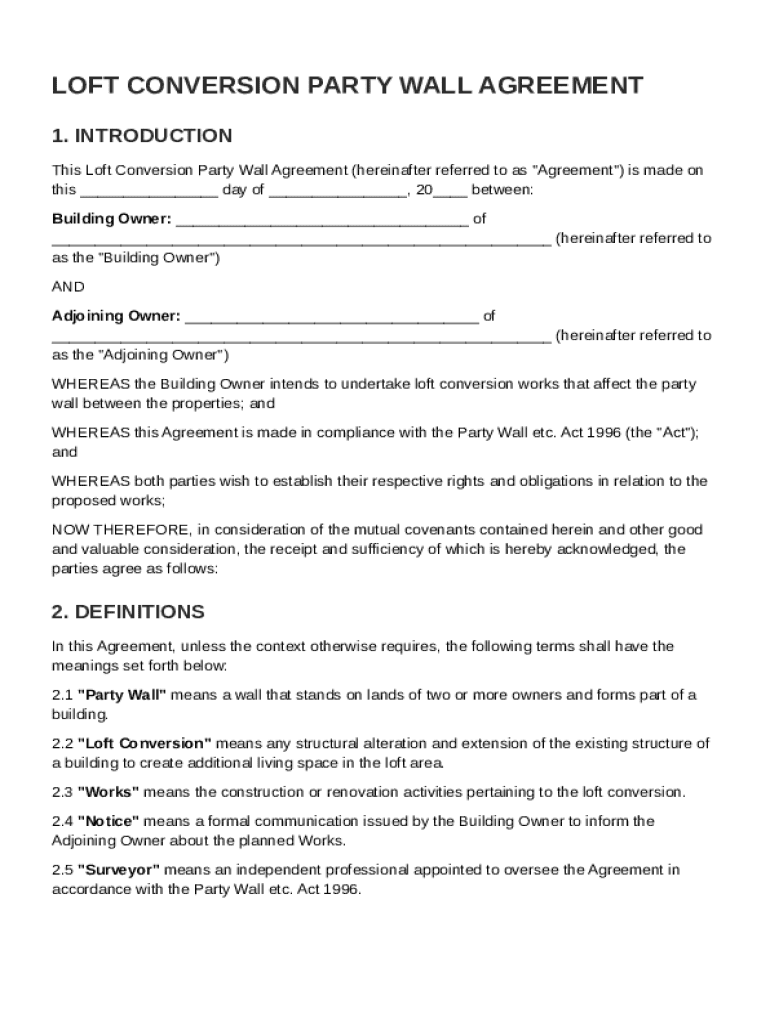







Definition & Meaning
The Loft Conversion Party Wall Agreement Template is a legal document used to outline the terms and conditions between a Building Owner and an Adjoining Owner. This agreement ensures mutual understanding when proposed loft conversion works impact a shared party wall. It stipulates the rights, obligations, and procedures in alignment with the Party Wall etc. Act 1996. Essential components include notice requirements, access rights, damage liability, insurance obligations, and dispute resolution mechanisms to minimize disruptions during construction.
How to Use the Loft Conversion Party Wall Agreement Template
To effectively use this template, begin by reviewing the notice requirements and negotiate terms with the Adjoining Owner. Key steps include:
- Identify Parties Involved: Clarify who the Building Owner and Adjoining Owner are.
- Specify the Work: Outline the proposed loft conversion work in detail.
- Determine Access Rights: Clearly state the access needed for the construction.
- Include a Schedule: Establish a timeline for both the work and inspections.
- Agree on Damage and Repair Terms: Define responsibility for potential damages.
The goal is to establish a clear consensus to prevent conflicts during the construction phase.
Important Terms Related to the Loft Conversion Party Wall Agreement Template
Understanding key terms in this agreement is vital for clarity:
- Party Wall: A wall shared between two properties that may be affected by the loft conversion.
- Notice: A formal declaration to the Adjoining Owner detailing proposed works.
- Adjoining Owner: The individual who shares the party wall with the Building Owner.
- Resolution Mechanisms: Processes outlined for handling disputes that may arise.
- Schedule of Condition: A document recording the pre-work condition of the properties.
Grasping these terms aids in comprehending the agreement's stipulations.
Key Elements of the Loft Conversion Party Wall Agreement Template
This legal document comprises several critical elements:
- Identification: Names and contact information of both owners.
- Description of Work: Comprehensive details of the loft conversion.
- Engineering Plans: Technical drawings to be appended for clear illustration.
- Work Timeline: Estimated start and end dates, including timeframes for specific stages.
- Compensation Terms: Provisions for any disruption caused to the Adjoining Owner.
Each element plays a crucial role in ensuring the agreement is comprehensive and enforceable.
Steps to Complete the Loft Conversion Party Wall Agreement Template
Completing this form involves a series of methodical steps:
- Preparation: Gather all necessary information and documents.
- Initial Draft: Fill out the template ensuring accuracy in details.
- Review: Have all parties thoroughly review the draft for any discrepancies.
- Amendments: Make any necessary changes based on feedback.
- Signatures: Obtain signatures from both owners to validate the agreement.
Following these steps adheres to legal requisites and ensures all parties are in agreement.
Examples of Using the Loft Conversion Party Wall Agreement Template
Consider real-world examples to contextualize its implementation:
- Example 1: A homeowner planning to add a dormer loft extension submits this agreement to their neighbor to outline construction impact and access needed for scaffolding.
- Example 2: An architect provides a pre-filled template to clients to cover typical modifications during loft renovations, ensuring adherence to legal protocols without project delays.
These illustrations emphasize the practical utility of the template in maintaining neighborly relations and legal compliance.
Legal Use of the Loft Conversion Party Wall Agreement Template
Aligning with legal requirements, this template ensures both parties understand their rights and responsibilities:
- Party Wall etc. Act 1996 Compliance: Reflects all provisions within this legislation.
- Binding Agreement: Once signed, it becomes a legally enforceable contract.
- Resolution Clause: Provides a pathway for addressing disputes legally.
Utilizing this template legally safeguards all parties and ensures adherence to statutory requirements.
Who Typically Uses the Loft Conversion Party Wall Agreement Template
Common users of this template include:
- Homeowners: Those planning loft conversions requiring modifications to shared walls.
- Architectural Firms: Professionals streamlining compliance for clients’ renovations.
- Construction Companies: To ensure projects adhere to legal standards and neighbor relations remain amicable.
Understanding the users helps convey the document’s relevance and necessity across different professions engaged in construction and property alteration.