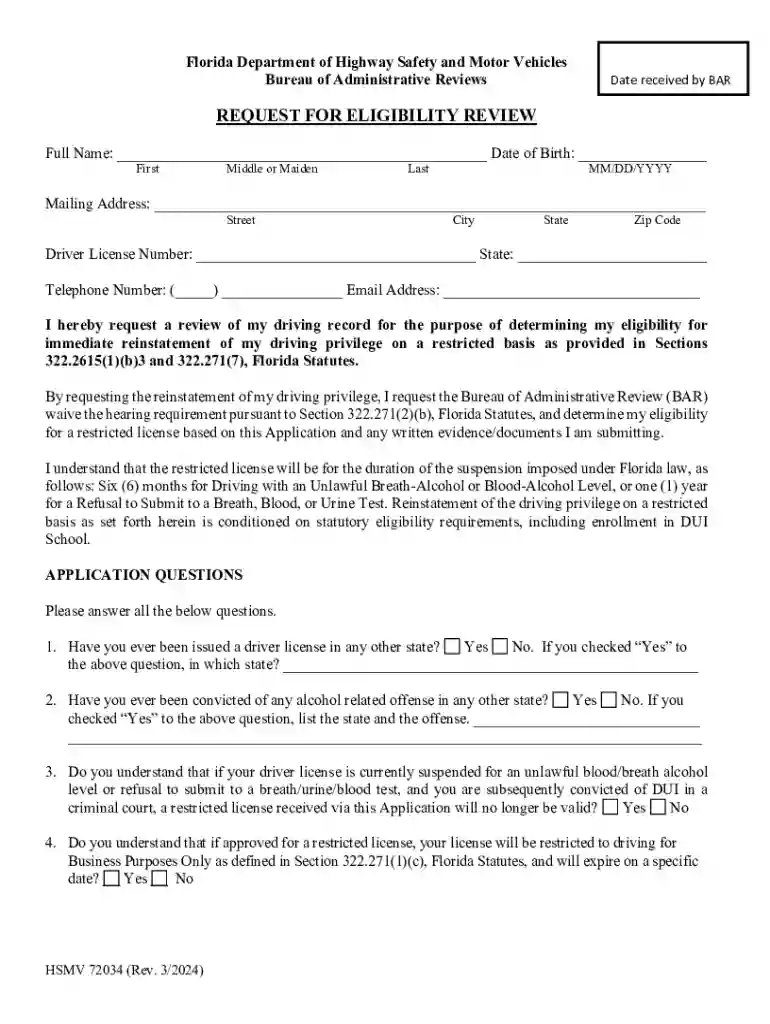
Application for Eligiblity Review 3 24 DRAFT Revised Updated 2026

Get Form
Application for Eligiblity Review 3 24 DRAFT Revised Updated Preview on Page 1

Here's how it works

01. Edit your form online
Type text, add images, blackout confidential details, add comments, highlights and more.

02. Sign it in a few clicks
Draw your signature, type it, upload its image, or use your mobile device as a signature pad.

03. Share your form with others
Send it via email, link, or fax. You can also download it, export it or print it out.

Definition and Meaning

The "Application for Eligibility Review 3 24 DRAFT Revised Updated" is a specific document utilized by individuals seeking to reinstate or review their eligibility for certain privileges, often related to driving or legal statuses in the state of Florida. This application might pertain to individuals who have undergone restrictions due to legal issues, such as driving under the influence (DUI), and are looking to regain their restricted driving privileges. Understanding the nuances of this form is critical for applicants to ensure they provide all necessary information to avoid processing delays.

How to Use the Application for Eligibility Review

This application is specifically intended for individuals needing a review of their eligibility status, often within the context of restricted driving privileges. To use this form effectively:

  1. Gather Personal Information: Prepare your personal details, including your full name, date of birth, and Social Security number.
  2. Compile Driving or Legal History: Collect details of your driving or legal history, focusing on any incidents that might affect your eligibility.
  3. Provide Evidence of Compliance: Include any documentation that demonstrates compliance with previous legal obligations, such as DUI School enrollment.
  4. Affirmation of Information: Ensure the accuracy of all provided information, as you will be required to affirm its truthfulness under penalty of perjury.

Steps to Complete the Application

To complete the "Application for Eligibility Review 3 24 DRAFT Revised Updated," follow these detailed steps:

  1. Carefully Read All Instructions: Before filling out the form, read all the instructions to understand what is required.
  2. Fill Out Applicant Information: Begin by entering all necessary personal information accurately.
  3. Detail Your Driving or Legal History: Provide a comprehensive history of driving incidents or legal issues related to the eligibility review.
  4. Attach Required Documentation: Include any evidence or documentation specified, such as enrollment in educational or remedial programs required for compliance.
  5. Review the Application for Completeness: Before submission, review all the sections to ensure no information is missing.
  6. Sign and Date the Form: Conclude the process by signing and dating the form to affirm the veracity of the information provided.

Eligibility Criteria

Understanding the eligibility criteria is fundamental for applicants who wish to successfully complete the review process. Generally, eligibility may depend on:


  • Compliance with Previous Orders: Ensuring all previous orders, such as fines or classes, have been addressed.
  • Time Elapsed Since Offense: A minimum period may need to pass following the relevant offense before eligibility can be reconsidered.
  • Current Driving Status: The status of your driving privileges, including whether they are currently revoked or suspended.
  • Legal Standing: Any ongoing legal issues that might affect eligibility status.
decoration image ratings of Dochub

Required Documents

Applicants must attach certain documents when submitting their form to ensure it is processed smoothly:

  • Proof of Identity: A government-issued ID or driver’s license.
  • Proof of Address: Utility bills or bank statements verifying your current address.
  • Evidence of Completion of Required Programs: Certificates from DUI school or other mandatory programs.
  • Payment of Filing Fee: Documentation of payment for any required fees associated with the application process.

Form Submission Methods

Depending on the applicant's preference, the application can usually be submitted through various methods:

  • Online Submission: Fastest and most efficient, allowing for quick uploads of necessary documents.
  • Mail Submission: Includes sending a hard copy of the completed application to the specified address, ensuring you keep a copy for your records.
  • In-Person Submission: Visiting the Florida Department of Highway Safety and Motor Vehicles for direct submission and any immediate questions or clarifications.

Penalties for Non-Compliance

Failure to correctly complete or submit the "Application for Eligibility Review 3 24 DRAFT Revised Updated" can result in a range of penalties, including:

  • Continued Restriction of Privileges: Inability to reinstate or review eligibility status, prolonging any restrictions already in place.
  • Additional Fines or Fees: Incurring additional fees due to incomplete or incorrect submissions.
  • Legal Repercussions: In some cases, failure to comply might result in further legal action or complications regarding Tennessee driving or legal privileges.

Application Process and Approval Time

The review and approval process for this application require careful adherence to timelines and conditions, including:

  • Review Process Duration: Typically, the department will take several weeks to process the application and review all components.
  • Notification of Decision: Applicants will be informed via mail or electronic communication regarding the outcome of their review.
  • Possible Appeals: If denied, applicants may be able to appeal the decision within a specified timeframe, requiring additional documentation or evidence.

State-Specific Rules

Florida has specific legal and procedural requirements which must be adhered to when completing the application. These rules can include:

  • Mandatory State Programs: Participation in Florida-specific programs, like state-approved DUI rehabilitation classes, may be required.
  • Compliance with State Deadlines: Meeting deadlines specific to Florida’s regulatory environment is crucial for timely processing.
  • Interaction with State Agencies: Coordination with local departments within Florida for document verification or additional requirements.

Software Compatibility with Document Platforms

For ease of processing, consider leveraging document management platforms:

  • DocHub Integration: DocHub supports a range of document formats and provides tools for completing forms electronically. It assists in editing, annotating, and managing such forms for submission.
  • Cloud Storage Options: Utilizing cloud services like Google Drive, Dropbox, or OneDrive for secure, accessible, and streamlined document management.
  • Security Measures: Ensure any digital handling of the application is secure, with appropriate encryption to protect sensitive information during editing and submission.
be ready to get more

Complete this form in 5 minutes or less

Get form

Got questions?

We have answers to the most popular questions from our customers. If you can't find an answer to your question, please contact us.
Contact us
GE programs include all degree programs at for-profit institutions and all non-degree programs at nonprofit institutions. For community colleges, GE programs are generally certificate programs. The financial value transparency accountability framework (FVT) which applies to non-GE programs.
In a broad sense, general education is defined as a program that develops students general knowledge, literacy, skills, and competencies to equip them with the foundation for lifelong learning and advanced academic curricula (UNESCO Institute for Statistics, 2012).
The short answer is only programs that are at a non-profit or public institution and are at least two academic years in length and that are specifically designed to be a transfer program and that do not lead to a certificate or other credential awarded by the institution are Title IV-eligible non-GE Programs.
The FAFSA Simplification Act will expand the Federal Pell Grant to more students and will link eligibility to family size and the federal poverty level (starting with the 202425 award year).
The Department is on track to launch the 2026-27 FAFSA by Oct. 1, 2025 as mandated by the FAFSA Deadline Act. The Department also announced that current and future FAFSA forms will rightfully reflect the biological reality that there are only two sexes: male and female.

Security and compliance

At DocHub, your data security is our priority. We follow HIPAA, SOC2, GDPR, and other standards, so you can work on your documents with confidence.
Learn more
ccpa2
pci-dss
gdpr-compliance
hipaa
soc-compliance
be ready to get more

Complete this form in 5 minutes or less

Get form

People also ask

Yes, you can still apply for FAFSA (Free Application for Federal Student Aid) even if your parents have a high income. However, the amount of financial aid you receive may be limited because FAFSA primarily considers your familys financial situation when determining your eligibility for need-based aid.
Non-U.S. citizens that qualify for federal student aid are known as eligible noncitizens.
The completers list contains students with programs in a graduated status. For the initial draft completers list, you will review and confirm the accuracy of the student records that NSLDS included on your institutions list.
Here are some key changes to be aware of in the 2024-2025 FAFSA. The FAFSA IS available later than usuaL. The FAFSA form will be significantly shorter. Automated transfer of tax data will be required. The EFC is now the SAI. Students may automatically qualify for Pell Grants. Students can send the FAFSA to more colleges.
Beginning with the 2024-25 FAFSA form, the Expected Family Contribution (EFC) will be replaced with a Student Aid Index (SAI). The formula for calculating the Student Aid Index (SAI) is: Estimated Cost of Attendance (COA) Student Aid Index (SAI) = financial need.

Related links