



01. Edit your form online
Type text, add images, blackout confidential details, add comments, highlights and more.

Type text, add images, blackout confidential details, add comments, highlights and more.

Draw your signature, type it, upload its image, or use your mobile device as a signature pad.

Send it via email, link, or fax. You can also download it, export it or print it out.
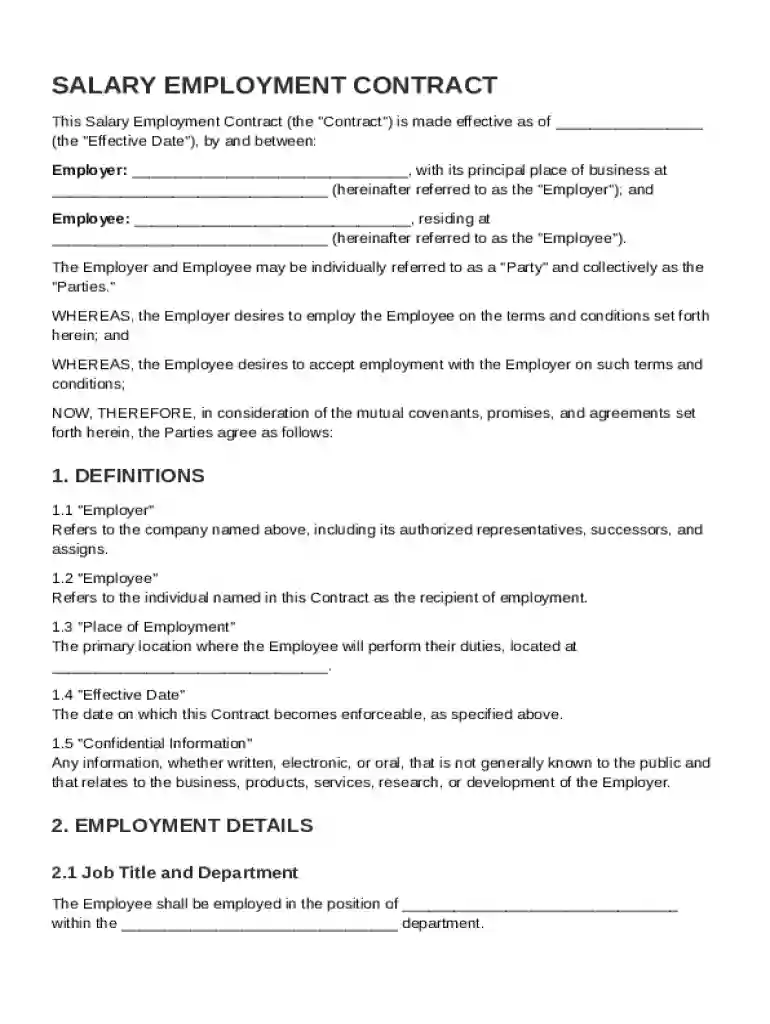
A Salary Employment Contract Template is a structured document used to outline the terms and conditions between an employer and an employee. This contract is crucial for establishing clear expectations regarding job responsibilities, salary, benefits, work schedules, and other employment details. By formalizing these key aspects, both parties are better protected, and potential misunderstandings are minimized. Essential elements typically encompass definitions of key terms, employment details, and clauses related to confidentiality and non-compete agreements.
Employment Details: Specifies job title, description, and responsibilities, ensuring that the employee understands their role.
Compensation Package: Clarifies salary, payment frequency, and any available bonuses or incentives.
Benefits: Lists the additional perks offered, such as health insurance, retirement plans, and vacation time.
Work Schedule: Outlines hours of work, including regular, overtime, and shift requirements.
Termination Conditions: Details conditions under which the contract can be terminated, including notice periods and severance pay.
Confidentiality Agreements: Protects the employer's proprietary information and specifies what constitutes a breach.
Utilizing the Salary Employment Contract Template involves a straightforward process. Start by downloading the template from a reliable source, such as DocHub, then follow these steps to customize it:
Fill in Basic Details: Begin with the employee's and employer's names, contact information, and start date.
Customize Employment Terms: Tailor the job title, description, compensation, and benefits to match the specific role.
Adjust Legal Clauses: Modify sections like termination, confidentiality, and non-compete clauses in alignment with company policy and legal requirements.
Review and Revise: Ensure accuracy by reviewing the template for clarity and completeness.
Sign and File: Once finalized, both parties should sign the document, maintaining copies for their records.
Consider a marketing firm hiring a project manager. The employer would customize the template to include the title "Project Manager," detail salary specifics, define work expectations, and include confidentiality terms relevant to the firm's trade secrets.
Understanding specific terminologies within the Salary Employment Contract Template enhances clarity and compliance. Key terms include:
Probationary Period: A set timeframe where the employer evaluates the employee's performance before confirming permanent employment.
Severance Pay: Compensation provided to an employee upon involuntary termination, calculated according to the contract’s terms.
Governing Law: Indicates which jurisdiction's laws apply to the contract, significantly impacting the contract's enforcement and interpretation.
Amendments Clause: Details how changes to the contract are handled, including the requirement for written agreement between parties.
The Salary Employment Contract Template is drafted to comply with employment laws, assisting employers in adhering to legal requirements. It must address mandatory components such as:
Fair Labor Standards Act (FLSA): Ensures that employment terms regarding wages and work hours meet legal standards.
Equal Employment Opportunity Laws: Enforces non-discriminatory practices in hiring, providing equal opportunities to all applicants.
State Employment Laws: Varies by location, covering minimum wages, labor rights, and employee protections.
A tech start-up expands into two states with different minimum wage laws. The employer must adjust the salary terms within each contract version to comply with state-specific wage requirements, demonstrating the necessity of tailored contracts.
Completing the Salary Employment Contract Template involves a series of strategic steps to ensure that all relevant information is captured and agreed upon:
Gather Job-Specific Information: Compile necessary details about the job role, expected outputs, and compensation package.
Consult Legal Guidance: Ensure alignment with applicable labor laws and obtain legal advice if needed.
Draft Initial Version: Customize the template to reflect specific employment terms and conditions.
Review with Employee: Discuss the contract details with the prospective employee, offering an opportunity for questions and clarifications.
Finalize and Sign: Make necessary adjustments, obtain signatures from both parties, and disperse signed copies.
Employment contracts may need adjustments based on varying state laws in the United States. For instance, employment-at-will doctrines and required benefits can differ:
California: Offers strong employee protections, requiring explicit terms regarding at-will employment.
New York: Mandates clear articulation of employee entitlements and termination guidelines.
Texas: Generally aligns with federal standards but allows for customization based on employment policies.
A company operating across multiple states may use the Salary Employment Contract Template to create versions that respect regional employment laws, such as mandated breaks or paid leave differences.
The Salary Employment Contract Template serves diverse industry applications, illustrating its flexibility:
Corporate Sector: Used for formalizing executive roles with detailed responsibilities, compensation structures, and exclusive agreement clauses.
Retail Industry: Adapts to include flexible scheduling terms and commission-based compensation models for sales employees.
Healthcare: Includes licensing requirements and continuing education obligations for medical professionals, ensuring adherence to industry standards.
A retail chain employing seasonal workers can modify contract terms within the template to suit temporary employment arrangements, providing clarity on duration, roles, and compensation.
At DocHub, your data security is our priority. We follow HIPAA, SOC2, GDPR, and other standards, so you can work on your documents with confidence.




Remote Work Agreement. I may work remotely to perform portions of my assigned duties at home. the duties, responsibilities, and conditions of my employment and
The employee is responsible for securing the equipment provided to the employee. THIS IS A SAMPLE! Feel free to use or modify it for your own use! The employee


