




01. Edit your form online
Type text, add images, blackout confidential details, add comments, highlights and more.

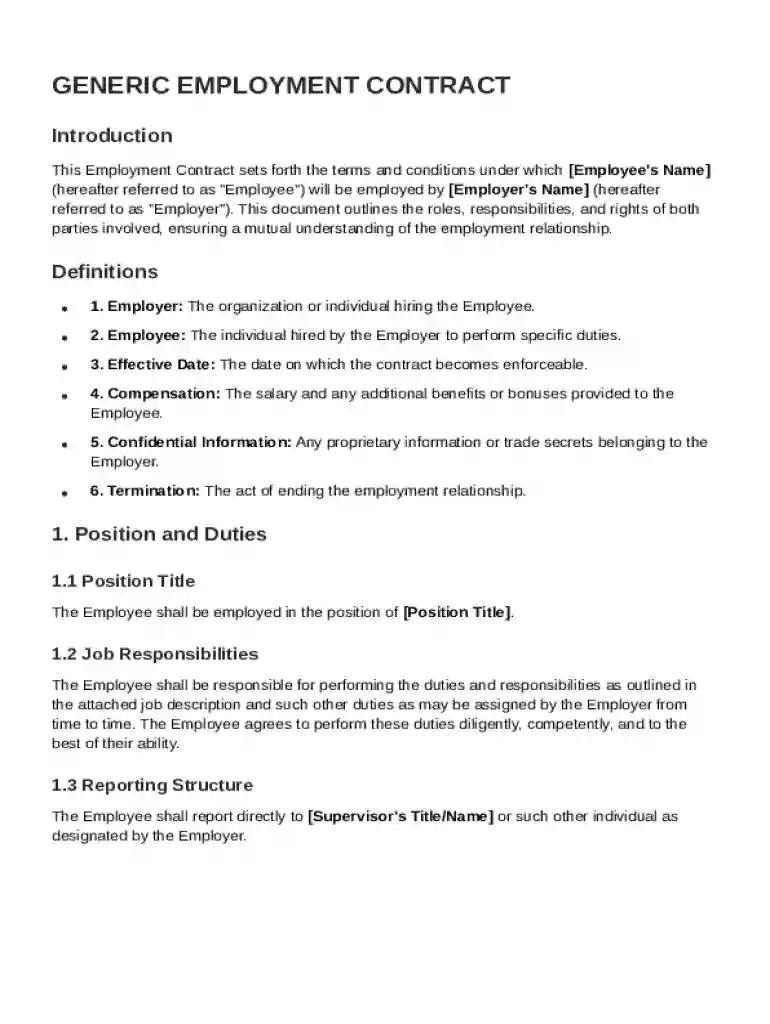
Type text, add images, blackout confidential details, add comments, highlights and more.

Draw your signature, type it, upload its image, or use your mobile device as a signature pad.

Send it via email, link, or fax. You can also download it, export it or print it out.
A Generic Employment Contract Template serves as a comprehensive document that establishes the terms and conditions of employment between an employee and an employer. This template is designed to provide a structured outline, ensuring that both parties have a clear understanding of their rights and obligations under the employment arrangement. The template typically includes essential components such as job responsibilities, compensation, benefits, work hours, confidentiality obligations, and termination procedures.
By standardizing these elements, the Generic Employment Contract Template simplifies the process of drafting a legally sound employment contract. It can be tailored to meet specific needs while maintaining the foundational clauses that protect both parties. This ensures legal compliance and provides clarity, reducing the potential for disputes or misunderstandings.
Using the Generic Employment Contract Template involves several crucial steps to customize the document according to the specific employment relationship. Here’s a step-by-step guide:
Review the Template: Begin by examining the template to understand its structure and the components that need customization.
Modify Job Details: Customize sections detailing job responsibilities, position title, and work schedule. Ensure accuracy to reflect the actual job expectations.
Adjust Compensation Terms: Specify salary, hourly wages, or commission structures, including payment frequency. Mention benefits such as health insurance, retirement plans, or bonuses.
Set Confidentiality Obligations: Detail any non-disclosure agreements or confidentiality clauses, especially if sensitive information will be accessed during employment.
Define Termination Procedures: Include the conditions under which the contract can be terminated, notice periods required, and any severance arrangements.
Review with Legal Counsel: Consult with a legal expert to ensure compliance with local and federal labor laws before finalizing the document.
The Generic Employment Contract Template is structured around several key elements that constitute a legally binding agreement. These components ensure comprehensive coverage of the employment arrangement:
Employee and Employer Details: Identification information such as names, addresses, and contact details of both parties.
Job Description: A detailed account of the employee's roles and responsibilities, expected performance standards, and specific duties.
Compensation and Benefits: Clear explanation of salary, pay schedule, bonuses, incentives, and benefits like health insurance or paid leave.
Work Hours and Conditions: Specifics on working hours, overtime policies, and arrangements for remote or flexible working conditions.
Confidentiality and Non-Compete Clauses: Terms protecting the employer’s proprietary information and limiting the employee's ability to engage in competitive activities post-employment.
Termination and Severance: Guidelines for ending the employment relationship, including notice requirements and potential severance packages.
These elements ensure clarity and mutual understanding, which are pivotal in minimizing legal disputes and ensuring a harmonious work relationship.
The Generic Employment Contract Template must be used in compliance with applicable labor laws to be legally enforceable. This involves considering various legal aspects:
Compliance with Labor Laws: Ensure that the contract adheres to local, state, and federal employment laws, including those related to discrimination, wage and hour laws, and employee rights.
Incorporation of Mandatory Clauses: Include clauses required by law, such as employee rights notices, workplace safety commitments, and accommodations for disabilities.
Review by Legal Experts: Engagement with a legal expert to review the contract ensures that it meets all legal standards and is enforceable in court.
By addressing these legal requirements, the Generic Employment Contract Template can function as a robust tool for maintaining lawful employment practices.
Understanding the terminology used within a Generic Employment Contract Template is essential for accurately interpreting the contract. Key terms often include:
Probationary Period: The initial phase of employment during which the employee's performance is evaluated before confirming permanent employment.
At-Will Employment: A clause indicating that either party can terminate the employment relationship at any time without specific cause, subject to legal obligations.
Severance Pay: Compensation provided to an employee upon termination of employment, particularly in cases of layoffs or dismissals without cause.
Covenant Not to Compete: An agreement restricting the employee from engaging in business activities that directly compete with the employer post-employment.
Understanding these terms helps both parties navigate the contract and uphold their respective rights and responsibilities.
Filling out a Generic Employment Contract Template involves a series of actions to ensure all relevant information is accurately captured. These steps provide a framework for completion:
Gather Required Information: Collect details about both parties, job specifications, and agreed-upon terms.
Customize Sections: Modify generic sections to reflect specific employment terms, such as compensation, and employee duties.
Insert Legal Clauses: Ensure all legal requirements are included by adding any necessary clauses for confidentiality and non-compete.
Double-Check for Accuracy: Review the entire document for consistency and accuracy, making sure all data is current and complete.
Obtain Legal Validation: Have the document reviewed by a legal professional to verify compliance and validity.
Secure Signatures: After finalizing, obtain signatures from both the employee and employer to formalize the agreement.
By following these steps, the template can be effectively utilized to deliver a comprehensive employment contract suitable for the specific situation.
Employment laws can vary significantly from state to state, affecting how the Generic Employment Contract Template must be adapted. Here are some considerations:
Minimum Wage Laws: States may have different minimum wage requirements, which should be reflected in the compensation agreements of the contract.
Right-to-Work Laws: Familiarize with state-specific legislation regarding union memberships and dues, if applicable to the employment scenario.
Paid Leave Regulations: Ensure compliance with state mandates on family leave, sick leave, or other time-off entitlements.
Employment Classification Guidelines: Understand state rules regarding the classification of employees vs. independent contractors, as misclassification can lead to legal repercussions.
Keeping these variations in mind ensures the contract remains compliant with the specific legal environment of the workplace.
Different individuals and organizations benefit from using a Generic Employment Contract Template. Typically, these include:
Small to Medium Businesses: They use templates as a cost-effective means to formalize employment terms without extensive legal resources.
Human Resources Departments: HR professionals leverage templates to ensure uniformity and compliance across all employment contracts within an organization.
Entrepreneurs and Startups: New business owners with limited legal infrastructure find templates invaluable in standardizing employment processes.
Freelancers and Contractors: They use tailored contracts to formalize agreements with clients and protect both parties from future disputes.
These users rely on the template for consistency and legal reliability, ensuring every employment relationship is documented systematically.


The Generic Employment Contract Template is versatile and applies to various employment situations:
Hiring New Employees: Employers use the template to establish terms when onboarding new staff, providing clarity from the onset.
Amending Current Contracts: When employment conditions change, such as role expansion or shifts in responsibilities, the template facilitates updates without drafting new contracts from scratch.
Temporary or Probationary Employment: Offers a structured framework to delineate terms for short-term roles or trial periods, ensuring expectations and evaluation processes are clear.
Remote Work Arrangements: As remote work gains prominence, the template can specify conditions unique to remote roles, such as communication protocols and work hour expectations.
By accommodating these scenarios, the template ensures that organizations and individuals can adapt their contracts to fit various employment contexts while maintaining legal integrity.
At DocHub, your data security is our priority. We follow HIPAA, SOC2, GDPR, and other standards, so you can work on your documents with confidence.


