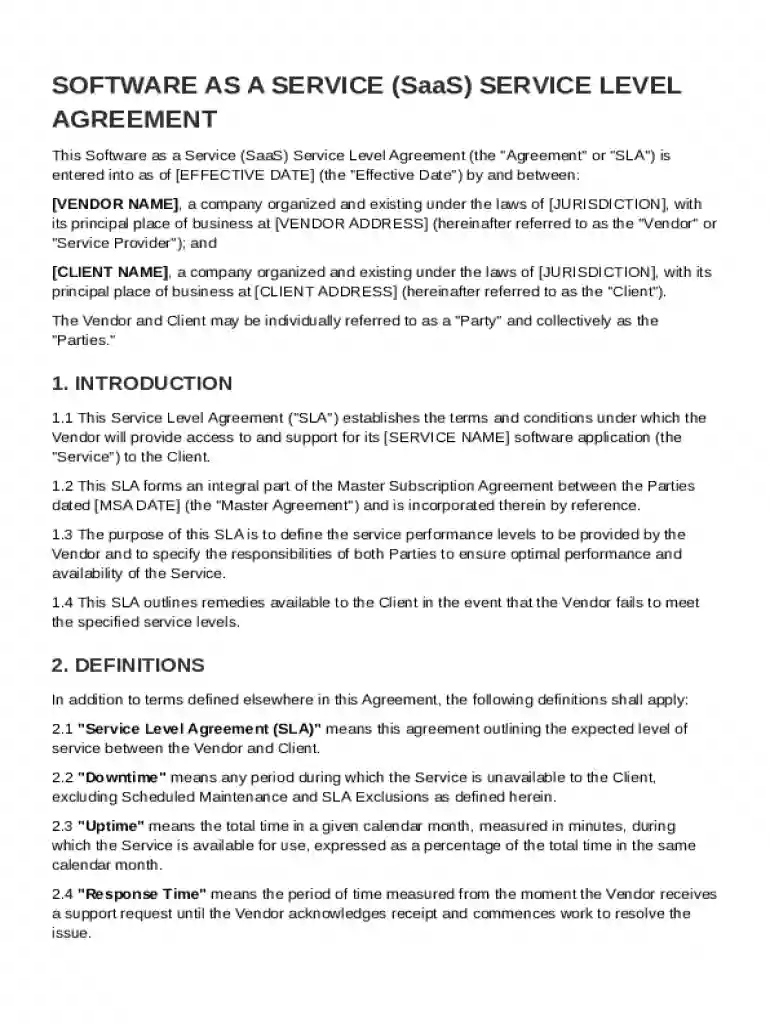
Definition and Meaning
A Software as a Service (SaaS) Service Level Agreement (SLA) Template is a formal document that establishes the terms and conditions between a service provider (the Vendor) and the customer (the Client). The template outlines specific metrics, responsibilities, and expectations to ensure a reliable and satisfactory delivery of services. This includes detailing performance standards such as uptime, response times, and resolution times. The SLA serves as a foundational agreement guiding the relationship between the two parties, setting predetermined obligations and remedies for violations.
Key Components of an SLA
- Uptime Requirements: The percentage of guaranteed service availability.
- Response Time Commitments: Time frames for initial response to client issues.
- Resolution Time Frames: Periods within which issues will be fully resolved.
- Support Availability: Specifies the availability of support and consultation services.
- Client Responsibilities: Duties or steps required by the client to fulfill the agreement.
How to Use the SaaS Service Level Agreement Template
Employing the SaaS Service Level Agreement Template properly involves multiple steps to ensure clarity and mutual understanding between the involved parties. Begin by reviewing the template to ensure it aligns with the services offered and the client's needs. Modify the sections to suit specific requirements and insert company-centered information such as contact details and bespoke performance metrics.
Detailed Usage Instructions
- Review Existing Clauses: Scrutinize each clause to understand and adjust as necessary.
- Customize Metrics: Adjust performance metrics such as uptime and response times according to industry standards.
- Clarify Defined Terms: Ensure all terms such as 'Downtime', 'Vendor', and 'Client' are coherently defined.
- Fill with Specific Data: Input specific data relating to both the Vendor and Client such as names and contact information.
- Legal Review: Conduct a comprehensive legal review to ensure compliance with applicable laws and regulations.
Steps to Complete the SaaS Service Level Agreement Template
Completing the SaaS Service Level Agreement Template requires precise attention to detail and adherence to the outlined structure. Follow these steps to ensure a thorough completion of the SLA Template.
- Gather Information: Collect all necessary information regarding the services, performance metrics, and client responsibilities.
- Fill Out Sections: Complete each section with the relevant data, leaving no fields blank.
- Consult with Legal Counsel: Engage legal counsel to review filled sections for compliance and legal viability.
- Revise as Needed: Make necessary revisions based on feedback from legal and technical stakeholders.
- Final Review and Approval: Conduct a final review with both parties to confirm accuracy and readiness.
- Signature Collection: Arrange for both parties to sign the document, ensuring all collected signatures are legally binding.
Key Elements of the SaaS Service Level Agreement Template
The Key Elements outlined in the SaaS Service Level Agreement Template serve as the backbone of any successful agreement. These define performance expectations and serve as a reference point for handling any discrepancies.
Crucial Elements Include:
- Service Description: Detailed description of the services provided by the Vendor.
- Performance Metrics: Quantitative metrics to measure service effectiveness and reliability.
- Reporting Procedures: Guidelines for documenting and reporting service issues.
- Service Review: Periodic review schedules to evaluate service delivery performance.
- Remedy Mechanisms: Processes for managing and resolving service failures.
- Exclusions: Instances that do not count as violations of the SLA, such as scheduled maintenance.
Legal Use of the SaaS Service Level Agreement Template
Utilizing the SaaS Service Level Agreement Template legally involves ensuring all obligations and rights are clearly defined and lawful. The document should align with legal standards and regulations applicable in the United States context and possibly incorporate arbitration clauses for dispute resolution.
Legal Compliance Aspects
- Adherence to Federal Laws: Ensure compliance with federal regulations for SaaS delivery.
- Incorporation of State Laws: Account for any influential state-specific laws, particularly for where both vendor and client are located.
- Data Protection Clauses: Include sufficient data privacy and security guarantees to comply with laws like GDPR or CCPA.
Important Terms Related to SaaS Service Level Agreement Template
Understanding the terminology within the SaaS Service Level Agreement Template is crucial for realizing its complexity and mutual obligations. The glossary of terms should facilitate a smoother negotiation and interpretation process.
Essential Terms to Know
- Uptime: The time during which the system is operational and functioning effectively.
- Downtime: Periods when the system is unavailable or non-functional, excluding scheduled maintenance.
- Incident Management: Processes for identifying, managing, and resolving service issues.
- Breach: A violation of terms as specified in the SLA.
- Compensation: Remedies or penalties if performance metrics are not met.
Who Typically Uses the SaaS Service Level Agreement Template
The SaaS Service Level Agreement Template is typically utilized by organizations offering SaaS products and their clients who require a structured roadmap governing service delivery.

Typical Users Include:
- Software Vendors: Companies developing and delivering SaaS solutions.
- IT Departments: Teams managing cloud-based applications and services.
- Business Clients: Enterprises purchasing cloud services for their operational needs.
- Legal Teams: Advisors ensuring compliance with industry standards and legal requirements.
Examples of Using the SaaS Service Level Agreement Template
Exploring practical applications of the SaaS Service Level Agreement Template illustrates its versatility and utility across various sectors.
Practical Scenarios
- New SaaS Deployments: Companies launching new SaaS products can use the SLA to outline the framework of service delivery to early adopters.
- Annual Contract Renewals: Revision and redrafting of SLAs for ongoing customer agreements to incorporate updated policies or metrics.
- Vendor Management: Organizations using multiple SaaS solutions from various vendors employ SLAs to manage and compare service quality and reliability.