




01. Edit your form online
Type text, add images, blackout confidential details, add comments, highlights and more.

Type text, add images, blackout confidential details, add comments, highlights and more.

Draw your signature, type it, upload its image, or use your mobile device as a signature pad.

Send it via email, link, or fax. You can also download it, export it or print it out.
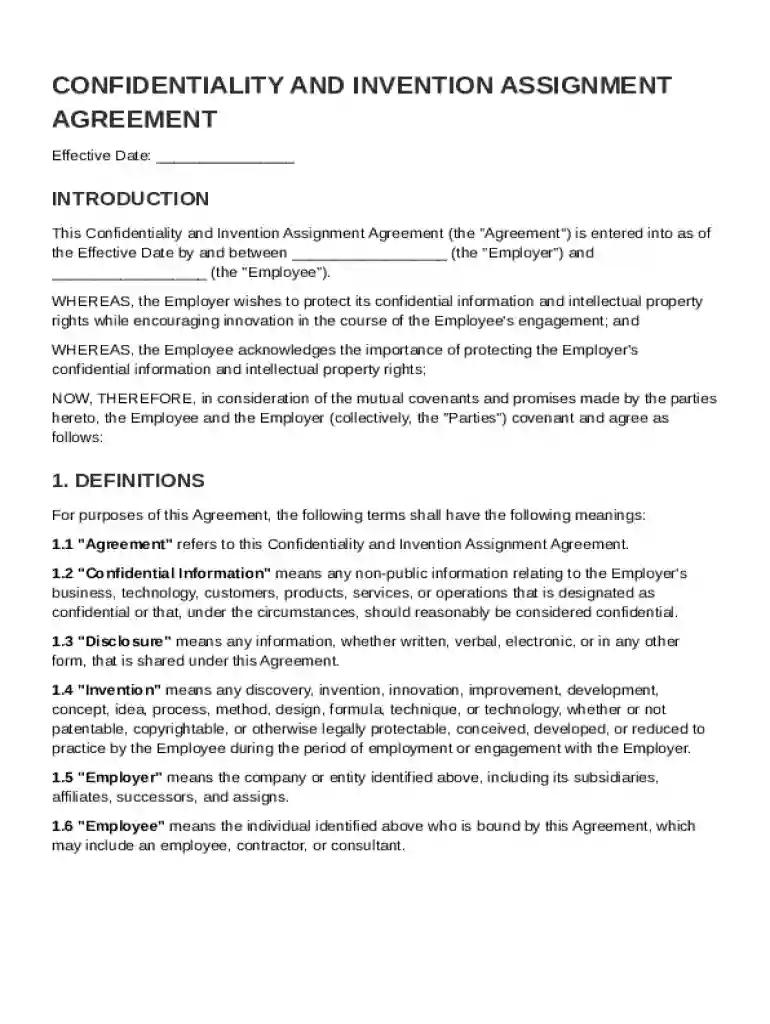
The Confidentiality and Invention Assignment Agreement Template is a legal document designed to protect an employer's proprietary information and intellectual property. It establishes the obligations of employees to maintain confidentiality regarding sensitive information and assigns ownership of any inventions created during their tenure to the employer. The agreement aims to safeguard the employer's innovations and trade secrets by clearly defining terms such as "Confidential Information" and "Invention" and outlining the employee's responsibilities both during and after their employment.
This document ensures that both parties understand their rights and duties concerning confidential information and inventions, providing a legal framework to prevent unauthorized use or disclosure of valuable intellectual property.
Using the Confidentiality and Invention Assignment Agreement Template involves several steps to tailor it to specific needs:
By following these steps, both parties can ensure that the document accurately reflects their agreement and minimizes the risk of disputes.
The template includes several critical elements that collectively ensure comprehensive protection and clarity:
These elements create a structured approach to managing intellectual property within an organization, providing clear guidelines for all involved parties.
The legal use of this agreement involves ensuring that it adheres to relevant federal and state laws regarding employment and intellectual property rights. In the United States, compliance with the ESIGN Act confirms the document's validity when executed electronically. Additionally, the agreement must not infringe on an employee's rights under laws such as the National Labor Relations Act, which protects certain types of employee communications.
Employers must ensure the agreement is enforceable, which often means seeking legal advice to tailor the document to their specific jurisdiction and circumstances.
Understanding the key terms used within the agreement is essential for its effective implementation:
Such terms clarify the specific responsibilities and protections provided under the agreement, making it easier for parties to comply with its provisions.
Completing the agreement requires careful attention to detail to ensure all relevant aspects are addressed:
These steps help create a legally sound document that effectively protects the employer’s interests.
The template can be applied in various real-world scenarios, such as:
In each case, the agreement helps ensure that sensitive information and proprietary innovations are safeguarded, fostering an environment of trust and innovation.
State laws can significantly affect the enforceability and interpretation of these agreements. For instance, California has specific regulations under the California Labor Code that restrict the assignment of inventions created outside of an employee's work hours using the employer's equipment. Employers must ensure that the agreement complies with the jurisdiction's legal requirements, which may require including or omitting certain clauses to maintain validity and enforceability.
Understanding these variations is crucial, as non-compliance can render parts of the agreement unenforceable, undermining its protective intent.
At DocHub, your data security is our priority. We follow HIPAA, SOC2, GDPR, and other standards, so you can work on your documents with confidence.


