



01. Edit your form online
Type text, add images, blackout confidential details, add comments, highlights and more.

Type text, add images, blackout confidential details, add comments, highlights and more.

Draw your signature, type it, upload its image, or use your mobile device as a signature pad.

Send it via email, link, or fax. You can also download it, export it or print it out.
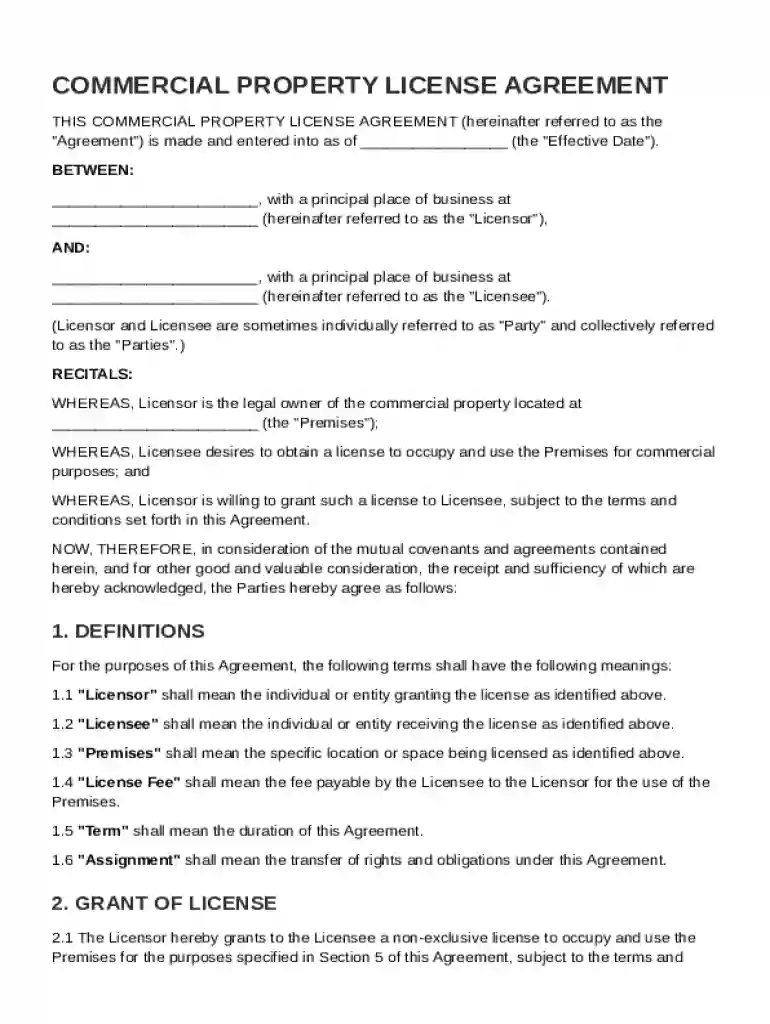
The Commercial Property License Agreement Template is a legal document used to outline the specific terms and conditions under which a property owner, known as the Licensor, grants another party, the Licensee, the right to use and occupy a commercial property. This template includes detailed sections regarding the definitions of various terms, the license fee, permitted uses of the property, and the parties' respective rights and responsibilities. Unlike a lease, this agreement does not create a leasehold interest; it maintains that the Licensee has a temporary, revocable right to use the premises under the specified conditions.
The template contains a section detailing the license fee payable by the Licensee to the Licensor. This fee is generally specified as a regular payment that allows the Licensee to use the premises. The template should outline the frequency of payments, such as monthly or annually, and specify any penalties for late payments. Real-world scenarios might include agreements where variable fees are adjusted based on the area of the property being used or the time of year (e.g., seasonal businesses).
The agreement template specifies the designated uses of the commercial property. This section ensures that the Licensee uses the property within the parameters the Licensor defines. For example, a retail space in a shopping mall might be restricted to use only for selling specific categories of merchandise. Including this detail prevents unauthorized activities that might conflict with other tenants or violate local zoning laws.
Both the Licensor and Licensee have specific maintenance responsibilities detailed in the template. This section clarifies who is responsible for routine upkeep, repairs, and any modifications to the property. For instance, the Licensee might be required to maintain the interior of the space, while the Licensor handles structural repairs and exterior maintenance.
The duration of the license and conditions for its termination are crucial elements. The agreement should specify the start and end dates, along with provisions for early termination or extension if applicable. Terms should be clear to avoid disputes, such as what constitutes a breach of the agreement that might lead to termination.
Insurance is an essential aspect of the agreement, covering liability and protecting both parties against damages or losses. The template should detail the types of insurance required, such as general liability or property insurance, and specify the minimum coverage amounts. Example provisions might require the Licensee to provide proof of insurance before commencing use of the property.
A legally compliant Commercial Property License Agreement Template ensures that the rights and obligations of both the Licensor and Licensee are enforceable under U.S. law. It should be aligned with federal and state regulations relevant to commercial property use. Legal considerations include ensuring compliance with zoning laws and accessibility requirements, which vary by state.
States may have distinct regulations affecting commercial property agreements. For instance, California might have specific disclosure requirements regarding environmental hazards, while New York might enforce stringent guidelines on usage restrictions and termination conditions. Customizing the template to align with these state-specific rules ensures that it remains legally effective and reduces the risk of future disputes.
Geographical location impacts legal requirements and business practices under this template. For instance, properties in coastal states may require additional clauses addressing environmental protection, while central states might focus on agricultural land use specifics. Understanding these differences is crucial when drafting or executing an agreement to ensure statewide compliance and acknowledgment of local business customs.
This template is particularly useful for business entities that only require temporary use of a property, such as pop-up shops, seasonal businesses, and event management companies. It provides flexibility for companies that need short-term commitments rather than the long-term obligations typical of a standard lease. Non-profits hosting annual events and startups testing market locations also find this template advantageous for its adaptability and ease of use.
At DocHub, your data security is our priority. We follow HIPAA, SOC2, GDPR, and other standards, so you can work on your documents with confidence.



This End-User License Agreement is a legal agreement between you. All copyrights, industrial property rights and other property rights to the Software
Template License Agreement. [APPROPRIATE RECITALS]. 1 Date and ending on the date of the first commercial sale of a Licensed Product in the Territory,Read more


