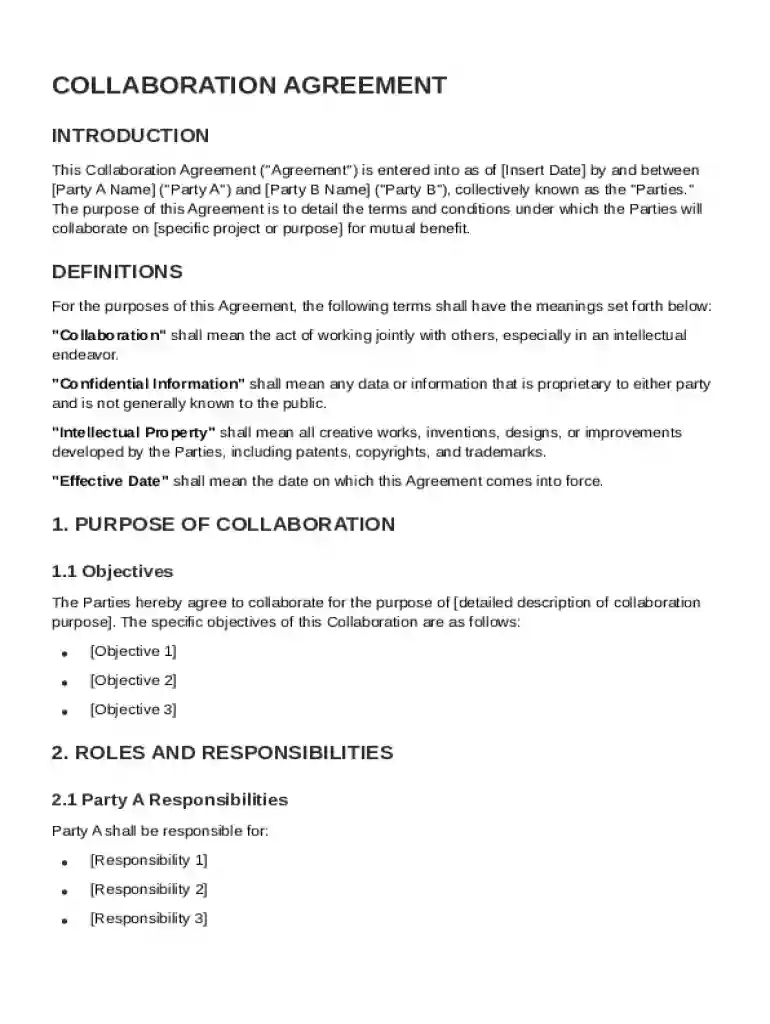
Key Elements of the Collaboration Agreement Template
A Collaboration Agreement Template is a structured document that outlines the essential components of a working relationship between two or more parties involved in a joint project. This document typically includes:
- Definitions: Clarifies key terms used throughout the agreement to ensure mutual understanding.
- Objectives: Specifies the goals of the collaboration, providing a clear direction and purpose for all parties involved.
- Roles and Responsibilities: Details the specific tasks and duties expected from each party, ensuring accountability.
- Financial Contributions and Resource Sharing: Outlines the financial obligations and the sharing of resources among parties to prevent disputes.
- Communication Protocols: Establishes methods and frequency of communication to keep all parties informed and coordinated.
- Confidentiality Obligations: Sets rules for handling sensitive information shared during the collaboration.
- Intellectual Property Rights: Allocates the rights and ownership of any intellectual property developed during the project.
- Termination Clauses: Describes conditions under which the agreement can be terminated, protecting parties’ interests in case of unforeseeable issues.
These elements ensure comprehensive coverage of all necessary aspects for a successful collaboration.
How to Use the Collaboration Agreement Template
Utilizing a Collaboration Agreement Template involves a step-by-step process that demands careful attention to detail:
- Gather Information: Collect relevant data about the parties involved, project objectives, and specific terms to be included.
- Customize the Template: Adapt the template to fit the unique requirements of the collaboration. This includes adding specific roles, responsibilities, and resources.
- Review Legal Considerations: Verify that the document complies with applicable state laws and regulations.
- Draft Clauses Carefully: Include detailed clauses covering every aspect of the collaboration, ensuring clarity and mutual understanding.
- Seek Legal Advice: Engage with legal professionals to review and validate the document for enforceability.
- Distribute for Review: Share the draft with all parties for feedback and modifications.
- Finalize the Document: Incorporate any agreed changes and secure signatures from all parties to formalize the agreement.
Following these steps ensures the collaboration agreement is tailored, legally valid, and effectively sets the framework for the project.
Legal Use of the Collaboration Agreement Template
Using a Collaboration Agreement Template within a legal context requires understanding several essential legal aspects:
- Enforceability: Ensure the agreement complies with relevant contract laws to be legally binding.
- Jurisdiction: Specify which state’s laws will govern the agreement to avoid jurisdictional issues.
- Dispute Resolution: Include mediation or arbitration clauses to handle disputes efficiently and out of court.
- Confidentiality: Legally binding confidentiality clauses protect sensitive information and intellectual property.
- Amendments: Allow for amendments to the agreement with mutual consent to adapt to changing project circumstances.
Employing these legal considerations protects all parties’ rights and duties, ensuring the agreement's integrity.
Examples of Using the Collaboration Agreement Template
Real-world scenarios demonstrate how the Collaboration Agreement Template is applied across different contexts:
- Technology Startups: Two tech companies jointly developing a new software application can use the agreement to outline intellectual property rights and resource sharing.
- Academic Research: Universities collaborating on scientific research projects benefit from clearly defined roles, financial contributions, and publication rights.
- Music Production: Musicians and producers work together using the template to clarify revenue sharing, creative input, and rights to compositions.
- Manufacturing Partnerships: Two manufacturing firms joining forces on production deal benefit from clearly outlined material supply terms and responsibilities.
These examples illustrate the template's adaptability across industries, facilitating smooth cooperation.
Important Terms Related to Collaboration Agreement Template
When dealing with a Collaboration Agreement Template, various terms are critical:
- Joint Venture: A business arrangement where parties agree to pool resources for a specific project.
- Due Diligence: The investigation and evaluation process undertaken before finalizing the agreement.
- Non-disclosure Agreement (NDA): A contract that restricts parties from disclosing confidential information.
- Breach of Contract: A violation of any terms agreed upon in the contract, potentially leading to legal action.
- Indemnification: A clause where one party agrees to compensate another for certain losses or damages.
Understanding these terms improves clarity and reduces the risk of misunderstandings.
State-Specific Rules for the Collaboration Agreement Template
The applicability and regulations of a Collaboration Agreement Template can vary significantly across states:
- Contract Law Variances: Different states may have unique requirements for enforceability.
- Filing Requirements: Some states might require filing the agreement with a regulatory body for specific industries.
- Intellectual Property Laws: The handling and assignment of IP can differ based on state regulations.
- Special Clauses: States may mandate inclusion of certain clauses for compliance, such as consumer protection elements.
Adhering to state-specific rules ensures the agreement's validity and alignment with local laws.
Steps to Complete the Collaboration Agreement Template
Filling out this template involves specific tasks:
- Enter Party Information: Input the names, addresses, and contacts of involved parties.
- Define the Scope: Clearly outline the project's purpose, including goals and objectives.
- Specify Terms: Detail financial contributions, resources, and role distributions.
- Include Legal Clauses: Add necessary legal protections, such as confidentiality, termination, and dispute resolution.
- Review: Have all parties revisit the agreement to ensure accuracy and completeness.
- Sign and Validate: All parties should sign and, if necessary, notarize the document for legal standing.
These steps guide users through completing the template effectively, ensuring it is ready for implementation.