01. Edit your form online
Type text, add images, blackout confidential details, add comments, highlights and more.

Type text, add images, blackout confidential details, add comments, highlights and more.

Draw your signature, type it, upload its image, or use your mobile device as a signature pad.

Send it via email, link, or fax. You can also download it, export it or print it out.
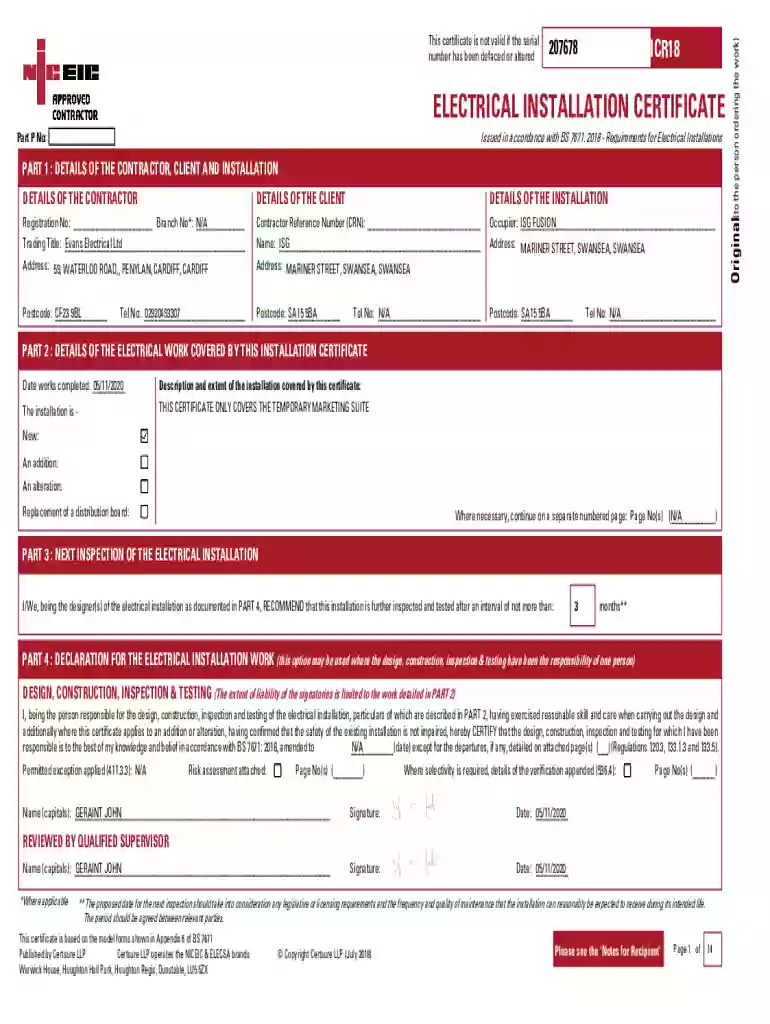
A Part P certificate and a BS 7671 certificate are critical documents within the electrical industry in the United Kingdom. The Part P certificate demonstrates compliance with electrical safety standards specific to domestic electrical installations as mandated by Building Regulations. On the other hand, the BS 7671 certificate is aligned with the standards set out in the Wiring Regulations, covering comprehensive safety measures applicable to electrical installations across different settings. Understanding these certificates is vital for ensuring electrical safety and legal compliance.
To obtain a Part P certificate, start by hiring a registered electrician. The electrician must be part of a government-approved scheme that ensures compliance with Part P of the Building Regulations. Once the work is completed, the electrician will issue the Part P certificate, confirming that the installation meets the necessary safety standards.
For a BS 7671 certificate, similar procedures apply, but it often relates to broader installation scenarios. Contractors or electricians carry out inspections and tests as outlined in BS 7671 standards. Upon successful completion of the required checks, the certificate is issued as proof that the installation adheres to the safety benchmarks established by BS 7671.
Both certificates contain essential information such as details of the electrical contractor, the specific work undertaken, and any recommendations for future inspections or maintenance. The Part P certificate will specify compliance with Building Regulations, while the BS 7671 certificate will list the specific sections of the Wiring Regulations adhered to during the installation.
Obtaining these certificates is crucial for multiple reasons. Primarily, they ensure the safety and reliability of electrical installations. This is not only important for the inhabitants of a property but also for compliance with legal and safety standards. Furthermore, having these certifications can be significant during property transactions, serving as proof of compliant electrical installations that could impact the property's value and insurability.
Homeowners, landlords, and property developers commonly require Part P certificates to satisfy Building Regulation compliance. Electricians and contractors responsible for larger or more complex installations typically use BS 7671 certificates to validate that the work adheres to industry standards.


Legally, these certificates serve as proof of compliance with necessary electrical safety standards. Without these documents, a property owner or operator risks legal penalties, including fines and potentially being ordered to make retrospective compliance changes. This underscores their importance, as they not only affirm quality work but also provide a legal safeguard.
Consider a property developer overseeing new housing projects. Obtaining BS 7671 certificates ensures that all completed installations are legally recognized as safe for habitation. Similarly, a homeowner undertaking significant renovations would need a Part P certificate to demonstrate that any electrical work aligns with safety regulations, thus ensuring both peace of mind and property value.
At DocHub, your data security is our priority. We follow HIPAA, SOC2, GDPR, and other standards, so you can work on your documents with confidence.