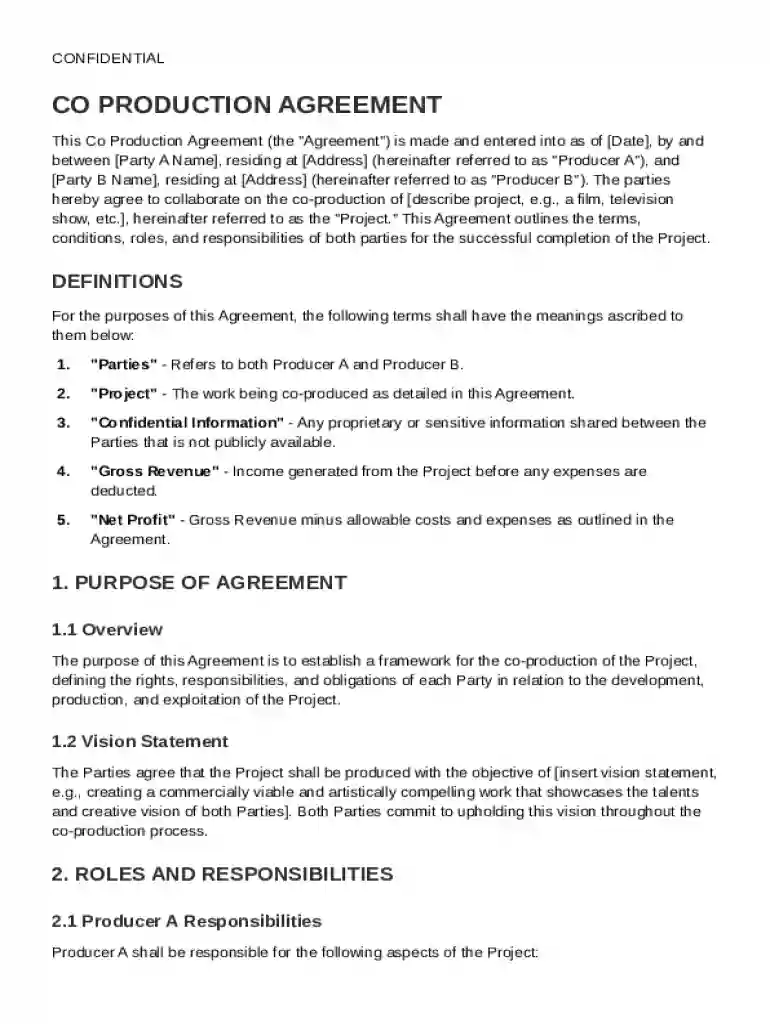
Definition & Meaning
A Co-Production Agreement Template is a legal document that outlines the terms and conditions under which two or more production entities, such as film or television producers, collaborate on a project. The agreement typically covers roles, responsibilities, financial contributions, intellectual property rights, revenue sharing, and other key aspects to ensure a successful partnership. Its purpose is to clearly define expectations and rights for all parties involved, minimizing potential disputes and streamlining the production process.
Key Features of a Co-Production Agreement
- Roles and Responsibilities: Specifies the duties and obligations of each party involved in the production.
- Financial Arrangements: Details on how costs will be allocated and how revenue will be distributed among the parties.
- Intellectual Property Rights: Clarifies ownership and usage rights of the created content.
- Confidentiality Obligations: Establishes guidelines for handling sensitive information.
- Dispute Resolution: Provides mechanisms for resolving any disagreements that may arise.
Key Elements of the Co Production Agreement Template
A comprehensive Co-Production Agreement Template should cover essential elements to protect the interests of all parties and facilitate smooth collaboration.
Financial Contributions and Revenue Sharing
- Budgeting: Outline each party's financial commitment to the project.
- Revenue Distribution: Specify how profits will be divided among the partners.
Intellectual Property Rights
- Ownership: Define who holds the rights to the project's intellectual property.
- Licensing: Determine if any party can license the content to third parties.
Project Timeline and Milestones
- Deadlines: Establish a clear timeline for key stages of the project.
- Deliverables: Detail the expected outputs at various phases of the production.
Communication and Reporting
- Regular Meetings: Schedule routine check-ins to discuss progress.
- Reporting Obligations: Specify the format and frequency of updates between parties.
How to Use the Co Production Agreement Template
Using a Co-Production Agreement Template effectively requires understanding its structure and tailoring it to specific project needs.
Steps to Customize the Template
- Identify Participants: List all parties involved in the co-production.
- Define Project Scope: Clearly describe the project's objectives and deliverables.
- Detail Financial Contributions: Assign budget responsibilities and profit-sharing arrangements.
- Allocate Responsibilities: Specify roles each party will play throughout the production cycle.
- Set Milestones: Establish deadlines and performance benchmarks.
- Review and Revise: Have legal counsel evaluate the agreement's terms.
Important Considerations
- Legal Terminology: Be mindful of precise language that reflects your intentions accurately.
- Jurisdiction: Ensure the agreement is compliant with relevant state and federal laws.
Legal Use of the Co Production Agreement Template
Understanding the legal framework of a Co-Production Agreement is crucial to ensuring it is enforceable and compliant with applicable laws.
Compliance with U.S. Laws
- Contract Law: The template must meet all contractual obligations under U.S. law.
- Intellectual Property Law: Adhere to regulations regarding copyright and trademark rights.
Potential Legal Challenges
- Ambiguities in Terms: Vague contract terms can lead to legal disputes.
- Jurisdictional Issues: Determine which state's laws govern the agreement.
Examples of Using the Co Production Agreement Template
Real-world scenarios can provide insights into how Co-Production Agreement Templates function in practice.
Film Production
- Example: Two production companies co-produce a feature film, sharing resources and risks. The agreement specifies the split of profits and distribution rights.
Television Series Collaboration
- Example: A television network partners with an independent producer to create a new series. The agreement outlines episode delivery schedules and marketing responsibilities.
Important Terms Related to Co Production Agreement Template
Understanding key terms within a Co-Production Agreement is essential for clear communication and effective collaboration.
Common Terms and Their Meanings
- Equity Investment: Financial contribution in exchange for a share of the profits.
- Recoupment Schedule: A timeline for recovering investment costs from revenue.
Clarification on Jargon
- Turnaround Rights: Conditions under which a project can be sold to another studio or network.
State-Specific Rules for the Co Production Agreement Template
Rules and regulations can vary significantly between states, affecting the formulation of a Co-Production Agreement.
Impacts of State Laws
- Tax Incentives: Some states offer tax benefits for productions, which can be addressed in the agreement.
- Labor Laws: Differences in labor regulations can affect staffing and project execution.
Customization for State Differences
- Incorporate Local Laws: Tailor the agreement to reflect local employment and tax statutes.
Primary Users
- Film Studios: Frequently collaborate on large budget projects requiring shared expertise.
- Independent Producers: Often partner with larger entities to gain access to wider distribution channels.
Other Stakeholders
- Financiers: May require co-production agreements to secure investments.
- Distributors: Use these agreements to understand content rights and distribution territories.