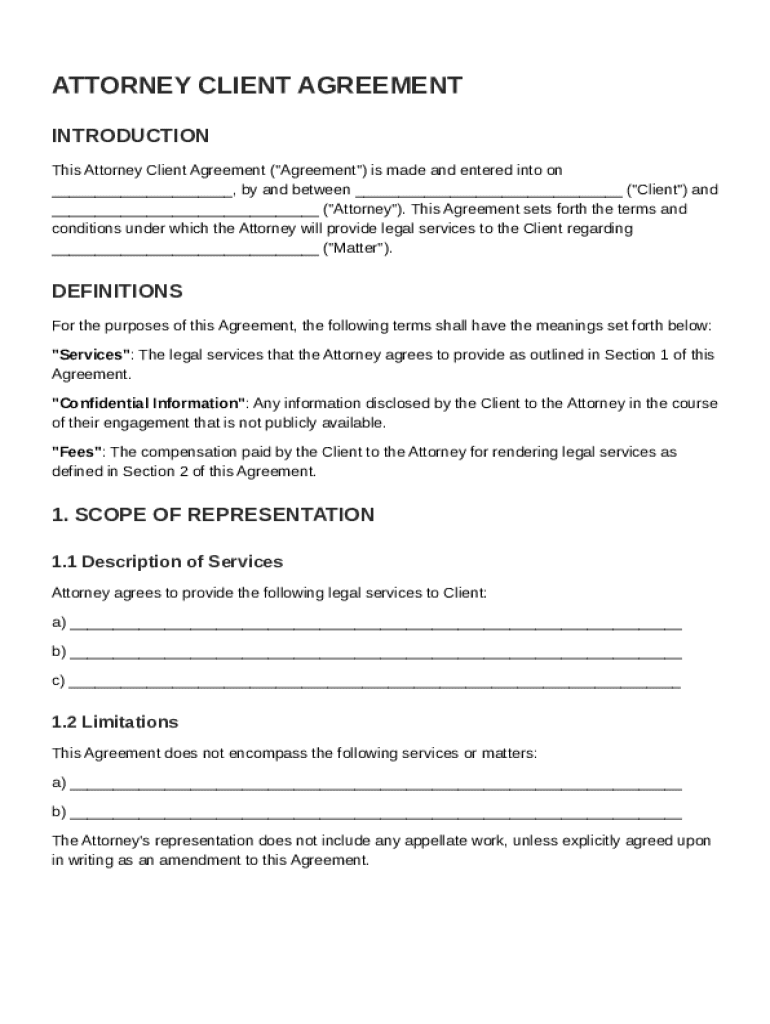







Definition & Meaning
The "Attorney Client Agreement Template" serves as a foundational document in legal engagements, outlining the terms under which an attorney will provide legal services to a client. This template specifies the relationship's framework by detailing the scope of representation, fee arrangement, and mutual obligations of both parties. It establishes clear communication protocols and expectations, thus reducing potential conflicts and misunderstandings. Crucially, this agreement upholds the principle of confidentiality, ensuring that client information is protected under privileged communication.
Key Components
-
Scope of Representation: Clearly delineates the specific legal services the attorney will provide. This can include, but is not limited to, advice, document preparation, negotiation, and litigation representation.
-
Fee Structures: Outlines how and when the client will be charged. This may consist of hourly rates, flat fees, or contingency fees, ensuring transparency in payment expectations.
-
Client Responsibilities: Details the client's obligations, which include providing accurate information, being available for consultation, and meeting payment terms.
-
Termination Conditions: Specifies the terms under which either party can terminate the agreement, providing legal recourse and procedures to follow in such events.
Key Elements of the Attorney Client Agreement Template
The key elements of the Attorney Client Agreement Template provide a comprehensive safeguard for both attorney and client, ensuring clarity and legal protection. These elements include provisions on confidentiality, dispute resolution, and fee agreements.
Confidentiality Provisions
-
Client-Attorney Privilege: Ensures communications between the attorney and client remain confidential and cannot be disclosed without client consent.
-
Data Protection: Outlines measures to secure client's personal and legal information, enhancing trust and privacy compliance.
Dispute Resolution
-
Arbitration Clauses: May include methods for resolving disputes outside of court to save time and resources. Arbitration is often faster and can be less formal than traditional court proceedings.
-
Mediation Options: Provides another alternative where both parties agree to mediate disputes through a third party, fostering amicable resolutions.
Fee Agreement
-
Retainer Fee: Defines upfront payment requirements and distinguishes between refundable versus non-refundable retainers.
-
Billing Practices: Describes how billing will be conducted, specifying detail in invoices and regularity of billing cycles.
Steps to Complete the Attorney Client Agreement Template
Completing the Attorney Client Agreement Template involves a series of steps to ensure accuracy and mutual understanding. Here is a comprehensive guide to assist both attorneys and clients.
-
Identify Legal Services: Determine and list the specific legal services required by the client. This includes defining the extent of the attorney's engagement for clarity.
-
Define Payment Terms: Both parties need to agree on a fee structure. This step often requires negotiation and clear documentation of payment terms and conditions.
-
Discuss Confidentiality: Ensure that the client understands the confidentiality provisions. This discussion is crucial to protect sensitive information and comply with legal standards.
-
Establish Termination Clauses: Outline conditions and processes under which the agreement can be terminated. Both parties should understand their rights and obligations in such scenarios.
-
Include Dispute Resolution Procedures: Agree on methods for handling disputes. This may include arbitration, mediation, or court proceedings.
-
Review and Finalize: Both parties should thoroughly review the document for accuracy and completeness. Professional legal advice may be sought, if needed, to ensure all aspects are covered effectively.
Who Typically Uses the Attorney Client Agreement Template
This template is widely used by legal professionals and individuals engaging in various types of legal services. Its adaptability makes it suitable across numerous contexts.


Users
-
Private Individuals: Often require legal services for personal matters such as family law, estate planning, and litigation support.
-
Small Businesses: Benefit from legal advice in areas like contract law, business formation, and regulatory compliance.
-
Corporations: Engage attorneys for complex transactions, employment law, and intellectual property issues.
Scenarios
-
Divorce and Family Law: Clients entering divorce proceedings or custody arrangements need clear representation terms.
-
Contractual Disputes: Businesses facing contract disputes require well-defined legal support parameters.
-
Real Estate Transactions: Buyers and sellers often engage attorneys to ensure legal compliance and due diligence during property transactions.
Legal Use of the Attorney Client Agreement Template
This template is a legal document governed by specific laws and regulations in different jurisdictions. Its proper use ensures enforceability and compliance with local legal requirements.
Binding Nature
-
Legally Enforceable: The agreement is legally binding once signed by both parties, carrying weight in court if disputes arise.
-
Regulatory Compliance: Adheres to laws governing legal practice in the attorney's jurisdiction, such as the American Bar Association's model rules.
Modifications and Amendments
-
Customizing Terms: Parties can amend terms to suit specific needs as long as modifications are mutually agreed upon and documented.
-
Review Periods: Encourages periodic review of terms to adjust for any changes in circumstance or law, ensuring ongoing compliance and relevance.
State-Specific Rules for the Attorney Client Agreement Template
Different states in the U.S. may impose unique regulations concerning attorney-client agreements. Understanding these state-specific rules is crucial for ensuring the agreement's validity.
Variation in Requirements
-
Fee Agreements: Some states require fee agreements, particularly contingency fees, to be in writing and detail specific percentages and expenses.
-
Disclosure Obligations: States may mandate disclosures around potential conflicts of interest and client rights, requiring explicit communication upfront.
State Laws on Dispute Resolution
-
Local Arbitration Rules: States can have varying requirements on how arbitration should be conducted, enforceability of arbitration clauses, and requisite arbitration certifications.
-
Mediation Requirements: Certain jurisdictions might mandate mediation before any legal proceedings, seeking to resolve disputes amicably and cost-effectively.
Important Terms Related to Attorney Client Agreement Template
Understanding the terminologies used within the Attorney Client Agreement Template is essential for both attorneys and clients. These terms provide clarity and specify the roles and expectations.
Core Terms
-
Retainer: Advance payment made to secure an attorney's services. It often serves as a deposit for ongoing legal work.
-
Jurisdiction: The legal authority under which the agreement falls. This typically relates to the geographical location where the legal services will be conducted.
Legal Nuances
-
Conflict of Interest: A situation where the attorney’s interests might be seen to intersect or interfere with the duties owed to a client.
-
Billable Hours: The hours an attorney spends working on a client’s case that are charged to the client based on an agreed rate.
Examples of Using the Attorney Client Agreement Template
Real-world examples illustrate the practical effectiveness and flexibility of the Attorney Client Agreement Template, showcasing its utility across various legal scenarios.
Practical Applications
-
Personal Injury Cases: Attorneys use contingent fee arrangements where they receive a percentage of the recovery. These agreements must be detailed to prevent disputes.
-
Intellectual Property Protection: Businesses may engage attorneys to handle trademark registrations with a fixed-fee setup, clearly defining what services are included.
-
Compliance Audits: Corporations retain legal advisors for compliance audits under retainer agreements, providing access to immediate advice and review services.
Case Studies and Scenarios
-
Family Law: A client retained an attorney for a divorce process. The agreement outlined mediation attempts before proceeding to litigation, promoting amicable settlements.
-
Business Counsel: A startup used the agreement to secure ongoing legal advice as it navigated incorporation, funding rounds, and employment contracts, aligning legal support with business growth.