
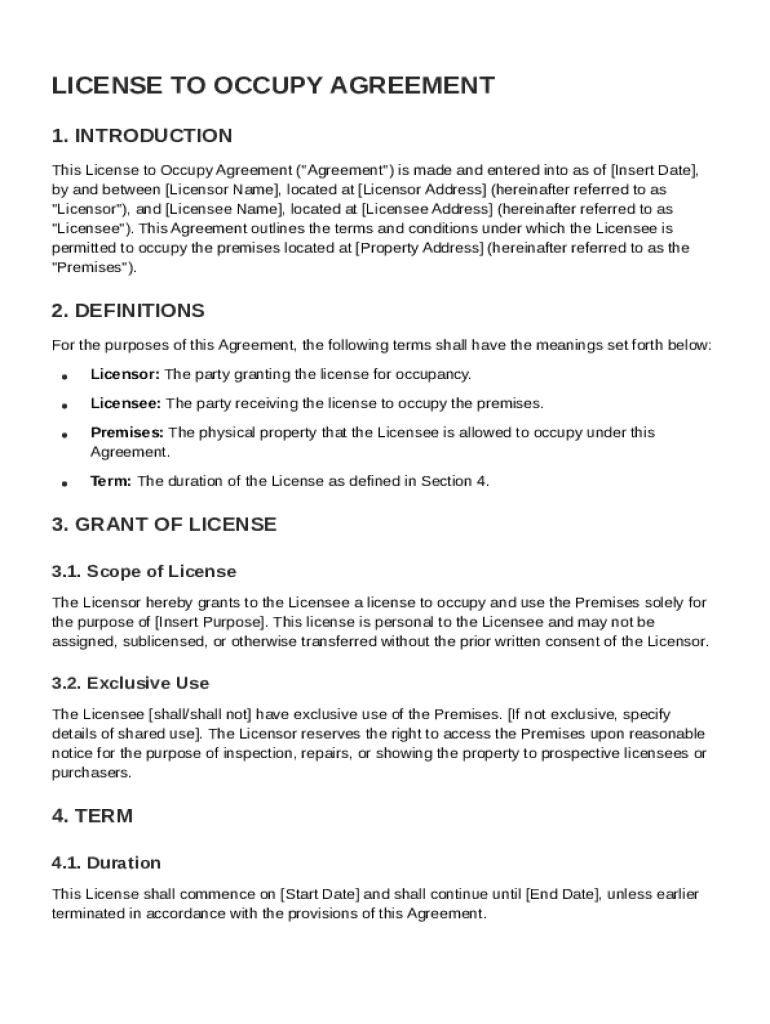







Definition and Purpose of the License to Occupy Agreement
A License to Occupy Agreement is a legal document outlining the terms under which a Licensee is permitted to occupy specified premises temporarily. Unlike a lease, which grants exclusive possession, this agreement grants the Licensor rights to access the premises, maintaining legal possession. Such agreements are typically used for short-term occupation, suitable when flexibility or a simple arrangement is preferred. This document contains details such as the duration of occupancy, payment terms, obligations of the Licensee, and conditions for termination. It is vital in defining the scope of use and ensuring that both parties clearly understand their rights and responsibilities.
Utilizing the License to Occupy Agreement Template
When using the License to Occupy Agreement Template, understanding its purpose and structure is essential. The template is designed to facilitate the creation of a comprehensive agreement without crafting the document from scratch. Users should begin by reviewing the template's sections, such as defined terms, payment obligations, and maintenance responsibilities. Modifications may be necessary to reflect the specific circumstances or special terms agreed upon by both parties. This process ensures that the final document meets the unique needs of the situation while maintaining legal integrity.
Step-by-Step Completion Process
- Download the Template: Start by accessing the License to Occupy Agreement Template from trusted providers such as DocHub.
- Fill in Basic Details: Input the names and contact information of both the Licensor and Licensee, the premises' address, and the intended term of occupancy.
- Specify Payment Terms: Clearly outline payment amounts, schedules, and accepted payment methods to prevent future disputes.
- Define Usage Scope: Detail the permitted use of the premises, ensuring compliance with local laws and building regulations.
- Outline Obligations: List maintenance responsibilities and any property rules the Licensee must adhere to during the occupancy period.
- Include Termination Conditions: Clearly state under what circumstances the agreement can be terminated and any notice periods required.
Key Elements of the License to Occupy Agreement Template
The template comprises several critical sections essential for its effectiveness:
- Premises Description: A detailed account identifying the area to be occupied to prevent disputes over space boundaries.
- Duration and Renewal: Specifies the start and end dates and any options or conditions for renewing the agreement.
- Rights and Obligations: Outlines what each party is allowed to do and their respective responsibilities in maintaining the premises.
- Payment Structure: Documents rental amounts, payment frequency, and penalties for late payments.
- Termination Clause: Includes conditions for ending the occupancy, notice requirements, and consequence management.
Important Terms Related to the License to Occupy Agreement
Understanding the terminology used in a License to Occupy Agreement is crucial for both parties. Key terms include:
- Licensor: The property owner or person granting the right to occupy the premises.
- Licensee: The individual or entity given permission to use the premises under agreed conditions.
- Exclusive Possession: Unlike a lease, this agreement does not provide exclusive possession—ownership remains with the Licensor.
- Indemnification: A clause requiring one party to compensate for any losses incurred by the other.
Who Typically Uses the License to Occupy Agreement Template
This template is often used by:
- Property Owners: Seeking to allow temporary occupancy without granting leaseholder rights.
- Commercial Businesses: Requiring short-term use of space for purposes such as events or temporary installations.
- Educational Institutions: Providing accommodations to students or visiting faculty temporarily.
- Contractors: Operating on-site for a specific project duration without a long-term commitment.


Legal Use and Compliance
Legal compliance is a significant consideration when implementing a License to Occupy Agreement. It is crucial that both parties understand that this document does not confer leasehold rights. Proper legal terminology and structure must be maintained to avoid misinterpretation. In certain jurisdictions, specific provisions must be included to comply with state laws, ensuring the agreement's enforceability.
Software Compatibility and Integration
The License to Occupy Agreement Template is designed for compatibility with various document editing software, including DocHub. Users can import, edit, and export the template using platforms that support formats such as PDF, DOC, and others. This compatibility ensures that users can seamlessly integrate the document into their existing workflows, particularly if using cloud-based services like Google Workspace.
Digital Versus Paper Version
The modern preference leans toward digital copies of the License to Occupy Agreement due to ease of distribution and enhanced security features. Digital versions allow for electronic signatures, reducing reliance on physical paperwork and streamlining the documentation process. However, it is crucial to ensure that any digital version remains aligned with legal requirements, such as the necessity for signatures to be ESIGN Act-compliant.




