Definition & Meaning
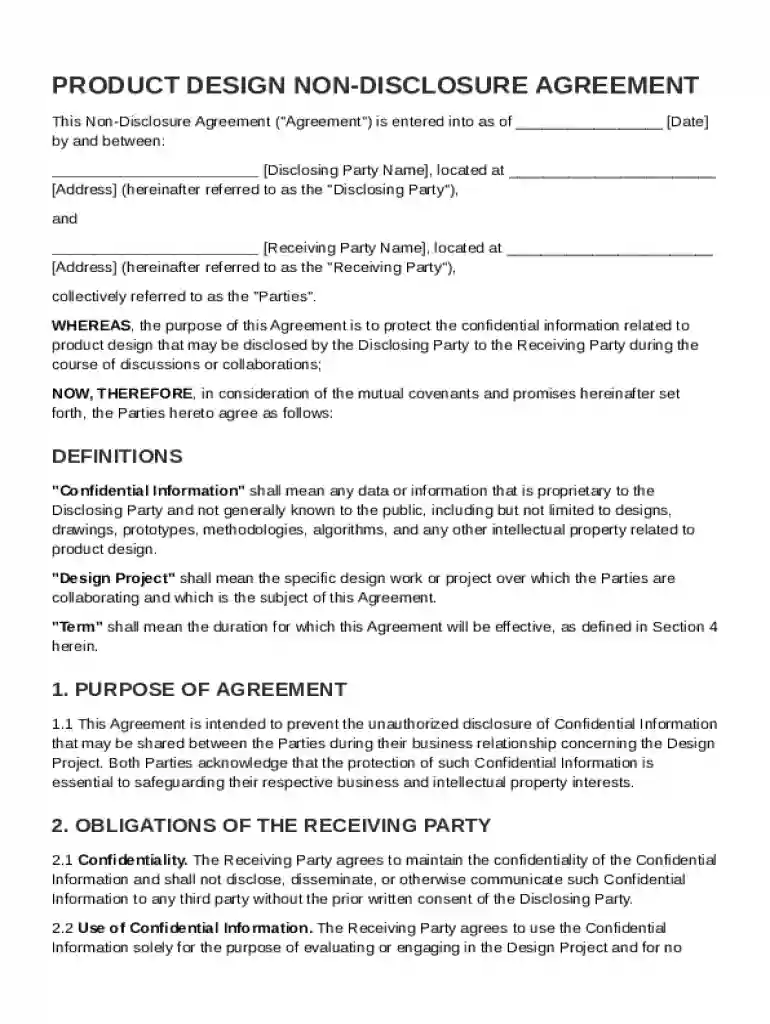
A Product Design Non-Disclosure Agreement (NDA) is a legal contract between two parties, typically a Disclosing Party and a Receiving Party, that aims to protect confidential information related to product design. The agreement creates a framework for sharing proprietary information in a collaborative context, ensuring that the Receiving Party does not disclose or misuse any sensitive data provided during the course of their partnership. The NDA is essential in safeguarding innovative concepts, designs, and processes that are crucial to maintaining competitive advantage in the market.
- Key Features:
- Identifies both parties involved.
- Establishes what constitutes confidential information.
- Stipulates the duration of the confidentiality obligation.
- Defines exclusions, such as information already public or independently discovered.
How to Use the Product Design Non-Disclosure Agreement Template
The Product Design NDA Template is designed for ease of use, helping parties establish clear terms without drafting an agreement from scratch. This template offers a convenient starting point, providing a comprehensive structure that can be customized to suit specific requirements.
- Customization Steps:
- Identify the Parties: Ensure both the Disclosing and Receiving Parties are correctly identified and their details filled in.
- Specify Confidential Information: Clearly outline what information is considered confidential under the agreement.
- Define Duration: Set the time period for which the confidentiality obligation will be valid.
- Clarify Obligations: Detail the responsibilities of the Receiving Party regarding the handling of protected information.
- Adjust Legal Provisions: Modify any legal clauses to reflect jurisdiction-specific requirements or additional terms unique to your collaboration.
Key Elements of the Product Design Non-Disclosure Agreement Template
Critical components of the NDA template ensure comprehensive protection and clarity between parties involved in product design collaborations. These elements define the scope and enforceability of the agreement.
Scope of Confidentiality:
- Includes design concepts, documentation, and any related information classified as sensitive.
Exclusions from Confidentiality:
- Information that becomes public through no fault of the Receiving Party.
- Knowledge already known to the Receiving Party prior to disclosure.
Obligations of the Receiving Party:
- Limit sharing information only with authorized personnel.
- Use acquired information solely for agreed-upon purposes.
Return of Materials:
- Obligation to return or destroy all confidential materials upon termination of the agreement.
Steps to Complete the Product Design Non-Disclosure Agreement Template
Completing the Product Design NDA involves precise steps to ensure all necessary legal requirements are met, and both parties are adequately protected.
- Download the Template: Obtain the template from a trusted source such as DocHub.
- Review & Customize: Tailor the agreement to include relevant details specific to your project and legal requirements.
- Seek Legal Advice: Consult with a legal professional to validate the agreement's compliance and enforceability.
- Signatures: Ensure both parties sign the agreement, establishing mutual consent and understanding.
- Distribute Copies: Provide executed copies to all stakeholders involved in the product design process.
Why Use the Product Design Non-Disclosure Agreement Template
Utilizing a Product Design NDA Template provides strategic advantages while maintaining confidentiality in collaborative projects.
- Risk Mitigation: Protects intellectual property from unauthorized disclosure, reducing the risk of competitive threats.
- Clarity & Precision: Offers a clear outline of terms and conditions, preventing misunderstandings and disputes.
- Efficiency: Saves time and resources by providing a structured format, allowing parties to focus on core design activities.
Legal Use of the Product Design Non-Disclosure Agreement Template
The NDA template complies with legal standards, ensuring enforceability in protecting confidential product design information.
- Legal Provisions:
- Adheres to intellectual property laws within relevant jurisdictions.
- Includes clauses that specify consequences for breach, including potential legal actions.
- Provides a legal framework offering remedies and protections in case of disputes over confidential information misuse.
Important Terms Related to Product Design Non-Disclosure Agreement Template
Understanding specific terminology is crucial for interpreting and effectively using the NDA.
- Disclosing Party: The individual or organization sharing confidential information.
- Receiving Party: The individual or organization obligated to maintain the confidentiality of the information received.
- Confidential Information: Data or material explicitly identified within the agreement as proprietary and sensitive.
- Breach: Any unauthorized disclosure or misuse of confidential information contrary to the terms outlined.
Software Compatibility
The Product Design NDA template is versatile and compatible with various digital document formats, enhancing accessibility and usability.
- Supported Formats:
- Editable formats like DOC and PDF allowing easy modifications.
- Compatibility with software applications such as Microsoft Word for creating tailored agreements.
- Integration with platforms like DocHub for secure online editing and electronic signing.
State-Specific Rules for the Product Design Non-Disclosure Agreement Template
While the NDA template provides a general framework, it is essential to consider state-specific regulations that may influence its terms and enforceability.
- Variations by Jurisdiction:
- Legal definitions and obligations can differ based on state laws.
- Consultation with legal counsel is advised to address any state-specific nuances, ensuring compliance and enforceability in the relevant jurisdiction.