






Definition and Meaning of the Intergovernmental Agreement Template
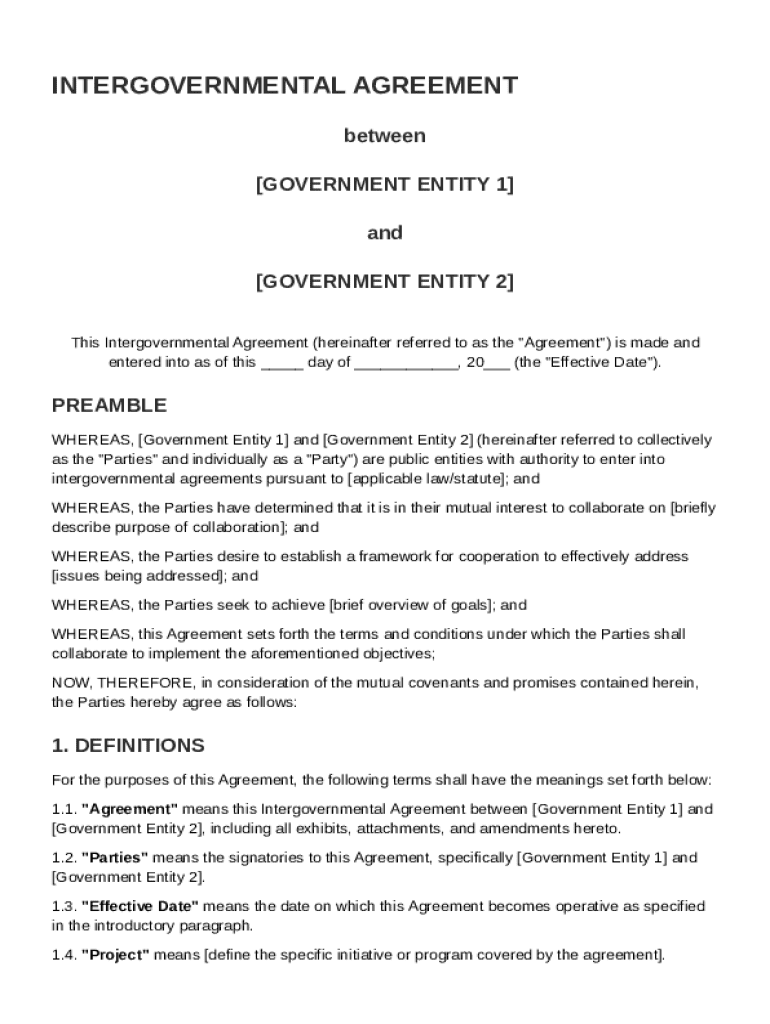
An Intergovernmental Agreement Template serves as a standard framework used by two or more public entities to outline terms of cooperation on shared initiatives. It ensures that all parties involved understand their roles, contributions, and responsibilities. These agreements are commonly used in various joint endeavors, such as infrastructure projects, resource management, or policy implementation. By setting these parameters, the template promotes transparency and efficiency in the collaboration process.
Core Components
- Parties Involved: Identifies the participating entities and briefly describes them.
- Purpose and Objectives: Clearly outlines the goals each entity aims to achieve through collaboration.
- Roles and Responsibilities: Details specific duties for each party to avoid overlapping efforts and ensure accountability.
Practical Examples
- A city and a county government might use an intergovernmental agreement to collaboratively manage a regional park.
- State transportation agencies may create agreements to coordinate on highway projects crossing regional lines.
Steps to Complete the Intergovernmental Agreement Template
Completing an Intergovernmental Agreement Template requires careful attention to detail to ensure all aspects of the collaboration are covered. The following steps provide guidance:
- Identify and Confirm Participating Entities: Ensure all involved parties are legally authorized and agree to the terms.
- Define the Objectives: Clearly state the project purpose and expected outcomes.
- Outline Roles and Responsibilities: Specify what each entity is responsible for, including resource allocation, funding, and staffing.
- Establish Governance Structures: Set up a Joint Oversight Committee or similar body to manage and facilitate the agreement.
- Detail Funding and Budget Allocation: Define how project funds will be sourced, allocated, and monitored.
- Draft Dispute Resolution Procedures: Create a protocol for resolving conflicts that may arise between parties involved.
- Incorporate Amendment Processes: Include procedures for modifying the agreement in response to changing circumstances.
- Review and Finalize the Document: Conduct a thorough review to ensure accuracy and mutual agreement before signing.
Examples of Implementation
- Joint Oversight Committee Formation: A committee comprising representatives from each entity can be tasked with overseeing project progress and compliance.
- Collaborative Budget Management: Entities might agree on a shared funding structure, each contributing a percentage based on their interest in the project.
Key Elements of the Intergovernmental Agreement Template
The effectiveness of an Intergovernmental Agreement largely depends on the comprehensive inclusion of key elements:
- Objectives and Scope: Clearly document what the agreement intends to achieve.
- Governance Framework: Define the decision-making process and organizational structure.
- Legal and Regulatory Compliance: Ensure the agreement aligns with applicable laws and regulations.
- Duration and Termination Clauses: Specify the timeline and provisions for extending, renewing, or ending the agreement.
- Monitoring and Evaluation: Set benchmarks and regular review mechanisms to assess progress and success.
Case Studies
- Infrastructure Development: A state and local government deploy an agreement to facilitate interstate transportation improvements.
- Emergency Services Collaboration: Neighboring cities draft an agreement for shared emergency response units to increase effectiveness and reduce costs.
Legal Use of the Intergovernmental Agreement Template
Legal considerations are paramount when drafting an Intergovernmental Agreement to ensure enforceability and compliance with jurisdictional requirements. Such agreements should be developed in consultation with legal advisors to underscore their legitimacy.
Legal Provisions and Requirements
- Jurisdiction Compatibility: Ensure that the agreement complies with the overarching laws of all involved territories.
- Enforcement Mechanisms: Include clear procedures for addressing breaches of the agreement.
- Binding Obligations: Acknowledge the commit to legally enforceable roles and responsibilities for each party.
- Public Transparency: Take into account any laws requiring public disclosure of terms.
Who Typically Uses the Intergovernmental Agreement Template
These templates are used by a variety of public sector entities seeking to formalize and enhance cooperation:
- Local Governments: Cities and counties entering into joint operational agreements for public services or infrastructure.
- State Agencies: Coordinating on statewide projects affecting multiple jurisdictions.
- Educational Institutions: Schools and universities collaborating on regional educational programs.


Examples
- School districts may create intergovernmental agreements to share resources, like transportation or specialized educational programs.
- Two states’ departments of natural resources might collaborate on a conservation initiative across shared waterways.
Software Compatibility: Digital vs. Paper Version
While traditionally drafted on paper, contemporary Intergovernmental Agreements are increasingly managed digitally for enhanced collaboration and efficiency.
Digital Advantages
- Version Control: Digital formats offer real-time updates and alterations, minimizing errors due to outdated versions.
- Accessibility: Electronic agreements can be accessed across various devices, promoting centralized storage and retrieval.
- Integration: Platforms like DocHub provide tools for digital signing, editing, and sharing, streamlining the process considerably.
Real-World Scenario
A regional environmental project involving multiple jurisdictions could benefit from a shared digital repository containing all iterations and amendments of their intergovernmental agreement.
State-Specific Rules for the Intergovernmental Agreement Template
Different states in the U.S. may have diverse statutory requirements regarding intergovernmental agreements. It is crucial for participating entities to be aware of these variations to ensure compliance.
Examples of State-Specific Variations
- Approval Processes: Some states mandate legislative approval for certain types of agreements.
- Public Access Laws: Requirements for public notification or hearings may differ.
- Dispute Resolution Procedures: Specific state guidelines may dictate how disputes are resolved including mandatory mediation or arbitration.
Responsible Compliance
To navigate these variances, engaging with state-specific legal counsel and regulators is advisable for validating the agreement's adherence to local laws.
Examples of Using the Intergovernmental Agreement Template
Analyzing real-world applications of intergovernmental agreements can provide insights into their versatility and effectiveness.
Case Studies
- Regional Tourism Promotion: Multiple cities establish a shared promotional campaign, leveraging pooled resources to attract visitors.
- Cross-County Public Transportation: Counties collaborate on expanding bus routes and schedules, reducing costs and serving more residents.
Lessons Learned
- Proactive conflict management structures tend to result in more successful partnerships.
- Continuous communication and regular review meetings can mitigate confusion and ensure steady progress.