




01. Edit your form online
Type text, add images, blackout confidential details, add comments, highlights and more.

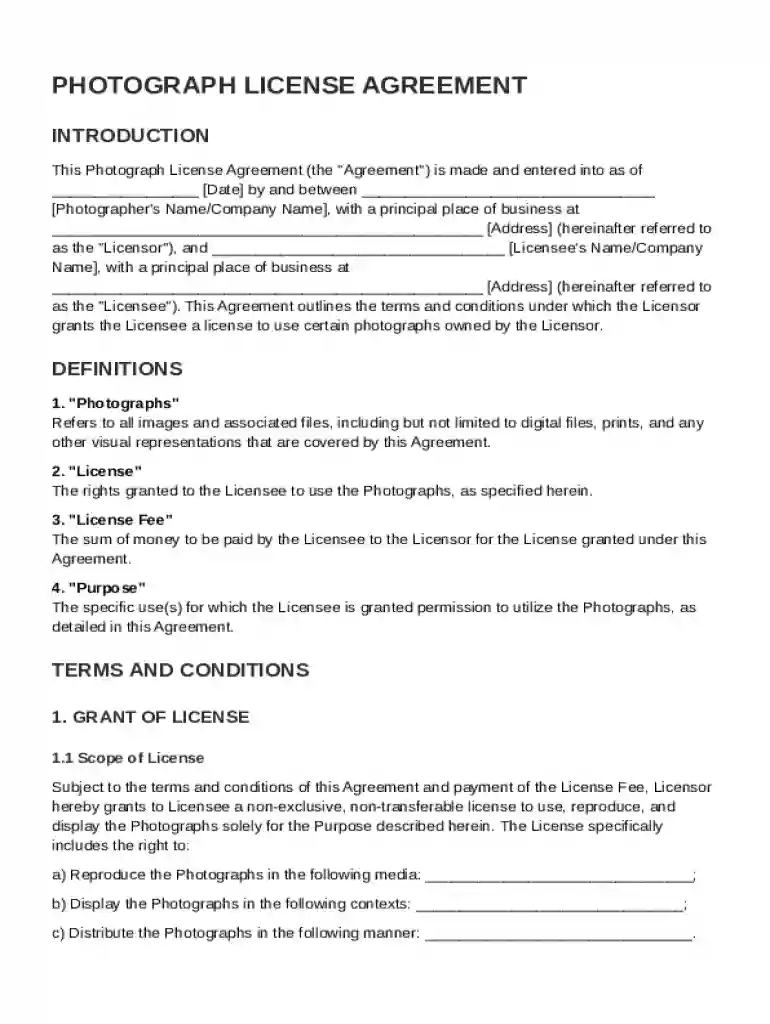
Type text, add images, blackout confidential details, add comments, highlights and more.

Draw your signature, type it, upload its image, or use your mobile device as a signature pad.

Send it via email, link, or fax. You can also download it, export it or print it out.
A Photograph License Agreement Template is a legal document designed to outline the terms and conditions under which a photographer (Licensor) grants permission for another party (Licensee) to use specific photographs. This agreement serves a dual purpose: protecting the intellectual property rights of the Licensor while clearly defining the scope and limits of use for the Licensee. The document typically covers crucial aspects such as the duration of the license, payment terms, usage restrictions, and ownership rights. By setting clear guidelines, the agreement helps prevent unauthorized use or distribution of photographs, thereby safeguarding the creator's work.
Key elements often included in the template are the identification of the photographs, duration and scope of the license, and stipulations regarding payment and usage. The agreement may also contain clauses on indemnification, credit requirements, and termination conditions, ensuring that both parties are aware of their rights and responsibilities.
The Photograph License Agreement Template is designed to be a flexible tool for both photographers and clients. To effectively use the template, start by customizing it to fit the particulars of the transaction or relationship. This involves inserting specific details such as the names of the involved parties, a description of the photographs, and the agreed-upon terms of use.
The template includes several critical components that define the agreement's terms. These elements provide the structure necessary for a clear, enforceable contract between parties.
Each element should be tailored to address the specific demands and protections required by both parties, ensuring no ambiguity or conflict.
The legal use of a Photograph License Agreement Template is essential to establishing enforceable rights. The template ensures compliance with applicable laws, such as those governing intellectual property and contract law. It highlights the necessity of obtaining explicit permission for the use of another's creative work, which is fundamental to preventing infringement claims.
Using this template correctly not only clarifies usage rights but also strengthens the legal standing of the agreement should any disputes arise.
Completing the Photograph License Agreement Template involves a systematic approach to ensure that all sections are accurately filled out and agreed upon by both parties.
This approach ensures that all pertinent details are addressed and that the agreement is comprehensive and enforceable.
Consider several scenarios where a Photograph License Agreement Template might be used:
These examples illustrate the versatility of the template in meeting diverse business needs, ensuring that the usage of photographs is properly managed and compensated.
Certain terms within the Photograph License Agreement Template are crucial for ensuring mutual understanding and protection of rights.
Understanding and including these terms is vital to prevent misunderstandings and conflicts, fostering a positive professional relationship.
While the template provides a general framework, state-specific regulations may influence its content and enforceability. Understanding these nuances is crucial for ensuring compliance and legal protection.
Conducting due diligence on state-specific laws will help tailor the agreement to comply with regional regulations, safeguarding both parties’ interests.
At DocHub, your data security is our priority. We follow HIPAA, SOC2, GDPR, and other standards, so you can work on your documents with confidence.


