






Definition & Meaning
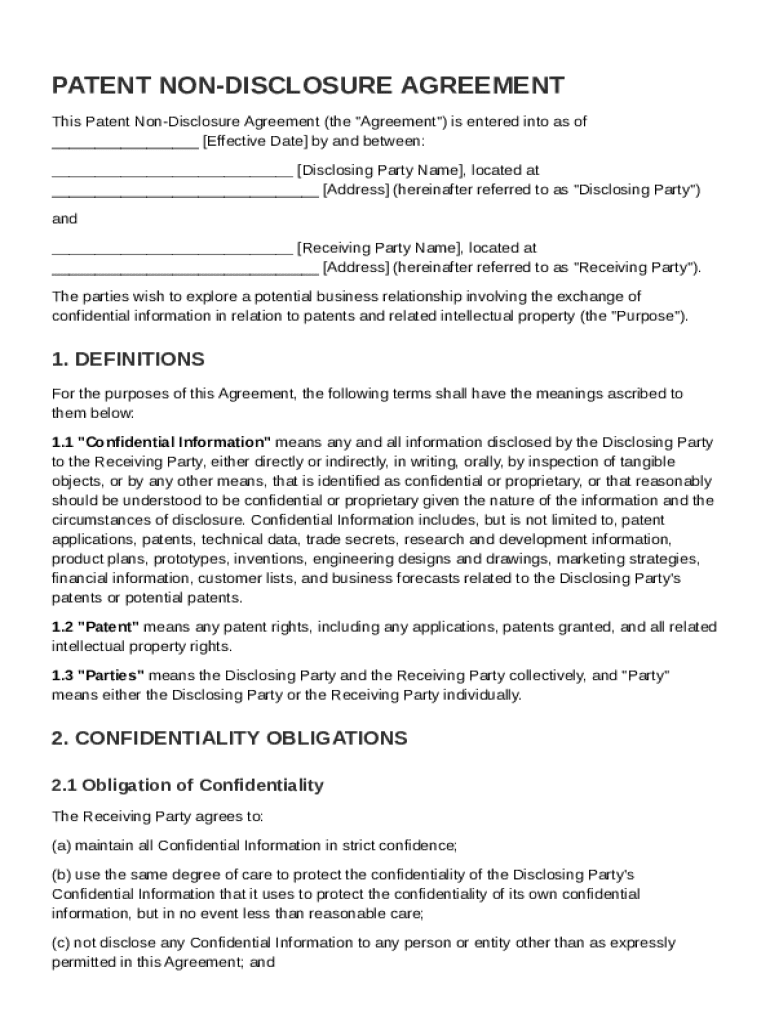
A Patent Non-Disclosure Agreement (NDA) is a legal contract used to protect confidential information related to patents and intellectual property shared between two parties, known as the Disclosing Party and the Receiving Party. Its primary purpose is to ensure that the Receiving Party does not disclose or misuse the disclosed information, particularly when the information pertains to sensitive patent details or proprietary inventions. The agreement serves as a safeguard for inventors and organizations, providing peace of mind by legally binding the parties to confidentiality.
How to Use the Patent Non-Disclosure Agreement Template
The Patent Non-Disclosure Agreement Template is used to formalize the process of keeping patent-related information confidential. This template can be used when sharing sensitive details of an invention or technology with potential investors, partners, or employees. Users should:
- Review the Terms: Understand all the clauses and conditions outlined in the template.
- Customize the Agreement: Fill in specific details, such as the names of the parties involved and the nature of the confidential information being disclosed.
- Specify the Duration: Clearly state the time frame during which the confidentiality obligations apply.
- Define the Scope: Outline what constitutes confidential information and any exclusions.
- Sign the Agreement: Both parties or their authorized representatives must sign to make the agreement legally binding.
Steps to Complete the Patent Non-Disclosure Agreement Template
Filling out a Patent NDA requires attention to detail to ensure clarity and enforceability:
- Identify Parties: List the legal names and contact information of all parties involved.
- Describe Information: Clearly outline the confidential information being shared.
- State Obligations: Detail the responsibilities of the Receiving Party regarding protection of the information.
- Include Legal Clauses: Add necessary clauses such as dispute resolution, governing law, and indemnification.
- Signatures: Ensure both parties sign the document. Optionally, include witnesses or a notary public for added legal strength.
Key Elements of the Patent Non-Disclosure Agreement Template
The NDA template includes critical components designed to protect the interests of the disclosing entity:
- Confidentiality Clause: Obligates the Receiving Party to keep disclosed information secret and outlines consequences for disclosure.
- Non-Use Provision: Stipulates that the Receiving Party can only use the information for purposes outlined in the agreement.
- Permitted Disclosure: Details circumstances under which information may be disclosed, such as legal requirements.
- Term and Termination: Specifies the duration of the agreement and conditions for termination.
- Return of Information: Requires the Receiving Party to return or destroy information upon termination of the agreement.
Examples of Using the Patent Non-Disclosure Agreement Template
Consider various scenarios where the Patent NDA might be employed:
- Startups Seeking Investment: When a startup approaches potential investors, a Patent NDA secures intellectual property during pitch meetings.
- Corporate Mergers: Companies involved in merger discussions may use an NDA to exchange sensitive patent information safely.
- Research Collaborations: Academic institutions and private companies might use an NDA while collaborating on technology research.
Who Typically Uses the Patent Non-Disclosure Agreement Template
This template is useful for numerous stakeholders in the patent process:
- Inventors and Innovators: Individuals looking to secure their inventions when discussing collaborations or licensing opportunities.
- Businesses and Corporations: Firms protecting trade secrets during negotiations and acquisitions.
- Legal Teams: Attorneys facilitating the exchange of sensitive information between clients and third parties while maintaining confidentiality.


Legal Use of the Patent Non-Disclosure Agreement Template
The legal framework:
- Binding Contract: The NDA functions as a contract enforceable by law, protecting the disclosed information.
- Breach Consequences: Details the legal repercussions for failing to adhere to the agreement’s terms.
- Amendments: Allows for modification of the agreement only if both parties provide written consent.
Important Terms Related to Patent Non-Disclosure Agreement Template
Key terms that are frequently used include:
- Disclosing Party: The entity or individual that shares confidential information.
- Receiving Party: The entity or individual granted access to the information under confidentiality terms.
- Intellectual Property: Creations of the mind, including inventions, symbols, names, images, and designs.
- Trade Secrets: Practices, designs, processes, or any information not generally known or ascertainable.
Software Compatibility
The Patent NDA template is compatible with various document software:
- Google Workspace: Direct importing from and exporting to Google Drive and Gmail.
- Dropbox and OneDrive: Easily integrates with cloud storage services for seamless access and sharing.
- DocHub Platform: Allows for editing, signing, and managing forms without conversion issues, ensuring a smooth user experience.
Business Types That Benefit Most from the Patent Non-Disclosure Agreement Template
Businesses across industries utilize this template:
- Technology Firms: Companies developing software and hardware products to protect proprietary innovation.
- Pharmaceutical Companies: Use NDAs when discussing new drug formulas and research methodologies.
- Manufacturing Enterprises: Protect unique processes and methods vital to competitive advantage.
Digital vs. Paper Version
Advantages of each format include:
- Digital: Enables efficient storage, sharing, and editing. Ideal for remote and dynamic work settings.
- Paper: Provides a tangible record, suitable for circumstances where digital access is limited or unwanted.