01. Edit your form online
Type text, add images, blackout confidential details, add comments, highlights and more.

Type text, add images, blackout confidential details, add comments, highlights and more.

Draw your signature, type it, upload its image, or use your mobile device as a signature pad.

Send it via email, link, or fax. You can also download it, export it or print it out.
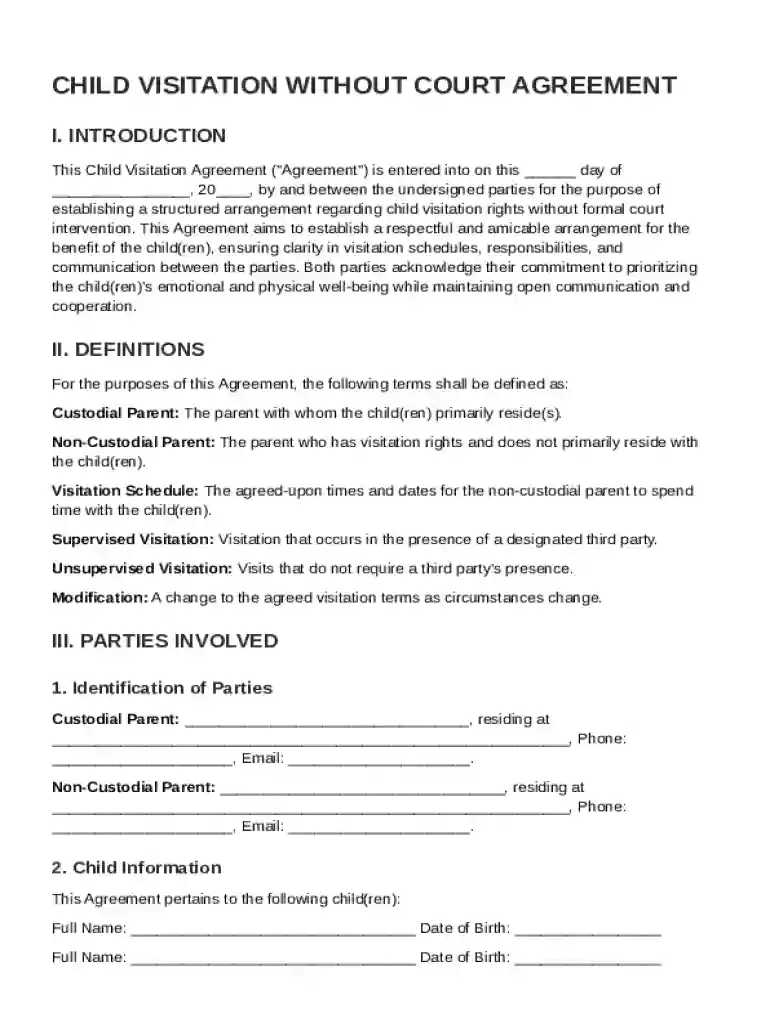
The Child Visitation Without Court Agreement Template is a structured document designed to formalize visitation arrangements between the custodial and non-custodial parents without court intervention. It serves to outline the agreed terms and conditions under which parent-child visits will occur, ensuring a clear understanding and minimizing potential conflicts. The template includes definitions of common terms, roles, and responsibilities involved in such agreements.
The primary purpose of this template is to provide a professional and legally sound framework that both parties can adhere to, prioritizing the child's best interests. It emphasizes transparent communication and mutual consent, making adjustments easier without the need for litigation.
Each party's contact information, relationship to the child, and custody status are documented in this section to ensure clarity and prevent misunderstandings.
A comprehensive visitation schedule is integral to the agreement. It details:
This section addresses who is responsible for transporting the child during visitations, safety measures, and punctuality requirements. Clear agreements on pick-up and drop-off locations and times help avoid conflict and confusion.
Gather Necessary Information: Before filling out the template, collect vital details such as both parents' contact information, the child's schedule, and any relevant legal documents.
Customize the Template: Use DocHub's editing tools to enter all required fields, adjust the visitation schedule, and specify transportation arrangements.
Review Legal Terms: Understand the legal implications of each section, ensuring both parties agree to all terms.
Finalize and Sign: Both parents should review the completed document for accuracy and completeness. The use of DocHub's e-signature feature can facilitate this process.
Store and Share Securely: Once signed, store the agreement securely on a cloud storage service and share it with relevant parties as needed.
While this template is designed to facilitate agreements without court involvement, it's important to ensure it complies with state-specific regulations. Users should be knowledgeable about pertinent laws and, if necessary, consult a legal professional to ensure the agreement meets all legal requirements.
In some jurisdictions, these agreements may need to be filed with the court or entered into the public record to ensure enforceability. Understanding these requirements prevents future disputes and legal issues.
A father who works weekdays arranges alternate weekend visits. The agreement includes pick-up after school on Fridays and return on Sunday evenings.
For Christmas, the agreement states the child will spend even years with the mother and odd years with the father, fostering a sense of balance and fairness.
A mother moves to a new city, prompting a revision of weekend visitation to accommodate new travel times, showcasing the agreement’s flexibility.
These pertain to the legal authority to make major decisions concerning the child's welfare, such as education, health care, and religious upbringing.
Defined as the non-custodial parent’s entitlement to spend time with their child.
Occasions when a third party is required to be present during visits, usually for safety or behavioral monitoring.
This template is most beneficial for:


DocHub supports seamless document editing and signing capabilities, fully compatible with common software platforms like Google Workspace, enhancing user experience without additional software requirements. This compatibility ensures that users can easily manage and personalize their visitation agreements from any device, promoting accessibility and efficiency.
At DocHub, your data security is our priority. We follow HIPAA, SOC2, GDPR, and other standards, so you can work on your documents with confidence.