Definition & Meaning
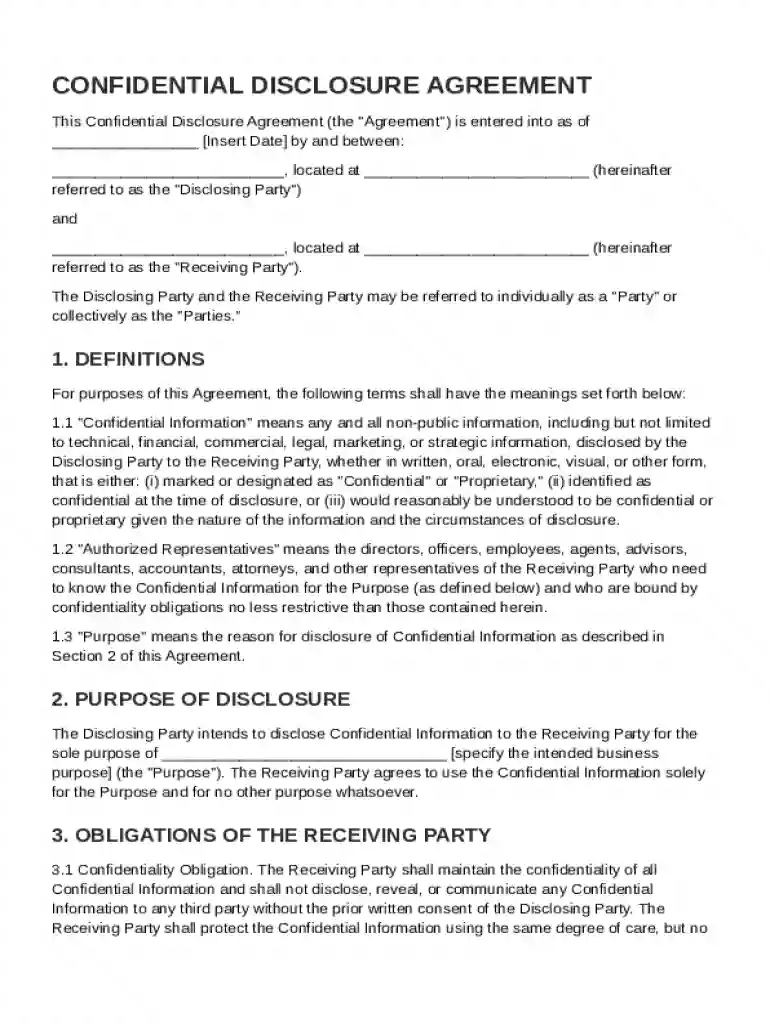
A Confidential Disclosure Agreement (CDA), also known as a non-disclosure agreement (NDA), is a legal document between a disclosing party and a receiving party. It outlines the terms under which confidential information will be shared and maintained. This agreement is essential for safeguarding proprietary information and ensuring that sensitive details are not disclosed to unauthorized third parties. The CDA defines what constitutes 'Confidential Information,' which can include trade secrets, business strategies, research data, or any other information the discloser wishes to keep private.
Key Elements of the CDA Agreement Template
A comprehensive CDA Agreement Template consists of several critical elements:
- Confidential Information Definition: Clearly specifies what information is considered confidential and how it should be handled.
- Purpose of Disclosure: Outlines the purpose for sharing the confidential information, ensuring both parties understand the scope of its use.
- Obligations of Receiving Party: Details the responsibilities of the receiving party, including maintaining confidentiality and restricting the use of the information.
- Exclusions from Confidentiality: Specifies information that is not covered under the confidentiality obligations, such as publicly available information or data independently developed by the receiving party.
- Term and Termination: Establishes the duration for which the agreement is valid and conditions under which it can be terminated.
- Remedies for Breach: Provides legal remedies and consequences in case the agreement is breached.
How to Use the CDA Agreement Template
Utilizing the CDA Agreement Template involves several steps to ensure the agreement is tailored to the specific needs of the parties involved:
- Identify the Parties: Clearly state the names and roles (disclosing or receiving) of each party involved in the agreement.
- Define the Confidential Information: Detail the specific types of information that will be protected under the agreement.
- Set Terms of Use: Establish how the confidential information can be used and any limitations on its use.
- Include Legal Provisions: Add standard legal clauses, such as governing law and dispute resolution processes.
- Review and Sign: Have both parties carefully review the template, make necessary revisions, and sign the document to make it legally binding.
Why You Should Use a CDA Agreement Template
Utilizing a CDA Agreement Template provides several benefits, particularly in environments where sensitive information is routinely exchanged:
- Protects Intellectual Property: Keeps proprietary information safe from unauthorized use or disclosure.
- Facilitates Business Partnerships: Enables open communication between businesses while maintaining trust and security.
- Mitigates Legal Risks: Clearly defines legal expectations and remedies in case of a breach, reducing the risk of costly legal disputes.
- Standardizes Documentation: Provides a structured framework that can be customized for different scenarios, ensuring consistency and clarity in legal documents.
Important Terms Related to CDA Agreement Template
Understanding key terms associated with a CDA Agreement Template enhances its effective implementation:
- Non-disclosure Agreement (NDA): Another term for a CDA used interchangeably in legal contexts.
- Proprietary Information: Information owned by an individual or company that is not public and is considered valuable.
- Breach of Contract: A violation or infringement of any of the terms outlined in the CDA.
- Governing Law: The legal jurisdiction whose laws will be applicable in interpreting and enforcing the agreement.
- Audit Trail: A secure record of changes or access to information within the agreement.
Steps to Complete the CDA Agreement Template
Filling out the CDA Agreement Template involves a systematic approach to ensure all sections are accurately completed:
- Insert Party Information: Enter the legal names and roles of all parties involved in the agreement.
- Specify Confidential Information: Specify what constitutes confidential material to avoid ambiguity.
- Define Use Limitations: Clearly articulate how the information can and cannot be used by the receiving party.
- Set Exclusion Criteria: Identify information not considered confidential under the agreement.
- Determine Duration: Establish the time period for which the confidentiality agreement is valid.
- Outline Breach Consequences: Detail the consequences or penalties if either party violates the agreement.
- Finalize and Sign: Both parties review and sign to acknowledge understanding and acceptance of the terms.
Legal Use of the CDA Agreement Template
The CDA Agreement Template serves as a legal tool to protect sensitive information in various professional contexts:
- Business Collaborations: Commonly used during joint ventures, mergers, or partnerships to safeguard trade secrets.
- Employee Contracts: Implemented in employee agreements to prevent sharing internal company information.
- Vendor Arrangements: Utilized in contracts with vendors or partners to protect proprietary business information shared during collaborations.
State-Specific Rules for the CDA Agreement Template
While the CDA Agreement Template provides a standard form, variations may be required to comply with laws specific to different U.S. states. For instance:
- California: Employs unique regulations that may affect non-compete clauses within NDAs.
- New York: Has specific requirements regarding the enforceability of confidentiality terms.
- Texas: Provides statutory guidelines to ensure transparency and fairness in contractual agreements.
Each state may have specific legal requirements and conditions that need to be addressed in the CDA Agreement Template to ensure full legal enforceability. It's advisable to consult legal counsel to customize the template according to state laws.