






Definition & Meaning
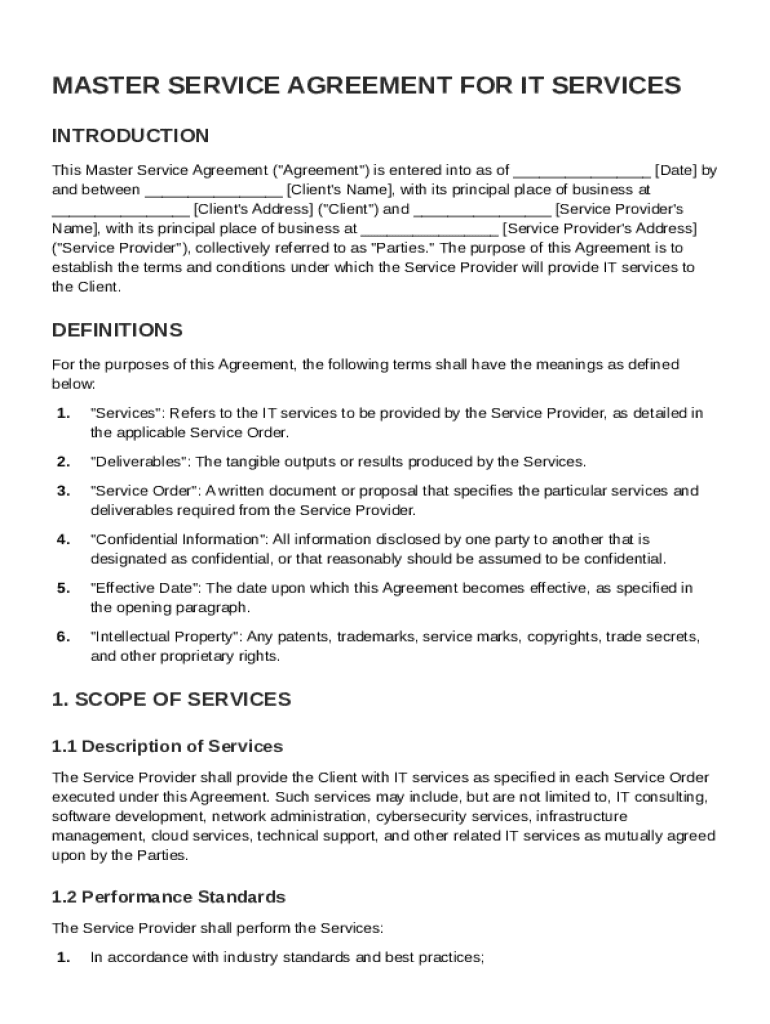
The "Master Service Agreement for IT Services" (MSA) sets forth a comprehensive framework, defining the terms and responsibilities between a Service Provider and a Client regarding IT services. It establishes the parameters for the scope of services, pricing models, confidentiality, intellectual property rights, and other crucial aspects of the professional relationship. This document binds both parties to clearly articulated expectations, reducing the potential for miscommunications and disputes.
A well-drafted MSA serves as a foundation for future amendments or additional agreements, often including Service Level Agreements (SLAs), that specify details like performance metrics. The MSA’s importance lies in its role as a baseline that clarifies all undertakings, ensuring that both the service delivery and the valuation are aligned with business goals.
Key Elements of the Master Service Agreement Template
An MSA for IT services primarily comprises several pivotal elements that form its core:
-
Scope of Services: Defines what the Service Provider agrees to deliver, outlining the specifics of tasks, deliverables, and timelines.
-
Payment Terms: Details the payment structure, including fees, invoicing timelines, and any penalties for late payment.
-
Confidentiality Obligations: Covers protocols to protect sensitive information, specifying how data should be handled and the repercussions of breaches.
-
Intellectual Property Rights: Clarifies who owns intellectual property produced, developed, or discovered during the service delivery.
-
Indemnification and Liability: Explains the parties' liabilities, including indemnifications that protect against losses due to third-party actions or negligence.
-
Termination Clauses: Sets conditions under which the agreement can be dissolved, such as breach of contract or mutual consent.
-
Dispute Resolution: Provides mechanisms for resolving disagreements, including mediation or arbitration processes.
Steps to Complete the Master Service Agreement Template
Completing an MSA involves several crucial steps that ensure all necessary aspects are covered:
-
Define the Scope and Services: Clearly outline the IT services to be delivered, including specific tasks and expectations.
-
Establish Payment Models and Terms: Agree on pricing structures, payment intervals, and any contingencies related to financial transactions.
-
Include Confidentiality and Security Provisions: Implement measures for safeguarding confidential information, particularly regarding data exchange.
-
Discuss Intellectual Property Rights: Ensure clarity on who retains ownership of intellectual property developed during the course of the contract.
-
Negotiate Indemnification: Confirm both parties understand liability aspects and any indemnifications required.
-
Draft Termination Procedures: Establish procedures for ending the agreement, including notice periods and required actions.
-
Plan for Dispute Resolution: Agree on methods and forums for resolving disputes, potentially including mediation or arbitration.
-
Review with Legal Counsel: Obtain legal review to ensure compliance with relevant laws and regulations.
Important Terms Related to Master Service Agreement Template
-
Service Level Agreement (SLA): A supplementary document detailing specific performance standards and metrics between the Client and Service Provider.
-
Client: The party receiving services.
-
Service Provider: The party delivering services.
-
Confidential Information: Data or any information shared during the service period that must remain private and secure.
-
Breach: Violation of any term within the agreement, triggering potential penalties or termination.
-
Liability Cap: The maximum amount one party is required to pay the other under the agreement.
Who Typically Uses the Master Service Agreement Template
MSAs are commonly utilized by businesses that rely on external IT vendors to support their technological infrastructure:
-
Large Enterprises: Often employ MSAs to manage relationships with multiple IT service providers for comprehensive support.
-
Small and Medium-Sized Businesses (SMBs): Use MSAs to define specific service needs and budgeting with their IT partners.
-
Government Agencies: Require MSAs to ensure that service agreements align with strict regulatory standards.
-
IT Consulting Firms: Use MSAs to structure engagements with clients, detailing deliverables and service offerings comprehensively.


Legal Use of the Master Service Agreement Template
The legal efficacy of an MSA hinges on its compliance with applicable jurisdictional laws.
-
Ensures Compliance: An MSA must adhere to state, federal, and industry-specific regulations in the U.S., such as data privacy laws.
-
Binding Agreement: Once signed, the MSA holds both parties legally accountable, ensuring enforcement of its terms.
-
Documenting Changes: Any amendments or changes to the service agreement should be documented in the form of addendums.
-
Legal Recourse: In the event of a breach, the MSA provides a framework for seeking legal recourse, backed by documented terms of service.
Examples of Using the Master Service Agreement Template
MSAs significantly vary based on industry requirements and specific service needs:
-
Technology Implementations: Firms aiding clients in hardware installation and configuration use MSAs for defining deployment services.
-
Software as a Service (SaaS): These companies deploy MSAs to clearly state service delivery metrics and client responsibilities.
-
Managed IT Services: Providers of comprehensive IT management use MSAs to determine the extent and availability of their operations support.
-
Consulting Services: These agreements are used to clarify expectations and project timelines in consulting engagements.
State-Specific Rules for the Master Service Agreement Template
Different states in the U.S. have unique legal stipulations affecting MSAs:
-
California: Requires compliance with stringent data protection laws impacting how confidential information is handled.
-
New York: Focuses on indemnification reform, especially concerning subcontractor arrangements within MSAs.
-
Texas: Has guidelines that emphasize clauses related to non-compete agreements within employment-related service agreements.
-
Florida: Specific rules on automatic renewal clauses must be observable when drafting MSAs.
Awareness of state regulations is fundamental to ensure that the MSA adheres to local legal requirements and is enforceable.
Software Compatibility and Integration
Modern service agreements often necessitate compatibility with management platforms:
-
Compatibility with CRM Systems: Integration with systems like Salesforce to track service delivery and client communication.
-
Document Management: Utilization of platforms like DocHub for seamless editing, signing, and sharing of MSAs digitally.
-
Project Management Tools: Syncing with tools like Asana or Trello to track tasks outlined in the service agreement.
-
Analytics and Reporting: Using software like QuickBooks to manage billing and assess service efficacy based on the MSA’s terms.
Technology integration enhances the practical implementation of the agreement, facilitating more efficient management and compliance tracking.