
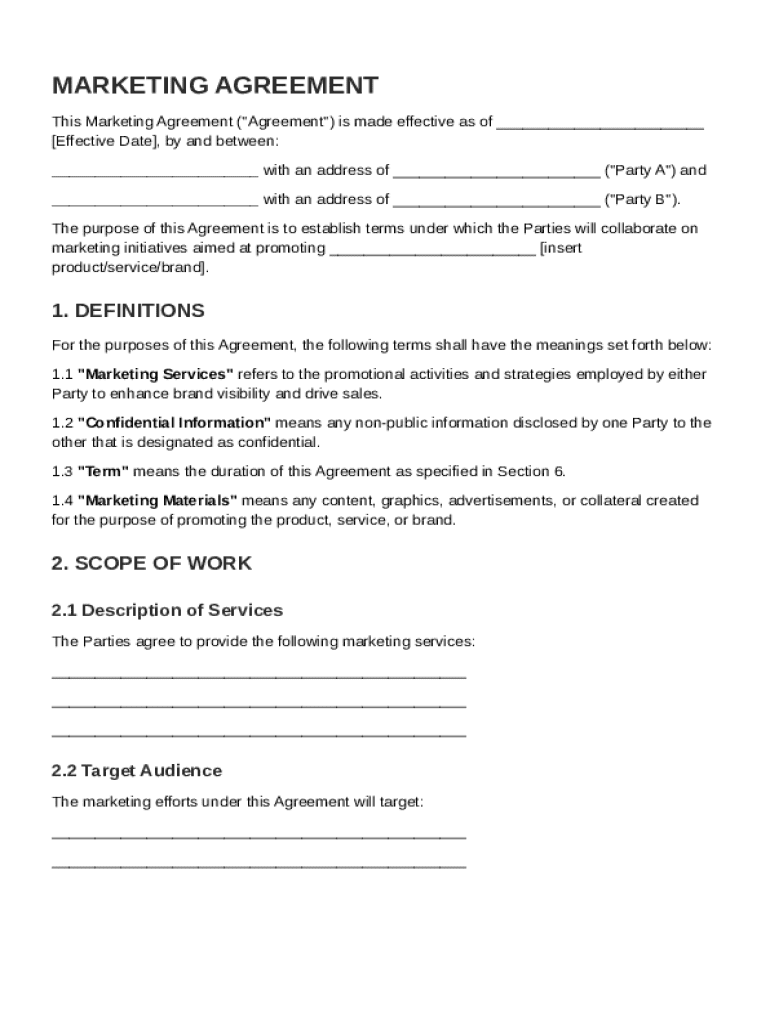







Definition and Meaning of a Marketing Agreement Template
A marketing agreement template is a pre-structured document designed to formalize the terms and conditions between two parties engaged in collaborative marketing activities. This legal document serves as a blueprint for defining the roles, responsibilities, and expectations of each party involved in promoting products, services, or brand initiatives. By using a template, businesses can streamline the process of drafting agreements, ensuring that all critical aspects are covered, thereby reducing the risk of oversight. Common sections include definitions of key terms, responsibilities, compensation terms, and marketing material ownership rights.
Key Elements of a Marketing Agreement Template
A comprehensive marketing agreement template should include several critical components to ensure clarity and mutual understanding between parties.
- Parties Involved: Names and details of the entities entering the agreement.
- Scope of Services: A detailed description of the marketing services or activities to be performed.
- Responsibilities and Obligations: Each party’s specific duties, including timelines and deliverables.
- Compensation and Payment Terms: How the marketing efforts will be compensated, including payment schedules and amounts.
- Ownership and Use of Marketing Materials: Who retains ownership of created content and the rights each party has to use it.
- Confidentiality Obligations: Clauses ensuring sensitive information remains protected.
- Termination Conditions: Terms under which the agreement can be terminated, including notice periods.
- Indemnification and Liability Clauses: Provisions to address risk and responsibility for damages or legal claims.
How to Use the Marketing Agreement Template
Utilizing a marketing agreement template streamlines the process of formalizing a marketing relationship. Begin by identifying the parties involved and clearly outlining the marketing activities to be conducted. Customize the template by filling in specific details, such as the scope of work and compensation terms, to reflect the unique aspects of your agreement. Review all clauses, especially those relating to confidentiality and termination, to ensure they meet both parties' requirements. Finalize the agreement by obtaining signatures from all parties involved, confirming mutual consent to the outlined terms.
Important Terms Related to Marketing Agreement Template
Understanding the terminology within a marketing agreement is crucial for effective communication and implementation:
- Deliverables: Tangible or intangible outputs required from the parties, such as reports or creative content.
- Exclusivity: Terms dictating whether the agreement allows for exclusive cooperation between the parties or if other partnerships can be pursued.
- Force Majeure: Clauses addressing unforeseeable events that might impede contract fulfillment.
- Non-compete Clauses: Conditions restricting the parties from engaging with competitors during or after the agreement’s duration.
Steps to Complete the Marketing Agreement Template
- Identify Parties: Record the legal names and addresses of all participating parties.
- Define Scope and Objectives: Document the precise nature of the marketing efforts and the goals aimed to be achieved.
- Assign Responsibilities: Clearly delineate tasks and who is responsible for each aspect.
- Specify Payment Terms: Include details such as payment schedules, amounts, and methods.
- Determine Material Ownership: Establish which party owns the developed marketing materials and any usage rights.
- Set Confidentiality Terms: Outline how sensitive information will be protected.
- Review and Sign: Double-check all sections for accuracy and completeness before obtaining signatures from all parties.
Legal Use of the Marketing Agreement Template
Marketing agreements serve a legal function by providing a formal framework that governs the collaborative efforts between businesses. They help establish clear boundaries regarding intellectual property rights, confidentiality, and compensation. Not only do these contracts reduce disputes by setting forth explicit expectations, but they also offer legal protection should disagreements arise. Both federal and state laws, including those related to contract formation and execution, apply to marketing agreements.
State-Specific Rules for Marketing Agreement Template
Marketing agreements may be subject to state-specific variations, particularly regarding enforcement and interpretation. Each state may have unique regulations concerning non-compete clauses, data privacy, and general contract law. For example, California has strict rules limiting the enforceability of non-compete clauses. Parties should consult legal counsel familiar with the relevant state's laws to ensure compliance with local regulations and to incorporate necessary adjustments into the agreement.
Examples of Using the Marketing Agreement Template
Marketing agreements can be utilized in various contexts, from small businesses launching local campaigns to multinational corporations coordinating extensive advertising initiatives. For instance, a small business might partner with a local PR agency to increase brand awareness, relying on a marketing agreement to outline deliverables and payment. Conversely, a global tech company might engage an influencer for social media promotion, using the agreement to specify content creation and distribution obligations, ensuring both parties are aligned in strategy and execution.




