







Definition & Meaning
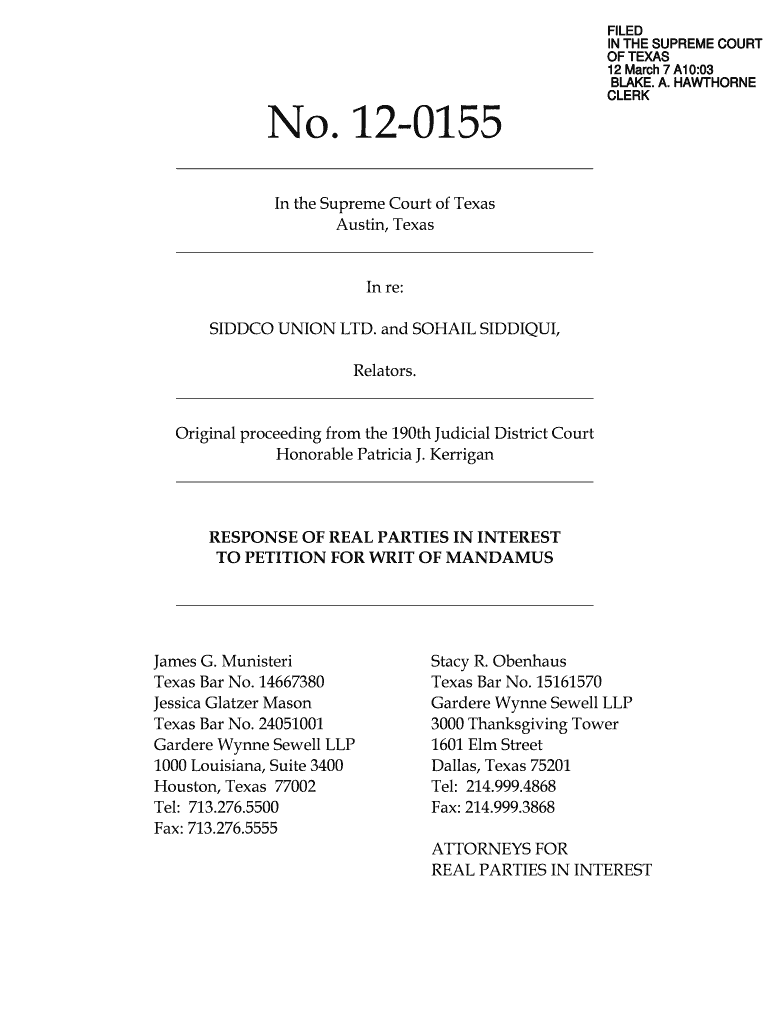
The "DALLAS-#2302520-v3-SIDDIQI response to petition f - supreme courts state tx" is a legal document filed in the Supreme Court of Texas. It serves as a formal response to a petition, specifically addressing a dispute involving Siddco Union Ltd. and Sohail Siddiqui against the Physician Group. The dispute centers on the appointment of an arbitrator to manage issues related to Texas Healthcare Alliance LLC. This response outlines arguments regarding the district court's authority to appoint an arbitrator under Texas law, emphasizing the legal reasoning and context in which this decision was made.
How to Use the Document
This response document is used in the context of legal proceedings within the Supreme Court of Texas. It is a part of the judicial process where parties involved in legal disputes formally present their positions. Attorneys representing Siddco Union Ltd. and Sohail Siddiqui would use this document to articulate their viewpoints on whether the district court's decision aligns with the applicable legal standards in Texas. This document likely contains detailed legal arguments, relevant legal precedents, and statutory references that support their position.
Important Components
- Legal Arguments: Detailed presentation of the arguments supporting Siddco Union Ltd. and Sohail Siddiqui's stance.
- Case Law References: Citations to previous cases and legal precedents that inform and support the arguments.
- Statutory Interpretations: References to Texas statutes relevant to arbitration and dispute resolution.
Steps to Complete the Document
Completing a response document such as this involves several key steps:
- Review the Petition: Begin by thoroughly analyzing the original petition filed to understand the claims and arguments presented by the opposing party.
- Research Legal Precedents: Identify relevant case law and statutes that bolster your client's position and counter the arguments of the petition.
- Draft Legal Arguments: Construct clear and cogent arguments that challenge the petition's claims, supported by appropriate legal reasoning and precedents.
- Compile Supporting Evidence: Gather any necessary documentation or testimony that substantiates the arguments made in the response.
- Finalize the Document: Ensure the response adheres to court formatting and submission requirements and undergoes thorough proofreading and review by legal counsel.
- Submit to the Court: File the completed response with the Supreme Court of Texas within the designated timeline stipulated by court rules.
Legal Use of the Document
The legal use of the "DALLAS-#2302520-v3-SIDDIQI response to petition f - supreme courts state tx" lies in its purpose as a formal legal argument presented to the court. Its primary function is to address the merits of the petition filed against Siddco Union Ltd. and Sohail Siddiqui. This document plays a critical role during judicial proceedings, where the court will evaluate both the petition and response to make a judgment.
State-Specific Rules
In Texas, there are specific procedural rules governing the filing of legal responses. These include guidelines on the timing of submissions, the required format, and the types of arguments that can be presented. Legal responses must align with Texas Rule of Civil Procedure 97, which mandates how defensive pleadings, including responses to petitions, should be structured and filed.
Considerations
- Filing Deadlines: Adhering to a specified deadline is crucial to ensure the response is considered.
- Formatting Requirements: Documents must comply with Texas court rules regarding typeface, spacing, and margin settings.
Key Elements of the Document
The document consists of several integral parts:
- Heading and Caption: Identifies the parties involved, the court in which it is filed, and the case number.
- Introduction: Provides a brief overview of the case and the purpose of the response.
- Factual Background: Outlines the relevant facts leading to the current dispute, presenting the respondent's perspective.
- Legal Analysis: Offers a detailed exploration of legal arguments, supported by statutes, and precedents.
- Conclusion: Summarizes the arguments and states the relief or outcome the respondent desires from the court.
Who Typically Uses This Document
Attorneys representing parties involved in legal disputes within the Texas judicial system typically prepare and use this type of response document. It is crafted by legal professionals with expertise in Texas law and is intended for use by the Supreme Court of Texas justices, clerks, and opposing legal counsel. It forms part of the broader litigation strategy to resolve disputes and achieve a favorable legal outcome for the client.
Examples of Using the Document
Consider a scenario where Siddco Union Ltd. and Sohail Siddiqui are engaged in a complex legal dispute over arbitrator appointments. In responding to the petition, their attorneys may use this document to present arguments that the district court correctly exercised its discretion under Texas law. They might cite specific Texas legal statutes or past case decisions that reinforce their stance, contributing to a robust defense that aims to persuade the court of the validity of their claims.




