
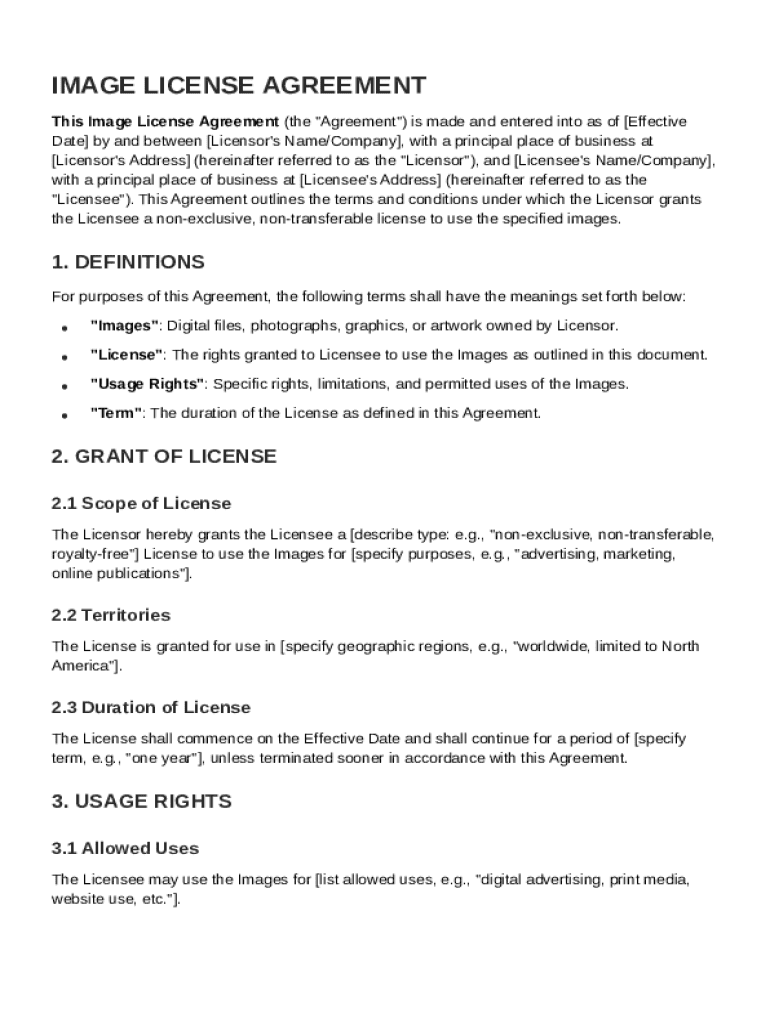







Definition & Purpose of an Image License Agreement
An Image License Agreement is a legal contract between a Licensor and a Licensee, detailing the terms under which images can be used. This agreement is crucial in ensuring that the Licensee has the right to use the images while the Licensor retains ownership. Commonly, these licenses are non-exclusive and non-transferable, meaning the Licensee can use the images but cannot grant others permission to do so. The document defines the scope, permitted and prohibited uses, and the duration of the license. Furthermore, it outlines payment terms and establishes liability limitations to protect both parties involved.
Key Elements of the Image License Agreement Template
The Image License Agreement Template includes several critical components to establish a clear and legally binding contract between the involved parties. These elements typically comprise:
-
License Grant: Specifies the type of license (e.g., non-exclusive, non-transferable) and delineates the rights provided to the Licensee.
-
Definitions: Clarifies the meaning of key terms used within the agreement, such as "Licensor," "Licensee," "Images," and "Usage Rights."
-
Scope and Limitations: Outlines the specific uses allowed under the license and any restrictions or prohibited actions.
-
Payment Terms: Details the compensation arrangement for the Licensor, including payment schedule and method.
-
Ownership Rights: Reaffirms the Licensor's sole ownership of the images and the rights retained by them.
-
Termination Conditions: Conditions under which the agreement can be terminated, such as breach of contract or mutual consent.
-
Indemnification: Ensures that both parties are protected against claims arising from the use of the images.
-
Governing Law: States the jurisdiction under which any legal disputes will be resolved.
How to Use the Image License Agreement Template
Utilizing the Image License Agreement Template effectively requires understanding its structure and filling it out with precise information. Follow these steps for a comprehensive approach:
-
Download: Obtain the template from a reliable source, ensuring it suits your jurisdictional requirements.
-
Fill in the Details: Enter specific details, such as the names and contact information of both the Licensor and Licensee, a description of the licensed images, and the agreed terms.
-
Define Usage Rights: Clearly specify the ways in which the images can be used by the Licensee, including any geographic or temporal limits.
-
Set Payment Conditions: Incorporate the agreed-upon compensation terms, ensuring clarity on amounts, frequency, and payment methods.
-
Review and Sign: Both parties should review the document carefully before signing. Consider seeking legal advice to ensure all clauses are appropriate and legally sound.
Steps to Complete the Image License Agreement Template
Completing an Image License Agreement Template requires careful attention to detail to avoid future disputes. Here’s a detailed step-by-step guide:
-
Gather Information: Collect all necessary information regarding the images, including digital copies or references.
-
Complete Identifying Information: Input the full names, addresses, and contact details of both parties.
-
Detail Image Descriptions: Accurately describe the images to ensure there is no ambiguity about what is covered in the agreement.
-
Negotiate Terms: Prior to completing, discuss terms with the other party to reach a mutual understanding regarding the scope, duration, and payment.
-
Customize Legal Clauses: Adjust default clauses to fit specific needs, such as indemnity and liability, or create new ones if necessary.
-
Finalize Payment Terms: Clearly state how and when the Licensor will be compensated.
-
Review Internal Consistency: Check for any inconsistencies or conflicting terms within the agreement.
-
Sign and Date: Both parties should sign and date the document to make it a binding agreement. Consider the presence of witnesses if necessary for further authentication.
Who Typically Uses the Image License Agreement Template
This template is primarily used by individuals and entities that engage in the creation, distribution, or usage of images. Typical users include:
-
Photographers and Artists: Who want to license their work without losing ownership.
-
Businesses and Corporations: That require imagery for marketing, advertising, or internal purposes.
-
Graphic Designers: Seeking agreements when using stock images for client projects.
-
Publishers and Media Agencies: Needing legally sound image rights for publication in print and digital formats.
-
Freelancers: Engaging in the creation and distribution of visual content for various clients.
Each of these users can tailor the agreement to fit their specific needs, ensuring that all parties have a clear understanding of their rights and obligations.


Legal Use of the Image License Agreement Template
Understanding the legal framework underpinning the Image License Agreement is essential for compliance and dispute avoidance. Here's a guide:
-
Ensure Compliance: Follow relevant intellectual property laws specific to the jurisdiction, typically aligned with U.S.-centric regulations.
-
Secure Ownership Proof: The Licensor should possess clear evidence of ownership or rights to license the images.
-
Consult Legal Expertise: Consider legal advice during drafting to prevent potential loopholes or misinterpretations.
-
Record Changes: Document any alterations to the agreement formally with both parties' acknowledgment.
-
Dispute Resolution: Include clauses that define how disagreements will be managed, favoring mediation or arbitration when possible.
-
Review Regularly: Update the agreement periodically to reflect any new legal developments or changes in the business relationship.
Important Terms Related to Image License Agreement Template
Several key terms are integral to understanding and executing an Image License Agreement effectively:
-
Licensor and Licensee: The parties involved in the agreement, where the Licensor provides the license and the Licensee receives it.
-
Intellectual Property Rights: Legal rights that grant the Licensor control over the usage of the image.
-
Exclusive vs. Non-Exclusive License: Identifies whether the Licensee has the sole right to use the image or if it can be licensed to multiple parties.
-
Usage Rights: Clearly defined permissions regarding how and where images can be used.
-
Confidentiality Clause: Protects sensitive information shared during the agreement process from being disclosed to unauthorized parties.
-
Termination Clause: Outlines conditions under which the agreement may be ended voluntarily or due to a breach.
Understanding these terms will ensure all parties have a mutual comprehension of the agreement’s intent and scope.
Examples of Using the Image License Agreement Template
Here are practical scenarios where an Image License Agreement can be beneficial:
-
Photographers Selling Stock Images: Allows photographers to monetize their images through licenses to multiple clients while retaining ownership.
-
Businesses Developing Marketing Campaigns: Ensures legal usage of images in advertisements, reducing the risk of copyright infringement.
-
Artists Collaborating on Joint Projects: Clearly defines each party’s input and rights, facilitating smooth collaboration with protections for their individual contributions.
-
Publishers Launching New Books: Enables legal inclusion of illustrative content, ensuring all visual elements are appropriately licensed.
These examples highlight the template’s versatility in various professional contexts, reinforcing its value as a protective and organizational tool.




