






Definition & Meaning
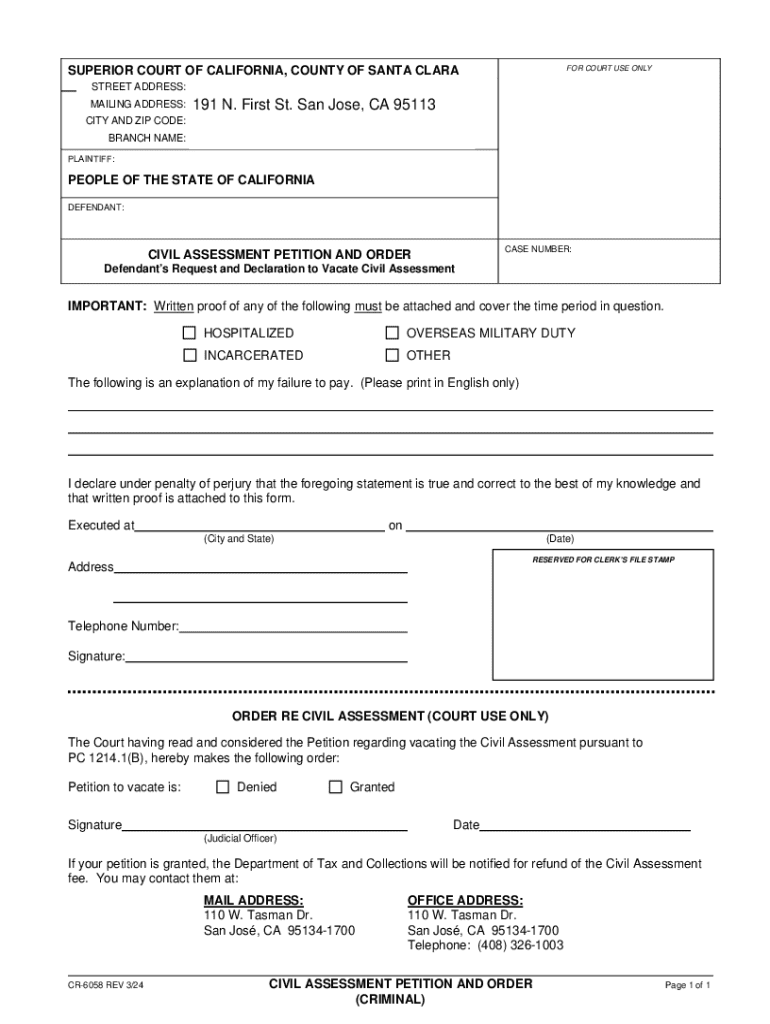
The "Civil Assessment Petition and Order" is a legal document used primarily in the Superior Court of California. It is utilized by defendants to request the cancellation of a civil assessment, which is a penalty fee imposed when a defendant fails to appear in court or pay a fine on time. This petition allows defendants to present valid reasons, such as hospitalization, military duty, or incarceration, that justify their inability to comply with court requirements, and seek relief from the associated penalty.
How to Use the Civil Assessment Petition and Order
To effectively use the Civil Assessment Petition and Order, defendants must first understand its purpose and process. The form is designed to be filled out by providing personal details, the case number, and a clear explanation of the circumstances that prevented compliance with original court obligations. It is essential to support the petition with relevant evidence, such as medical records or official military orders, to substantiate claims. After completing the form, it must be submitted to the appropriate court for consideration.
Steps to Complete the Civil Assessment Petition and Order
-
Gather Required Information:
- Collect all necessary personal details, court case information, and any documentation that supports your claim (e.g., hospital discharge papers).
-
Fill Out Personal Details:
- Complete sections that require your name, address, and contact information.
-
Provide Case Details:
- Include case number, court location, and any relevant dates associated with the assessment.
-
Explain Justification:
- Write a detailed declaration explaining why you were unable to meet court requirements, referencing supporting documents.
-
Attach Supporting Evidence:
- Attach copies of documents such as medical certificates or military orders that validate your claim.
-
Review and Submit:
- Double-check all entered information for accuracy before submitting the form to the court.
Who Typically Uses the Civil Assessment Petition and Order
This form is predominantly used by individuals who have received a civil assessment due to failing to appear in court or pay a fine on time. Users often include:
- Defendants experiencing unforeseen circumstances such as medical emergencies.
- Military personnel on active duty unable to comply with scheduled court appearances.
- Individuals incarcerated or detained at the time of their court obligation.


Important Terms Related to the Civil Assessment Petition and Order
- Defendant: The individual contesting the civil assessment.
- Civil Assessment: A financial penalty imposed for failing to comply with court orders.
- Declaration: A formal statement made by the defendant outlining their situation.
- Supporting Evidence: Documents that validate the reasons for not fulfilling court obligations.
Key Elements of the Civil Assessment Petition and Order
- Personal Information Section: Collects the defendant’s name, contact details, and identification.
- Case Information Section: Details the specifics of the court case and civil assessment.
- Declaration Section: Where the defendant articulates reasons for requesting the vacation of the assessment.
- Order Section: Used by the court to enter a decision regarding the petition.
State-Specific Rules for the Civil Assessment Petition and Order
While this petition is primarily used in California, each state might have specific requirements or variations in the forms used to address similar legal issues. Understanding state-specific laws is crucial for accurate filing.
- In California, defendants need to provide substantial proof of their claims.
- Some jurisdictions may have alternative forms or procedures for similar requests.
Required Documents
When submitting a Civil Assessment Petition and Order, additional documents must often be included:
- Proof of Circumstances: Such as hospitalization records, military orders, or incarceration proof.
- Identification Documents: Valid photo ID to verify the defendant's identity.
- Case Documents: Copies of any relevant notices from the court.
By following the outlined structure and guidelines, individuals can maximize their chances of successfully contesting a civil assessment. Through understandable steps and ensuring adherence to the requirements, you maintain compliance and demonstrate legitimate reasons for the vacating request.