






Definition and Purpose of the CC-DC-CR-072A - Petition for Expungement of Records
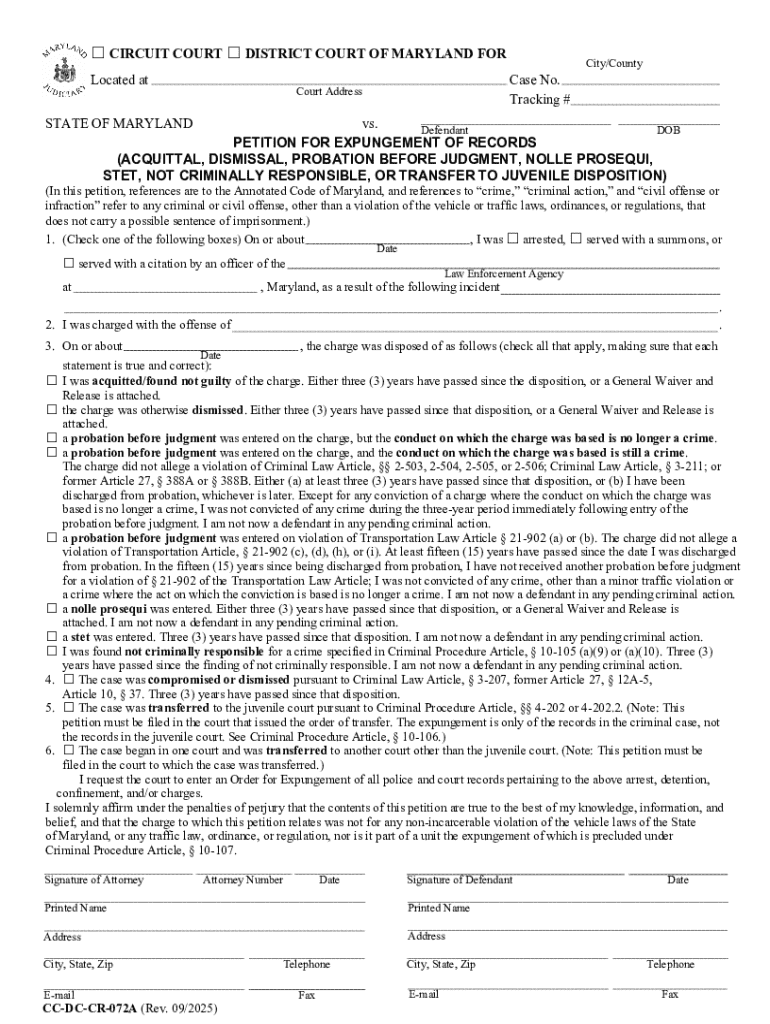
The CC-DC-CR-072A form serves as a formal request for the expungement of criminal records in the State of Maryland. Its core objective is to provide individuals who meet specific eligibility requirements with the opportunity to clear their criminal history following acquittal, dismissal, or other qualifying legal outcomes. This legal measure is essential for those seeking to remove barriers to employment, housing, or other opportunities that may be hindered by a criminal record.
- Expungement process: Erases qualifying criminal records from public access.
- Eligibility: Dependent on specific legal conditions such as the outcome of the case (e.g., acquittal).
- Legal implications: Once approved, the record is effectively sealed and unavailable to certain background checks, providing a fresh start for the petitioner.
How to Use the CC-DC-CR-072A - Petition for Expungement
To effectively utilize the CC-DC-CR-072A form, applicants need to understand the steps involved in submitting a successful petition. The process ensures compliance with state requirements and maximizes the likelihood of expungement approval.
- Review eligibility: Verify your eligibility based on the nature of the offense and the outcome of the case.
- Complete the form: Accurately fill out each section, ensuring all personal and case details are correctly provided.
- Submit accompanying documents: Attach necessary documentation such as a copy of court orders or case dispositions.
- File with the court: Submit the completed petition to the appropriate court as outlined in Maryland state guidelines.
- Follow up: Attend any required court hearings and remain informed about the status of your application.
Steps to Complete the CC-DC-CR-072A - Petition for Expungement
Successfully completing the CC-DC-CR-072A form requires careful attention to detail and adherence to state-provided instructions. Here's a step-by-step breakdown:
- Gather information: Collect all required personal information and case-specific details.
- Provide clear responses: Ensure that all answers are truthful and complete to avoid processing delays.
- Include court details: Specify the court in which the final disposition occurred.
- List relevant charges: Clearly list all charges for which expungement is being sought.
- Sign and date: Affirm your petition by signing and dating the form where required.
- Attachments: Attach all supporting documents to substantiate your request.
Eligibility Criteria for the CC-DC-CR-072A
To initiate the expungement process with the CC-DC-CR-072A, certain eligibility criteria must be met to ensure that the petition is legally viable.
- Outcome of the case: Only cases that ended with acquittals, dismissals, or probation before judgement might qualify.
- Timeframe since disposition: A certain amount of time must have passed since the case's conclusion, which varies depending on the outcome.
- Absence of subsequent charges: Petitioners must typically have no new criminal charges pending during the waiting period.
- Compliance with conditions: Fulfillment of any conditions requested by the court or outlined in the case disposition.


Legal Use of the CC-DC-CR-072A in Maryland
The legal framework for the CC-DC-CR-072A form guides its application and eligibility within Maryland's judicial system.
- Jurisdiction-specific: The form is specifically applicable within the State of Maryland, and individuals should ensure that their circumstances fit state laws.
- Court proceedings: The petition forms part of a legal proceeding where the petitioner's case is reviewed by a judge.
- Legal representation: While not mandatory, legal assistance is recommended to navigate the intricacies of the expungement process.
Required Documents for CC-DC-CR-072A Submission
Submitting the CC-DC-CR-072A form necessitates accompanying documentation to confirm petition details and fulfill procedural requirements.
- Court records: Copies of the original charges and the court's final disposition.
- Police records: Any arrest records that pertain to the case.
- Identity verification: Official identification documents such as a driver’s license or state ID.
- Additional affidavits: If required, affidavits that support claims made within the petition.
State-Specific Rules for the CC-DC-CR-072A
Maryland's expungement laws outline specific conditions and criteria, thus providing the framework for utilizing the CC-DC-CR-072A form within the state.
- Filing deadlines: Compliance with deadlines set for submitting petitions after the final disposition.
- Hearing requirements: Some cases necessitate a judicial hearing where petitioners may need to present their case.
- Specific statutes: Reference to particular Maryland statutes that govern the eligibility and procedure for expungements.
Important Terms Related to CC-DC-CR-072A
Understanding key legal terms associated with the CC-DC-CR-072A form helps ensure clarity and comprehension throughout the expungement process.
- Expungement: The legal process of removing a criminal record from public access.
- Disposition: The final outcome or resolution of a criminal case, crucial in assessing eligibility.
- Acquittal: A formal declaration of innocence, typically a condition for expungement eligibility.
- Probation before Judgement: A legal stipulation that affects expungement eligibility criteria.